Senin, 29 April 2019

Weird Black Hole Is Shooting Out Wobbly Jets Because It's Dragging Spacetime - ScienceAlert

Some 7,800 light-years away, in the constellation of Cygnus, lies a most peculiar black hole. It's called V404 Cygni, and in 2015, telescopes around the world stared in wonder as it woke from dormancy to devour material from a star over the course of a week.

That one event provided such a wealth of information that astronomers are still analysing it. And they have just discovered an amazing occurrence: relativistic jets wobbling so fast their change in direction can be seen in mere minutes.

And, as they do so, they puff out high-speed clouds of plasma.

"This is one of the most extraordinary black hole systems I've ever come across," said astrophysicist James Miller-Jones of the International Centre for Radio Astronomy Research (ICRAR) at Curtin University in Australia.

V404 Cygni is a binary microquasar system consisting of a black hole about nine times the mass of the Sun and a companion star, an early red giant slightly smaller than the Sun.

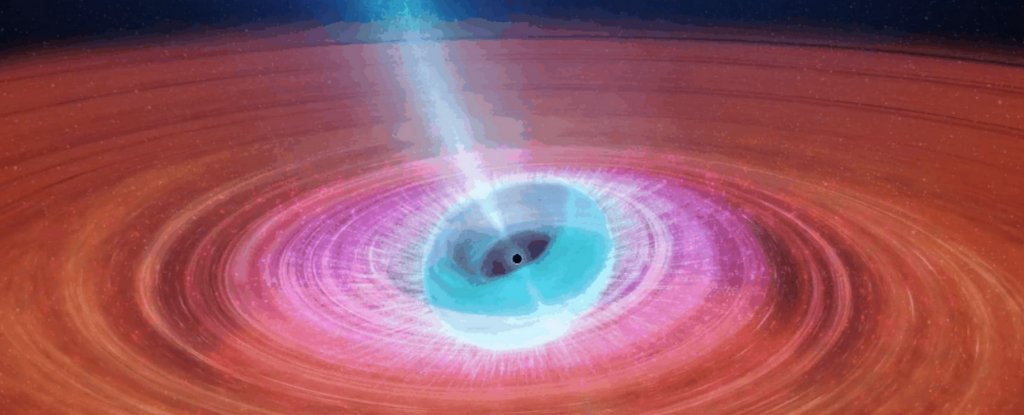
The black hole is slowly devouring the red giant; the material siphoned away from the star is orbiting the black hole in the form of an accretion disc, a bit like water circling a drain. The closest regions of the disc are incredibly dense and hot, and extremely radiant; and, as the black hole feeds, it shoots out powerful jets of plasma, presumably from its poles.

Scientists don't know the precise mechanism behind jet production. They think material from the innermost rim of the accretion disc is funnelled along the black hole's magnetic field lines, which act as a synchrotron to accelerate the particles before launching them at tremendous velocities.

But V404 Cygni's wobbly jets, shooting out in different directions at different times, on such rapidly changing timescales, and at velocities up to 60 percent of the speed of light, are in a class of their own.

"We think the disc of material and the black hole are misaligned," Miller-Jones said. "This appears to be causing the inner part of the disc to wobble like a spinning top and fire jets out in different directions as it changes orientation."

It's a bit like a spinning top that starts to wobble as it's slowing down, the researchers said. This change in the rotational axis of a spinning body is called precession. In this particular instance, we have a handy explanation for it courtesy of Albert Einstein.

In his theory of general relativity, Einstein predicted an effect called frame-dragging. As it spins, a rotating black hole's gravitational field is so intense that it essentially drags spacetime with it. (This is one of the effects scientists hoped to observe when they took a picture of Pōwehi.)

In the case of V404 Cygni, the accretion disc is about 10 million kilometres (6.2 million miles) across. The misalignment of the black hole's rotational axis with the accretion disc has warped the inner few thousand kilometres of said disc.

The frame-dragging effect then pulls the warped part of the disc along with the black hole's rotation, which sends the jet careening off in all directions. In addition, that inner section of the accretion disc is puffed up like a solid doughnut that also precesses.

"This is the only mechanism we can think of that can explain the rapid precession we see in V404 Cygni," Miller-Jones said.

It's so fast that the usual method radio telescopes use for imaging space were practically useless. Usually, these devices rely on long exposures, observing a region for several hours at a time, moving across the sky to track their target. But in this case, the method produced images too blurred to be of use.

So the team had to use a different method, taking 103 separate images with exposure times of just 70 seconds and stitching them together to create a movie - and sure enough, there were the wibbly wobbly spacetimey jets.

"We were gobsmacked by what we saw in this system - it was completely unexpected," said physicist Greg Sivakoff of the University of Alberta.

"Finding this astronomical first has deepened our understanding of how black holes and galaxy formation can work. It tells us a little more about that big question: 'How did we get here?'"

The research has been published in Nature.

Let's block ads! (Why?)


https://www.sciencealert.com/extraordinary-black-hole-shoots-out-wobbling-jets-as-it-devours-a-star

2019-04-29 15:18:21Z
52780280722798

Scientists find ‘alien’ grain of dust in Antarctica that could challenge our understanding of the solar system - The Independent

[unable to retrieve full-text content]

Scientists find ‘alien’ grain of dust in Antarctica that could challenge our understanding of the solar system  The Independent

A tiny, "alien" grain of dust that was created as a long-gone star died has been found by scientists. The tiny speck of stardust was found inside of a chondritic ...


https://www.independent.co.uk/life-style/gadgets-and-tech/news/alien-grain-of-dust-antarctica-solar-system-life-a8891486.html

2019-04-29 15:00:48Z
CAIiEC0uISdWkkk595TLCRQ3wFAqFwgEKg4IACoGCAowzdp7ML-3CTCRx_0F

Asteroid collision impact drill set for this week - Fox News

World governments have been concerned for decades about a potential asteroid collision and the chaos that would ensue upon Earth. Now, the actions of what agencies around the world would do about it are being shared with the public for the first time ever on social media.

Though the drill is run every two years by asteroid scientists around the world, the European Space Agency has decided to share the event publicly so everyone can see what would happen and what actions might be taken to mitigate the damage.

“The first step in protecting our planet is knowing what’s out there,” says Rüdiger Jehn, ESA’s Head of Planetary Defense, in a statement. “Only then, with enough warning, can we take the steps needed to prevent an asteroid strike altogether, or to minimize the damage it does on the ground.”

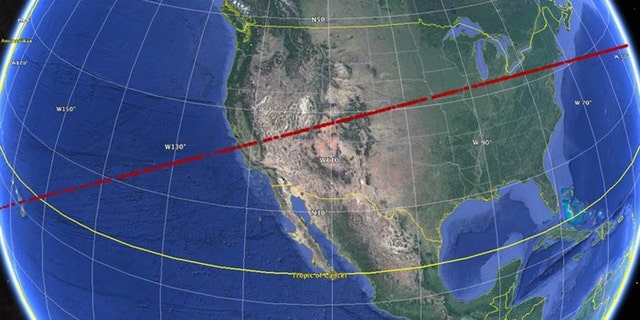
Graphic showing the hypothetical impact risk corrdior of asteroid 2019 PDC, when its orbit is still not fully known. (Credit: Google Earth, ESA)

Graphic showing the hypothetical impact risk corrdior of asteroid 2019 PDC, when its orbit is still not fully known. (Credit: Google Earth, ESA)

ELON MUSK IS GOING TO HELP NASA SAVE EARTH FROM AN ASTEROID COLLISION

Updates from the drill will be shared on the ESA Operations Twitter account, starting Monday, April 29 and running until May 3.

The first tweet has already been written, with the ESA writing: "A hypothetical asteroid has been 'discovered', and worryingly looks set to impact Earth. Follow the progress of fictional asteroid #2019PDC and the response on the ground, over the next few days of the #PlanetaryDefense Conference. #FictionalEvent🌍☄️"

The asteroid scientists who take part in the drill are doing so as part of the 2019 Planetary Defense Conference, which is put on by NASA's Planetary Defense Coordination Office and the U.S. Federal Emergency Management Agency. The scientists will be assigned different roles, such as "space agency," "astronomer" or "national government," and will work off what each other is doing, the ESA added in the statement.

In 2016, NASA formalized the agency’s prior program for detecting and tracking near-Earth Objects (NEOs) and put it inside its Science Mission Directorate.

Though there are 20,000 asteroids (and counting) whose orbit brings them near Earth, NASA has been expanding its protocols for how to take action from a potential collision.

HOW AMERICA CAN GET ITS SLICE OF THE $1 TRILLION SPACE ECONOMY

Last June, NASA unveiled a 20-page plan that details steps the U.S. should take to be better prepared for NEOs such as asteroids and comets that come within 30 million miles of the planet.

Lindley Johnson, the space agency's planetary defense officer, said at the time that the country "already has significant scientific, technical and operational capabilities" to help with NEOs, but implementing the new plan would "greatly increase our nation’s readiness and work with international partners to effectively respond should a new potential asteroid impact be detected.”

In addition to enhancing NEO detection, tracking and characterizing capabilities and improving modeling prediction, the plan also aims to develop technologies for deflecting NEOs, increasing international cooperation and establishing new NEO impact emergency procedures and action protocols.

ANCIENT ASTEROID STRIKES ON MARS MAY HAVE 'PRODUCED KEY INGREDIENTS FOR LIFE'

Earlier this month, NASA awarded a $69 million contract to SpaceX, the space exploration company led by Elon Musk, to help it with asteroid deflection via its Double Asteroid Redirection Test (DART) mission.

CLICK HERE FOR THE FOX NEWS APP

Let's block ads! (Why?)


https://www.foxnews.com/science/asteroid-collision-impact-drill

2019-04-29 13:43:32Z
52780277812415

SpaceX readies for early morning launch Wednesday at Cape Canaveral - WFTV Orlando

CAPE CANAVERAL, Fla. - SpaceX is planning to launch thousands of pounds of supplies, research equipment and hardware to the International Space Station early Wednesday.

The launch announcement comes after SpaceX completed a static fire test of its Falcon 9 rocket on Saturday.

Related Headlines

The rocket is set to blast off at Space Launch Complex 40 at Cape Canaveral Air Force Station at 3:59 a.m.


TRENDING NOW:


This launch will mark SpaceX’s 17th mission under NASA's Commercial Resupply Services contract to send cargo to the International Space Station.

WFTV will share coverage of the launch if it happens on Wednesday on Eyewitness News This Morning.


DOWNLOAD: Free WFTV News & Weather Apps

Not near a TV? Click here to watch WFTV newscasts live

Watch Live: Doppler 9 HD

Let's block ads! (Why?)


https://www.wftv.com/news/local/spacex-readies-for-early-morning-launch-wednesday-at-cape-canaveral/944319165

2019-04-28 22:41:15Z
52780278599684

Minggu, 28 April 2019

The day the asteroid might hit - EarthSky

Line drawing of asteroid orbit in the inner solar system.

Hypothetical orbit for fictional asteroid 2019 PDC, via ESA.

The European Space Agency (ESA) said late last week it’ll be tweeting coverage of a major international asteroid impact exercise live via social media from April 29 to May 3, 2019. You can follow the coverage via the @esaoperations Twitter channel. It’s a drill – much like the tornado drills some of us underwent in elementary school – but in this case conducted by scientists, space agencies and civil protection organizations, all acting as if an asteroid is headed for an impact with Earth. This exercise – simulating a fictional, but plausible, imminent asteroid impact – is conducted every two years by asteroid experts across the globe. It’s being conducted from the Planetary Defense Conference in Washington, D.C. ESA said:

During the week-long scenario, participants – playing roles such as ‘national government’, ‘space agency’, ‘astronomer’ and ‘civil protection office’ – don’t know how the situation will evolve from one day to the next, and must make plans based on the daily updates they are given.

Follow the live coverage April 29 to May 3 via @esaoperations on Twitter

You can also participate, in a more limited way, via ESA’s Facebook page. It will host two livestream videos straight from the Planetary Defense Conference. The first will be today (Sunday, April 28) at 12 UTC (14 CEST, 8 a.m. EDT; translate UTC to your time) with Rüdiger Jehn, ESA’s Head of Planetary Defense. The second will be Thursday, May 2, at around mid-afternoon European time.

Check out livestream videos from the Planetary Defense Conference via ESA’s Facebook page

For daily updates on the asteroid impact scenario, check out “Rolling coverage: Brace for hypothetical asteroid impact,” beginning on the first day of the conference, Monday, April 29.

Follow ESA’s rolling coverage: Daily updates on the asteroid impact scenario.

This year’s hypothetical asteroid has been given the label ‘2019 PDC’. NOTE: Although realistic, all “objects” and “events” described below are completely fictional and do NOT describe an actual asteroid impact. ESA described the fictional scenario this way:

— An asteroid was discovered on March 26 2019, and has been given the name 2019 PDC by the International Astronomical Union‘s (IAU) Minor Planet Center.

— Initial calculations suggest the orbit of 2019 PDC will bring it within 7.5 million km [4.6 million miles] of Earth’s orbit. (Or, within 0.05 AU of Earth’s orbit).

.— 2019 PDC is travelling in an eccentric orbit, extending 2.94 AU at its farthest point from the sun (in the middle of the main asteroid belt), and 0.94 AU at its closest. It completes one full orbit around the sun every 971 days (2.66 years). See its orbit in more detail here.

— The day after 2019 PDC is discovered, ESA and NASA’s impact monitoring systems identify several future dates when the asteroid could hit Earth. Both systems agree that the asteroid is most likely to strike on April 29, 2027 – more than eight years away – with a very low probability of impact of about 1 in 50,000.

— When it was first detected, asteroid 2019 PDC was about 57 million km [35.4 million miles] from Earth, equal to 0.38 astronomical units [0.38 of the average Earth-sun distance]. It was travelling about 14 km/s [8.7 miles/sec], and slowly getting brighter.

— As observations continue, the likelihood of an impact in 2027 increases. Three weeks after discovery, after observations were paused during the full moon (and reduced visibility), the chance of impact has risen to 0.4 percent – that’s a chance of 1 in 250.

Google Earth image of Earth, with a red line shown across the middle of the U.S.: the 'risk corridor.'

View larger. | Graphic showing the hypothetical impact risk corridor of hypothetical asteroid 2019 PDC, when its orbit is still not fully known. ESA said: “The asteroid’s uncertainty region at the time of the potential impact is much longer than the diameter of the Earth, but its width is only about 70 kilometers (45 miles). The intersection of the uncertainty region with the Earth creates a so-called ‘risk corridor’ across the surface of the Earth. The corridor wraps more than halfway around the globe, spanning from Hawaii on the western end, across the U.S. and Atlantic Ocean, and all the way to central and southern Africa on the eastern end. The red dots on the Google Earth image trace the risk corridor.” Image via ESA.

— Very little is known about the asteroid’s physical properties. From its brightness, experts determine that the asteroid’s mean size could be anywhere from 100-300 meters [approximately 300 to 1,000 feet].

— Asteroid 2019 PDC continued to approach Earth for more than a month after discovery, reaching its closest point on May 13. Unfortunately, the asteroid was too far away to be detected, and it is not expected to pass close to Earth until 2027 – the year of impact.

— As astronomers continued to track 2019 PDC, the chance of impact continued to rise. By April 2019, the first day of the Planetary Defence Conference, the probability of impact will have risen to 1 in 100.

This exercise is being produced by experts from NASA’s Planetary Defense Coordination Office working together with the U.S. Federal Emergency Management Agency (FEMA) at the 2019 Planetary Defense Conference, Washington, D.C. The conference is strongly supported by ESA, NASA and other agencies, organizations and scientific institutions.

Follow the live tweets April 29 to May 3 via @esaoperations on Twitter

Check out livestream videos from the Planetary Defense Conference via ESA’s Facebook page

Follow ESA’s rolling coverage: Daily updates on the asteroid impact scenario.

Read more from ESA: The day the asteroid might hit

Bottom line: At the Planetary Defense Conference in Washington, D.C. – April 29 to May 3, 2019 – scientists, space agencies and civil protection organizations will be acting as if an asteroid is headed for an impact with Earth. This exercise – simulating a fictional but plausible imminent asteroid impact – is conducted every two years by these asteroid experts. This story tells how to follow the exercise on social media.

Deborah Byrd

MORE ARTICLES

Let's block ads! (Why?)


https://earthsky.org/human-world/esa-social-media-hypothetical-impact-scenario-pdc

2019-04-28 11:48:45Z
52780277812415

SpaceX Delays Next Dragon Cargo Launch to May 1 - Space.com

SpaceX has pushed back the launch of a Dragon cargo mission for NASA this week by 24 hours, with liftoff now targeted for Wednesday (May 1). 

The uncrewed Dragon resupply ship will now launch to the International Space Station Wednesday at 3:59 a.m. EDT (0759 GMT) from Space Launch Complex 40 at Cape Canaveral Air Force Station in Florida, according to SpaceX and NASA. SpaceX test-fired the Falcon 9 rocket that will launch the mission on Saturday (April 27). 

"Static fire test of Falcon 9 complete — targeting May 1 launch from Pad 40 in Florida for Dragon's seventeenth mission to the @Space_Station," SpaceX representatives said in a Twitter update on the mission. 

Related: How SpaceX's Dragon Space Capsule Works (Infographic)

The one-day launch slip follows a four-day delay of the mission (it was initially scheduled to launch April 26) by NASA and SpaceX "due to station and orbital mechanics constraints," NASA officials said at the time. 

SpaceX representatives said the company would use those four extra days for launch vehicle checks and the Falcon 9 static fire test, which fired the booster's first stage engines briefly. Static fire tests are a standard SpaceX activity before every launch.

The upcoming Dragon cargo mission will be SpaceX's 17th delivery flight for NASA. The spacecraft will deliver more than 5,500 lbs. (2,495 kilograms) of fresh supplies, experiment hardware and other gear to the Expedition 59 astronauts currently on the space station.

SpaceX also has a contract to fly astronauts to the station for NASA using the company's new Crew Dragon spacecraft, which made its first uncrewed test flight in March. An in-flight abort system test for Crew Dragon is expected later this year, followed by a crewed test flight by NASA astronauts. 

But before SpaceX can proceed with the in-flight abort test, the company must complete its investigation into an April 20 anomaly during a Crew Dragon abort system test. That anomaly occurred as SpaceX was testing the Crew Dragon's eight SuperDraco abort engines on a test stand at Landing Zone 1, one of the company's two rocket landing pads at Cape Canaveral Air Force Station.

Meanwhile, SpaceX is also gearing up for another big mission: the next launch of its massive Falcon Heavy megarocket. 

Last week, SpaceX successfully test fired the center core stage of the Falcon Heavy that will be used to launch the Space Test Program-2 mission for the U.S. Air Force. That mission will include a host of different payloads for the U.S. Air Force, NASA, Planetary Society and other customers.

 Email Tariq Malik at tmalik@space.com or follow him @tariqjmalik. Follow us @Spacedotcom and Facebook.  

Let's block ads! (Why?)


https://www.space.com/spacex-dragon-cargo-crs-17-launch-delay.html

2019-04-28 12:35:00Z
52780278599684

Sabtu, 27 April 2019

NASA will simulate an asteroid impact scenario with live tweeting - Mashable

What would happen if an asteroid impacted Earth sorta like a comet did in 1998's 'Deep Impact?"
Image: Dreamworks/Paramount/Kobal/REX/Shutterstock

If an asteroid were ever to be come hurtling towards Earth, what would be the plan to stop it from impacting the planet?

That's the question NASA and its partners, including the European Space Agency and the U.S.'s Federal Emergency Management Agency (FEMA), are gathering at the 2019 Planetary Defense Conference in early May to investigate.

During the five day conference, NASA and its partners plan to engage in a "tabletop exercise" that simulates what would happen if scientists and authorities were to learn of a near-Earth Object (NEO) impact scenario.

"A tabletop exercise of a simulated emergency commonly used in disaster management planning to help inform involved players of important aspects of a possible disaster and identify issues for accomplishing a successful response," says NASA.

In the exercise (detailed by the ESA here), NASA and its partners have to respond to a "realistic — but fictional — scenario" involving a NEO named "2019 PDC," which has a 1 in 100 chance of impacting Earth in 2027.

Armed with all of the hypothetical information about "2019 PDC," the exercise is intended to see how the various organizations and governments would handle the situation as it unfolds.

"The first step in protecting our planet is knowing what’s out there," said Rüdiger Jehn, the ESA’s Head of Planetary Defence. "Only then, with enough warning, can we take the steps needed to prevent an asteroid strike altogether, or minimize the damage it does on the ground."

In such a situation, the ESA says it would live tweet details "so you’ll find out the ‘news’ as the experts do." And for the hypothetical 2019 PDC asteroid exercise at the conference, the agency will indeed live tweet the series of decided actions as if they are made.

"These exercises have really helped us in the planetary defense community to understand what our colleagues on the disaster management side need to know," said Lindley Johnson, NASA's Planetary Defense Officer. "This exercise will help us develop more effective communications with each other and with our governments."

Despite NASA having participated in six NEO impact exercises before, each scenario is different and the agency says it's learned that the focus is not always on the asteroid details, even though that's still crucial to creating a plan to either deflect it or reduce its impact.

"What emergency managers want to know is when, where and how an asteroid would impact, and the type and extent of damage that could occur," said Leviticus Lewis of the Response Operations Division for FEMA.

Well, you know what they say...it's better to be prepared. At the very least, NASA and friends won't be panicking as hard if an asteroid were ever to really hit Earth.

Uploads%252fvideo uploaders%252fdistribution thumb%252fimage%252f91006%252fbc8be35c 14ed 4e21 9aa4 2e0064c1d0b9.jpg%252foriginal.jpg?signature=eiul1gluktirjpa5mvpdpaxvxjy=&source=https%3a%2f%2fblueprint api production.s3.amazonaws

Let's block ads! (Why?)


https://mashable.com/article/nasa-esa-fema-asteroid-impact-earth-simulation-response/

2019-04-27 17:09:39Z
52780277812415