Selasa, 30 April 2019

Astronomers witness 'one of the most extraordinary black hole systems' - CNN

The black hole, known as V404 Cygni, doesn't behave like others. The jets shoot out possibly within minutes of each other and in all different directions. And while the researchers admit that black holes are some of the most extreme objects in the universe, this one is different.
"This is one of the most extraordinary black hole systems I've ever come across," study author James Miller-Jones said in a statement. Miller-Jones is also an associate professor at Curtin University's International Centre for Radio Astronomy Research.
The study published Monday in the journal Nature.
This is the first photo of a black hole
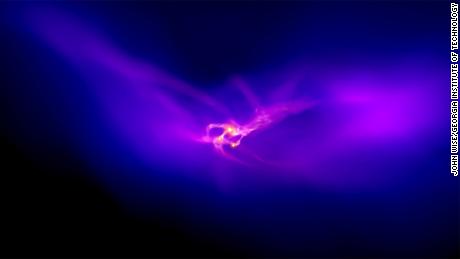
"Like many black holes, it's feeding on a nearby star, pulling gas away from the star and forming a disk of material that encircles the black hole and spirals towards it under gravity," he said. "What's different in V404 Cygni is that we think the disk of material and the black hole are misaligned. This appears to be causing the inner part of the disk to wobble like a spinning top and fire jets out in different directions as it changes orientation."
The black hole was first discovered in 1989 because it released jets and radiation. Previous outbursts associated with this black hole were noted in 1938 and 1956 and found on archival photographic plates.
V404 Cygni caught the attention of astronomers around the world when it unleashed another bright outburst that lasted for two weeks in 2015. Telescopes everywhere trained on the event, which led to a wealth of observational data.
Normally, jets shoot out from the poles of black holes. These jets were firing off in different directions at different rates over a couple of hours.
Astronomers have found the fastest-growing black hole ever seen, and it's got a monster appetite
The black hole itself is rotating and the gravitational pull is so strong, it's actually pulling nearby space and time around with it. This is called frame-dragging.
The material in the jets is blasted out from the black hole's rotating accretion disk. The disk forms when material from a nearby star is pulled into a circle around the black hole.
For scale, the black hole is nine times more massive than our sun and V404 Cygni's disk is 10 million kilometers across. The jets shoot out material at 60% of the speed of light.
Because the spin axis of the black hole is misaligned, frame-dragging also warps part of the disk, causing an intense wobbling that is responsible for the jets shooting off in different directions.
These are the first massive black holes from the early universe
"This is the only mechanism we can think of that can explain the rapid precession we see in V404 Cygni," Miller-Jones said. "You can think of it like the wobble of a spinning top as it slows down, only in this case, the wobble is caused by Einstein's general theory of relativity."
The researchers had to use a different technique to capture what was happening in the black hole. Normally, they use long exposures.
"These jets were changing so fast that in a four-hour image we saw just a blur," said Alex Tetarenko in a statement, another of the study authors and East Asian Observatory Fellow.
Instead, 70-second-long individual exposures were combined to make a film of the action the astronomers were witnessing.
"We were gobsmacked by what we saw in this system — it was completely unexpected," said Greg Sivakoff in a statement, study author and associate professor at the University of Alberta's department of physics. "Finding this astronomical first has deepened our understanding of how black holes and galaxy formation can work. It tells us a little more about that big question: 'How did we get here?'"

Let's block ads! (Why?)


https://www.cnn.com/2019/04/30/world/spinning-black-hole-jets-scn/index.html

2019-04-30 17:20:00Z
52780280722798

NASA head issues meteor warning, calls for cooperation to meet threat - NBCNews.com

/ Source: CNBC.com

By Chloe Taylor, CNBC

Meteors that could destroy an entire U.S. state are a real threat to Earth, NASA’s chief warned on Monday.

Speaking at the Planetary Defense Conference in Washington, D.C., NASA Administrator Jim Bridenstine warned that the risk posed by meteor crashes was not being taken seriously.

“This is not about Hollywood, this is not about movies, this is about ultimately protecting the only planet we know right now to host life,” he said.

Bridenstine pointed to the meteorite that exploded over the Russian city of Chelyabinsk in 2013, which had “30 times the energy of the atomic bomb at Hiroshima” and injured around 1,500 people. Just 16 hours after the crash, NASA detected an even larger object that approached the earth but did not land on it, he revealed.

NASA Administrator Jim Bridenstine at the Planetary Defense Conference at the University of Maryland on April 29, 2019.Joel Kowsky / NASA

“I wish I could tell you that these events are exceptionally unique, but they are not,” Bridenstine said. “These events are not rare — they happen. It’s up to us to make sure that we are characterizing, detecting, tracking all of the near-Earth objects that could be a threat to the world.”

According to scientific modeling systems, such events are expected to happen once every 60 years — but Bridenstine pointed out that destructive meteorites had crashed on the earth three times in the last century.

In 2018, the White House published an action plan that required NASA to detect, track and characterize 90 percent of near-Earth objects measuring 140 meters (460 feet) in diameter — but Bridenstine admitted on Monday that the space agency had a long way to go to meet that goal.

“We’re only about a third of the way there,” he said. “We want more international partners that can join us in this effort. We want more systems on the face of the Earth that can detect and track these objects, and we want to be able to feed all of that data into one single operating system so that ultimately, we have the best, most accurate data that we can possibly get.”

Bridenstine warned that failing to invest in such a network could have catastrophic consequences.

”(At 140 meters) it’s big enough to destroy a state in the United States of America,” he said. “It’s big enough to destroy an entire European country.”

“We know for a fact that the dinosaurs did not have a space program,” he added. “But we do, and we need to use it.”

Earlier this month, NASA awarded a contract to Elon Musk’s SpaceX that will see the company provide launch services for the agency’s Double Asteroid Redirection Test (DART) mission. The $69 million mission, expected to launch in 2021, will test the earth’s capability of deflecting an asteroid by colliding a spacecraft with it at high speed.

Want more stories about asteroids?

SIGN UP FOR THE MACH NEWSLETTER AND FOLLOW NBC NEWS MACH ON TWITTER, FACEBOOK, AND INSTAGRAM.

Let's block ads! (Why?)


https://www.nbcnews.com/mach/science/nasa-head-issues-meteor-warning-calls-cooperation-meet-threat-ncna1000101

2019-04-30 15:09:00Z
52780277812415

NASA Eyes Space Station Power Glitch Ahead of SpaceX Dragon Launch - Space.com

NASA engineers are troubleshooting a power glitch on the International Space Station that might affect plans for a SpaceX Dragon capsule's cargo delivery mission this week.

The power issue isn't a concern for the six astronauts currently living and working onboard the space station, according to a NASA statement released yesterday (April 29). But it has affected the Canadarm2 robotic arm, which worries NASA when the agency looks ahead to the scheduled SpaceX Dragon launch tomorrow (May 1).

NASA spokesperson Dan Huot told Space.com the power issue has affected one of two power systems on the station's robotic arm, leaving it without a backup. The Canadarm2 robot arm is vital to SpaceX's Dragon mission, since astronauts will use the appendage to capture Dragon when it arrives at the orbiting lab.

Related: How SpaceX's Dragon Space Capsule Works (Infographic)

A pair of astronauts worked on the robotic arm's power supply during a spacewalk conducted earlier this month, but that work focused on jumper cables along the arm's length. The current problem, instead, is with the station equivalent of a circuit-breaker, basically.

"An issue is being worked with a Main Bus Switching Unit (MBSU) that distributes electrical power to two of the eight power channels on the station," NASA officials said in the statement released yesterday. "Flight controllers have been working to route power through the remaining six power channels."

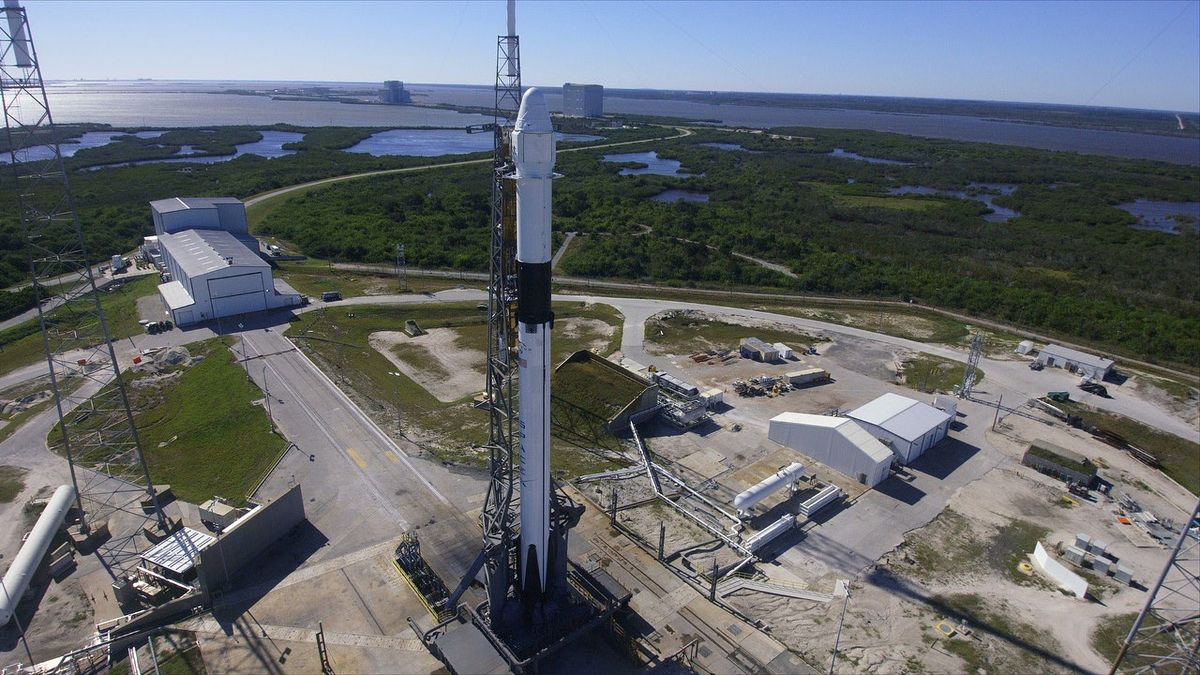
The launch currently scheduled for early tomorrow morning has already been hit by two delays, which pushed the launch first from April 26 to April 30 on account of "station and orbital mechanics constraints," then to May 1. The rocket will lift off from Space Launch Complex 40 at Cape Canaveral Air Force Station in Florida.

When it does launch, the capsule will set off on a leisurely three-day journey to the space station, where astronauts will unpack the more than 5,550 lbs. (2,495 kilograms) of supplies it carried. That includes fresh supplies and new science experiments.

Space.com managing editor Tariq Malik contributed to this report.

Email Meghan Bartels at mbartels@space.com or follow her @meghanbartels. Follow us on Twitter @Spacedotcom and on Facebook.

Let's block ads! (Why?)


https://www.space.com/spacex-dragon-nasa-station-power-glitch.html

2019-04-30 13:48:00Z
CBMiQmh0dHBzOi8vd3d3LnNwYWNlLmNvbS9zcGFjZXgtZHJhZ29uLW5hc2Etc3RhdGlvbi1wb3dlci1nbGl0Y2guaHRtbNIBRmh0dHBzOi8vd3d3LnNwYWNlLmNvbS9hbXAvc3BhY2V4LWRyYWdvbi1uYXNhLXN0YXRpb24tcG93ZXItZ2xpdGNoLmh0bWw

NASA chief warns asteroid threat is real: ‘It’s about protecting the only planet we know to host life' - Fox News

NASA Administrator Jim Bridenstine is sounding the alarm that an asteroid strike is not something to be taken lightly and is perhaps Earth's biggest threat.

Speaking at the International Academy of Astronautics' 2019 Planetary Defense Conference in College Park, Md., on Monday, Bridenstine said the space agency and other asteroid scientists need to make sure people understand that the threat is very real and not just the imagination of big-budget blockbuster movie directors.

"We have to make sure that people understand that this is not about Hollywood, it's not about movies," Bridenstine said at the conference, according to Space.com. "This is about ultimately protecting the only planet we know right now to host life, and that is the planet Earth."

NASA GAMEPLANS MASSIVE ASTEROID STRIKE

"We know for a fact that the dinosaurs did not have a space program. But we do, and we need to use it," Bridenstine added, attempting to portray planetary defense on the same level as a return trip to the Moon. The Trump administration wants to see astronauts return to the Moon by 2024, with or without the help of NASA.

NASA Administrator Jim Bridenstine testifies before the House Committee on Science, Space and Technology on April 2, 2019, during a hearing to review NASA's fiscal year 2020 budget request.

NASA Administrator Jim Bridenstine testifies before the House Committee on Science, Space and Technology on April 2, 2019, during a hearing to review NASA's fiscal year 2020 budget request.

Bridenstine knows the perils of asteroid strikes all too well. In February 2013, he had been a Congressman in Oklahoma for just a month when a devastating asteroid streaked across the Russian sky.

Known as the Chelyabinsk Event, it was the largest known meteor strike in over a century and it injured more than 1,600 people. It "released the energy equivalent of around 440,000 tons of TNT," according to NASA.

"I wish I could tell you these events are exceptionally unique," Bridenstine said during the presentation, noting they have occurred three times in the past 100 years. "But they are not."

Currently, there are two asteroid-centric missions going on around the world —  NASA's OSIRIS-REx probe, which reached the Bennu asteroid in December 2018, and the Japanese Hayabusa2 spacecraft, which recently "bombed" the Ryugu asteroid in an effort to learn more about it.

HOW AMERICA CAN GET ITS SLICE OF THE $1 TRILLION SPACE ECONOMY

Bridenstine highlighted the scientific importance of both of these missions but added that planetary defense is also an important component. "Yes, it's about science, it's about discovery, it's about exploration, but one of the reasons we do those missions is so that we can characterize those objects to protect, again, the only planet we know to host life."

"We have to use our systems, use our capabilities to ultimately get a lot more data, and we have to do it faster," Bridenstine said.

Planetary defense

When it comes to planetary defense, NASA is not sitting on its haunches, having taken several steps to protect Earth by detecting and tracking near-Earth Objects, also known as NEOs.

Last June, NASA unveiled a 20-page plan that details steps the U.S. should take to be better prepared for NEOs, asteroids and comets that come within 30 million miles of Earth. Lindley Johnson, the space agency's planetary defense officer, said at the time that the country "already has significant scientific, technical and operational capabilities" to help with NEOs, but implementing the new plan would "greatly increase our nation’s readiness and work with international partners to effectively respond should a new potential asteroid impact be detected.”

There are approximately 18,000 known NEOs and that number is constantly growing.

MYSTERIOUS INTERSTELLAR METEOR MAY HAVE SLAMMED INTO EARTH IN 2014

In 2016, NASA formalized the agency’s prior program for detecting and tracking NEOs and put it inside its Science Mission Directorate.

NASA will launch its first asteroid defense mission, the Double Asteroid Redirection Test (DART) mission, in 2022. Earlier this month, NASA awarded a $69 million contract to SpaceX, the space exploration company led by Elon Musk, to help with DART.

Currently, asteroid scientists from around the world are conducting a drill showing what the various global agencies would do about a potential asteroid collision. For the first time, the drill is being played out over social media. Updates of the hypothetical event are being shared on the ESA Operations Twitter account until May 3.

CLICK HERE FOR THE FOX NEWS APP

Let's block ads! (Why?)


https://www.foxnews.com/science/nasa-chief-asteroid-threat

2019-04-30 13:28:01Z
52780277812415

What if an asteroid was about to hit Earth? Scientists ponder question - Phys.org

A Nasamosaic image of asteroid Bennu, composed of 12 PolyCam images

Here's a hypothetical: a telescope detects an asteroid between 100 and 300 meters in diameter racing through our solar system at 14 kilometers per second, 57 million kilometers from Earth.

Astronomers estimate a one percent risk the will collide with our planet on April 27, 2027. What should we do?

It's this potentially catastrophic scenario that 300 astronomers, scientists, engineers and emergency experts are applying their collective minds to this week in a Washington suburb, the fourth such international effort since 2013.

"We have to make sure people understand this is not about Hollywood," said NASA Administrator Jim Bridenstine as he opened the sixth International Planetary Defense Conference at the University of Maryland's campus in College Park.

Countries represented include China, France, Germany, Israel, Italy, Russia and the United States.

The idea that the planet Earth may one day have to defend itself against an asteroid used to elicit what experts call a "giggle factor."

But a meteor that blew up in the atmosphere over Russia on February 15, 2013, helped put an end to the sneers.

On that morning, a 65-foot (20-meter) asteroid appear out of nowhere over the southern Urals, exploding 14 miles (23 kilometers) above the town of Chelyabinsk with such force that it shattered the windows of thousands of buildings.

A thousand people were injured by the shards.

But "the positive aspect of Chelyabinsk is that it made the public aware, it made the political decision makers aware," Detlef Koschny, co-manager of the Planetary Defence Office of the European Space Agency (ESA) told AFP.

A meteorite trail is seen above a residential apartment block in the Urals city of Chelyabinsk, on February 15, 2013

How many?

Only those asteroids whose orbit around our Sun brings them within 31 million miles of our planet—defined as "near Earth"—are of interest.

Astronomers are finding new ones each day: more than 700 so far this year, for a total of 20,001, said Lindley Johnson of NASA's Planetary Defense Coordination Office, which was created in 2016.

Among the most risky is a rock named 2000SG344: 165 feet in diameter, with a one in 2,096 chance in striking the Earth within a hundred years, according to the ESA.

The majority are very small, but 942 are more than 0.6 miles across, estimates astronomer Alan Harris.

The scientist told an audience that some large ones are probably still out there: "A fair fraction of the biggest ones are hiding... basically parked behind the Sun."

They are found mainly by two US telescopes, one in Arizona and the other in Hawaii.

The ESA has built a telescope for this purpose in Spain and is planning others in Chile and Sicily.

Many astronomers are demanding a space telescope because terrestrial telescopes are unable to detect objects on the other side of the Sun.

A view of the facade of a local paint and varnish plant damaged by a shockwave from a meteor in the Urals city of Chelyabinsk on
A view of the facade of a local paint and varnish plant damaged by a shockwave from a meteor in the Urals city of Chelyabinsk on February 15, 2013

Deflecting an asteroid

This week's exercise seeks to simulate global response to a catastrophic meteorite. The first step is aiming telescopes at the threat to precisely calculate its speed and trajectory, following rough initial estimates.

Then it boils down to two choices: try to deflect the object, or evacuate.

If it is less than 165 feet, the international consensus is to evacuate the threatened region. According to Koschny, it is possible to predict the country it will strike two weeks ahead. Days away from impact, it can be narrowed down to within hundreds of kilometers.

What about bigger objects? Trying to nuke them to smithereens like in the movie Armageddon would be bad idea, because it could just create smaller but still dangerous pieces.

The plan, instead, is to launch a device toward the asteroid to divert its trajectory—like a cosmic bumper car.

NASA plans to test this idea out on a real asteroid 492 feet across, in 2022, with the Double Asteroid Redirection Test (DART) mission.

One issue that remains is politics, says Romana Kofler, of the United Nations Office for Outer Space Affairs.

"Who would be the decision making authority?" she asked. "The consensus was to leave this aspect out."

The United Nations Security Council would likely be convened, but it's an open question as to whether rich countries would finance an operation if they themselves weren't in the sights of 2000SG344 or another celestial rock.


Explore further

The day the asteroid might hit

© 2019 AFP

Citation: What if an asteroid was about to hit Earth? Scientists ponder question (2019, April 30) retrieved 30 April 2019 from https://phys.org/news/2019-04-asteroid-earth-scientists-ponder.html

This document is subject to copyright. Apart from any fair dealing for the purpose of private study or research, no part may be reproduced without the written permission. The content is provided for information purposes only.

Let's block ads! (Why?)


https://phys.org/news/2019-04-asteroid-earth-scientists-ponder.html

2019-04-30 07:15:51Z
52780277812415

'These events are not rare': NASA exercise highlights existential threat of asteroid impacting Earth - New Zealand Herald

It's the doomsday scenario fit for a Hollywood blockbuster — and NASA scientists are about to see it go down.

This week researchers will run an exercise at the 2019 Planetary Defence Conference that will play out a "realistic scenario" of an asteroid flying through space on an impact trajectory with Earth, reports news.com.au

NASA's Planetary Defence Co-ordination Office (PDCO) is running the simulation exercise as part of a recently announced federal "action plan" for defending our planet against asteroid impact.

The hypothetical asteroid is thought to be about 100 to 300 metres in size and only has a very small likelihood of smashing into Earth on April 29, 2027, according to a NASA web page dedicated to the highly detailed scenario.

Advertisement

Global astronomers are always on the lookout for near-Earth objects (NEOs), which are classified as asteroids and comets that orbit the Sun and come within 50 million kilometres of Earth's orbit.

Along with the NASA unit, the European Space Agency's Space Situational Awareness-NEO Segment and the International Asteroid Warning Network (IAWN) are tasked with hunting the skies for potentially dangerous space rocks.

These "tabletop exercises" are not uncommon and are about walking through the steps that will need to be taken along with governments and emergency agencies to mitigate the risk to society should the unthinkable happen.

"These exercises have really helped us in the planetary defence community to understand what our colleagues on the disaster management side need to know," said Lindley Johnson, NASA's planetary defence officer. "This exercise will help us develop more effective communications with each other and with our governments."

NASA has been tasked with the goal of identifying and tracking 90 per cent of near-Earth meteors that are larger than 140 metres by the year 2020. But the task could end up taking nearly three decades, experts claim. And even then we're far from protected.


Last month, it was revealed a relatively small and undetected meteor blew up over the Bering Sea, off Russia's Kamchatka Peninsula on December 18. The explosion — which happened 25.6 kilometres above the Earth's surface — released 10 times the energy produced by the atomic bomb dropped on Hiroshima in World War II.

Six years ago, a meteor exploded over the Russian city of Chelyabinsk and released a shockwave that shattered thousands of windows and injured more than 1600 people. That meteor was only 19 metres wide.

A meteor streaks through the sky over Chelyabinsk, Russia, in 2013. Photo / AP

"The thing is the one over Chelyabinsk and this latest one (in December) are about 10 times smaller" that the ones targeted by the NASA mandate, astronomer Alan Duffy explained to news.com.au last month. "It's far harder to detect those, and we still haven't found all the larger asteroids yet."

He has called for more funding to be allocated to monitoring systems, asserting "it is just a matter of time before one of these blasts occur over a city and cause incredible damage".

During a keynote address at the opening of the Planetary Defence Conference, NASA administrator Jim Bridenstine warned preparing for an asteroid impact is something that needs to be taken very seriously.

"We have to make sure that people understand that this is not about Hollywood, it's not about movies. This is about ultimately protecting the only planet we know, right now, to host life, and that is the planet Earth," he said.
"These events are not rare, they happen."

Let's block ads! (Why?)


https://www.nzherald.co.nz/world/news/article.cfm?c_id=2&objectid=12226623

2019-04-30 06:24:32Z
52780277812415

Senin, 29 April 2019

What if a killer asteroid were headed toward Earth? NASA plans to find out this week - NBC News

By David Freeman

Think of it as a crash course in averting asteroid crashes.

As part of the 2019 Planetary Defense Conference, NASA, the Federal Emergency Management Agency and their international partners will conduct a so-called tabletop exercise designed to show how they would react to the discovery of a fictional asteroid heading our way.

The exercise is being conducted as part of a federal "action plan" for defending Earth against asteroids that was announced last June. It will play out over the five days of the conference, which begins in College Park, Maryland, on Monday and runs through May 3. You can watch it live in the player below.

"Exercises like this have been run at several conferences over the years, and government agencies have also ​had them," Andrew Rivkin, a planetary astronomer at Johns Hopkins University Applied Physics Laboratory in Laurel, Maryland, and an expert on asteroids, told NBC News MACH in an email. "It's definitely worth doing, if only so people are aware of the issues and how complex some of them are."

Rivkin, who said he was participating in the exercise, likened it to a fire drill but added that the consequences of a major asteroid strike "could be very bad (just ask the dinosaurs)," referring to the impact of a six-mile-wide asteroid that is believed to have caused the dinosaurs' demise some 65 million years ago.

According to the loosely scripted scenario, astronomers discover that a make-believe space rock dubbed 2019 PDC has a one-in-100 chance of smashing into Earth in 2027. Participants in the exercise, including the European Space Agency and the International Asteroid Warning Network, as well as NASA and FEMA, will consider how they might mount space missions to investigate and possibly deflect the asteroid — and how the effects of an impact might be mitigated.

Even though 2019 PDC is fictitious, the threat posed by asteroid strikes is all too real. As of the start of 2019, more than 19,000 near-Earth objects (NEOs) had been discovered — and 30 more are discovered each week as astronomers continue to search for them.

"We've only found about one-third of NEOs large enough to cause severe regional damage, so we have a lot of work left to do," Amy Mainzer, an astronomer and asteroid expert at NASA's Jet Propulsion Laboratory in Pasadena, California, said in an email. "We need to build and operate more capable space- and ground-based telescopes, in my opinion," she added.

The animation depicts a mapping of the positions of known near-Earth objects (NEOs) at points in time over the past 20 years. There are more than 18,000 known NEOs, with new ones being discovered at the rate of about 40 per week.NASA/JPL-Caltech

So far, experts haven't identified any large objects on a collision course with Earth.

"We are confident that searches have found anything big enough to be a worldwide problem," Rivkin said in the email. "The space agencies of the world are working together to complete the search programs to make sure the neighborhood is safe, and NASA is planning a mission called DART [for Double Asteroid Redirection Test] to practice deflecting an asteroid just in case we ever need to do so. We don't anticipate having to do so any time in the foreseeable future, but it's good to be prepared!"

Want more stories about asteroids?

SIGN UP FOR THE MACH NEWSLETTER AND FOLLOW NBC NEWS MACH ON TWITTER, FACEBOOK, AND INSTAGRAM.

Let's block ads! (Why?)


https://www.nbcnews.com/mach/science/what-if-killer-asteroid-were-headed-toward-earth-nasa-plans-ncna999031

2019-04-29 16:00:00Z
52780277812415