The newly described millipede (Burmanopetalum inexpectatum) stuck in amber.
Leif Moritz
A tiny millipede stuck in amber has had 99 million years to contemplate its sticky predicament. The itsy insect didn't live to enjoy its 2019 coming-out party as a scientific curiosity, but the rest of us can marvel at the remarkable specimen.
The millipede is trapped in Cretaceous-era amber found in Myanmar. Researchers determined the millipede is the first fossil found from the order Callipodida, but it was strange enough to require a new suborder. It's now called "Burmanopetalum inexpectatum," with the latter word meaning "unexpected" in Latin.
The researchers created this 3D model of the millipede.
Leif Moritz
The team created a 3D model of the 0.3-inch (8.2-millimeter) millipede to more closely study its anatomy.
"With the next-generation micro-computer tomography (micro-CT) and the associated image rendering and processing software, we are now able to reconstruct the whole animal and observe the tiniest morphological traits which are rarely preserved in fossils," said zoologist Pavel Stoev of the National Museum of Natural History in Bulgaria.
The Callipodida order of millipedes still exists today, with over 100 species crawling around the planet. This particular fossil was the only one of its order found among over 500 millipede specimens trapped in the same amber deposit.
NEW YORK (AP) — Nearly 40 years after it was found by a monk in a Chinese cave, a fossilized chunk of jawbone has been revealed as coming from a mysterious relative of the Neanderthals.
Until now, the only known remains of these Denisovans were a few scraps of bone and teeth recovered in a Siberian cave. DNA from those Siberian fossils showed kinship with Neanderthals. But the remains disclosed little else.
The new discovery was made roughly 1,400 miles (2,300 kilometers) to the southeast in Gansu province of China. The right half of a jawbone with teeth is at least 160,000 years old, scientists reported Wednesday in the journal Nature. No DNA could be found, but scientists recovered protein fragments that they compared to the Siberian DNA. That showed the fossil came from a Denisovan.
The find addresses several mysteries. One was why the Siberian DNA indicated Denisovans were adapted to living at high altitudes when the Siberian cave is relatively close to sea level. The Chinese cave, by contrast, is on the high-altitude Tibetan Plateau, about 10,800 feet (3,280 meters) high.
“Now we have an explanation,” said Jean-Jacques Hublin of the Max Planck Institute for Evolutionary Anthropology in Leipzig, Germany, one of the paper’s authors.
In fact, “it’s a big surprise” that any human relative could live in the cold climate and thin air of the plateau at that time, more than 100,000 years before our own species showed up there, he told reporters.
Previous research had indicated that Denisovans must have lived somewhere other than Siberia, because traces of their DNA can be found in several present-day populations of Asia and Australia whose ancestors probably didn’t pass through that region. The new finding expands their known range, although Hublin said it’s still not clear where Denisovans first appeared. They are named for Siberia’s Denisova cave, where the remains were found.
The new work was a long time in coming. The monk who found the fossil in 1980 gave it to a Buddhist leader, who passed it along to Lanzhou University in China. Study of it began in 2010.
The discovery also provides new anatomical details that can be compared to other fossils from China, some of which are “good candidates for being Chinese Denisovans,” Hublin said.
Experts unconnected to the research agreed the fossil could help identify other remains as Denisovan.
“We always assumed ... that Denisovans were distributed all across Asia,” said Bence Viola of the University of Toronto.
The Nature paper points out similarities to a fossil jaw reported in 2015 that had been dredged by a fishing net off the coast of Taiwan. So maybe the Denisovan range can be extended that far south, he said.
Such linking of fossils might eventually reveal Denisovan body shape and size, he said. From the scant known remains “I assume they were large guys, but it’s kind of hard to prove,” Viola said.
In addition to the anatomy, the study’s approach of using protein from the bone or teeth could also be used on fossils to look for evidence of Denisovan identity, said Eric Delson of Lehman College in New York. Even if a fossil is found not to be Denisovan, the analysis could reveal details of how it fits on the evolutionary tree, he said.
“The method potentially tells us a whole new way of looking at fossils,” he said.
Katerina Harvati of the University of Tuebingen in Germany said the ability of Denisovans to adapt to the inhospitable climate of the Tibetan Plateau is remarkable. It adds to growing evidence that our ancient relatives were more capable than scientists had thought, she said.
___
The Associated Press Health and Science Department receives support from the Howard Hughes Medical Institute’s Department of Science Education. The AP is solely responsible for all content.
In 1980, a Buddhist monk in Tibet entered a sacred cave to pray. On the floor, he found half of a human jawbone, studded with two teeth.
A team of scientists on Wednesday reported that the fossil belonged to a 160,000-year-old Denisovan, a member of a lineage of mysterious, Neanderthal-like humans that disappeared about 50,000 years ago.
The fossil is the first evidence of this species found outside the Denisova Cave in Siberia, buttressing the theory that these relatives of modern humans once lived across much of central and eastern Asia.
“I’m very excited — we have a Denisovan that’s somewhere else than Denisova,” said Bence Viola, a paleoanthropologist at the University of Toronto who was not involved in the new study. “We’d known about Denisovans for 10 years and hadn’t found them anywhere else.”
The new fossil demonstrates that Denisovans were remarkably hardy, able to endure harsh conditions on the Tibetan plateau, at an elevation of 10,700 feet, with only simple stone tools.
The find also suggests that these Denisovans may have evolved genetic adaptations to high altitudes, and that living Tibetans may have inherited those genes thanks to interbreeding between Denisovans and modern humans in prehistoric times.
In the 1970s, Russian researchers began excavating Denisova Cave in Siberia. Over the years, they found a wealth of bones. A few looked like they might have come from humans or an extinct human relative.
Image
A virtual reconstruction of the Tibetan jaw in which an adhering crust was digitally removed. CreditJean-Jacques Hublin, MPI-EVA, Leipzig
Hoping for clues, the archaeologists sent some of the bones to the Max Planck Institute for Evolutionary Anthropology in Leipzig, Germany, whose experts excel at retrieving DNA from fossils.
Some of the bones contained Neanderthal DNA, it turned out. But in 2010, Max Planck researchers discovered that one finger bone held different genes from an unknown human lineage.
Over the past decade, scientists have discovered more Denisovan teeth and bone fragments, including a chunk of a skull. Denisovans appeared to have lived in the cave, off and on, from 287,000 years ago to about 50,000 years ago.
Judging from their DNA, Denisovans shared a common ancestor with Neanderthals about 400,000 years ago. They interbred with Neanderthals and with our own species. Today, people in East Asia, Australia, the Pacific islands and the Americas all carry some Denisovan DNA.
The spread of Denisovan DNA in living humans strongly suggested that they may have lived throughout East and Southeast Asia. And maybe not just there: Earlier this month, a team of researchers argued that a population of Denisovans reached New Guinea and interbred further with modern humans.
But year after year, no one could find a Denisovan fossil outside the Siberian cave.
In 2010, Dongju Zhang, an archaeologist at Lanzhou University in China, began studying the Tibetan jaw, which had been languishing in storage at her institution.
Right away, she could tell it was humanlike — but not human. “We all have chins, but this doesn’t have one,” Dr. Zhang said in an interview.
Eventually, she located the cave in Tibet where the jaw had been discovered. Monks at a nearby temple told her they regularly found human remains on their visits.
“They said they were half-bone and half-stone,” said Dr. Zhang.
Image
The limestone cave in which the jawbone was found, above riverbed near Xiahe, Tibet. Buddhist monks visiting the cave to pray discovered humanlike remains inside.CreditDongju Zhang, Lanzhou University
When she and her colleagues made a small excavation in the cave, they found ancient tools, a sign of human occupation.
She emailed photos of the jaw to Jean-Jacques Hublin, a paleoanthropologist at the Max Planck Institute. Intrigued, he traveled to China to examine the fossil, and soon he and Dr. Zhang had begun a collaboration with other experts to learn more.
Chuan-Chou Shen and Tsai-Luen Yu of National Taiwan University handled the task of figuring out how old it was. The jaw still had bits of rock stuck to it, and these contained uranium. By measuring the uranium’s decay into thorium, Dr. Shen and Dr. Yu were able to estimate the bone’s age.
The jaw turned out to be at least 160,000 years old, by far the oldest evidence of humans on the Tibetan plateau. Its antiquity also supported the scientists’ hunch that it did not belong to our own species.
DNA could reveal its true identity. But Qiaomei Fu, a geneticist at the Institute of Vertebrate Paleontology and Paleoanthropology in Beijing, found that no genetic material had survived.
Fortunately, other biological molecules can be found in fossils. At Max Planck, Frido Welker, a molecular anthropologist, discovered ancient proteins in the jawbone’s teeth.
The proteins were not from modern humans; instead, they were a match to Denisovan DNA from Siberia.
With the new discovery and other recent finds, a picture of the Denisovans has grown clearer. Everything about their heads seems to have been big, from their giant molars to their thick jaws to their massive brain cases. Dr. Viola speculated adults may have weighed well over 200 pounds.
“I’d assume they’d be very large and robust individuals,” he said. “These are like a football players.”
The discovery of Denisovans living at high altitude is intriguing for another reason: Tibetans today share a special genetic link to Denisovans.
Image
The cave in which the jawbone was found sits in a rugged valley.CreditDongju Zhang, Lanzhou University
When most people travel to high elevations, they respond to the low level of oxygen by making extra hemoglobin in their red blood cells.
“That’s bad, because it makes your blood thick,” said Emilia Huerta-Sanchez, a population geneticist at Brown University who was not involved in the new study.
But many Tibetans don’t make extra hemoglobin, thanks to an unusual version of a gene they carry called EPAS1. In 2014, Dr. Huerta-Sanchez and her colleagues discovered that this unusual gene came from Denisovans.
How did Denisovans end up with a gene that promotes health at high altitudes? And how did it end up becoming so common in Tibetans but so rare in other people?
Until scientists find DNA from Tibetan Denisovans, the history won’t be clear, Dr. Huerta-Sanchez said.
“We don’t know the order of events,” she said. “But Denisovans are such a mysterious group that anything we learn is exciting.”
In recent decades, Chinese paleontologists have found a number of puzzling bones that are almost human and are tens or hundreds of thousands of years old.
Researchers now may compare them to the Tibetan jaw, and search the fossils for ancient proteins.
“Denisovans are already somewhere in a museum drawer,” Dr. Welker predicted. “We just haven’t able to link them together yet.”
Anyone who has been following the European Space Agency’s Twitter account over the past week may have gotten a small scare when the organization started tweeting about an “enormous asteroid” that’s on track to hit our planet in 2027.
The good news is that’s not actually going to happen.
ESA is just one of many space agencies and organizations participating in a simulated scenario of what would happen if humans did discover a massive asteroid heading our way. It’s an exercise that NASA, the Federal Emergency Management Agency, and others do every year to figure out how the world should respond to such a terrifying event. It’s coordinated through NASA’s Center for Near-Earth Object Studies, which is hosting a conference this week that’s dedicated to asteroids and planetary defense.
“We’re trying to ask what we would do,” Paul Chodas, manager of the Center for Near-Earth Object Studies at NASA’s Jet Propulsion Laboratory, tells The Verge. “We’re trying to make it a realistic simulation, ask the questions: what would we know, when? From the moment it’s discovered, all the way up to whatever happens later on.”
This year, the simulated situation is dire. The story starts in March when scientists discover a near-Earth asteroid that’s estimated to be between 330 to 1,000 feet wide. The asteroid, dubbed 2019 PDC, is expected to pass by Earth on May 13th at a safe distance of 12 million miles. But after following 2019 PDC’s trajectory for a couple of weeks, the fictional scientists initially determine that the asteroid will swing back by Earth again in 2027. And when it does, the rock has a 1 percent chance of slamming into the planet.
One percent may not seem very high, but for the planetary science community, it’s enough for experts to take notice. Typically, near-Earth asteroids of this size don’t reach such a high percentage of hitting the planet. “One percent is a threshold at which we’re going to take it very seriously and consider what options we have,” Chodas says.
But then things get worse. The simulation fast-forwards to July 2019, after scientists have been able to observe 2019 PDC for a few more months. That allows them to get a better idea of the asteroid’s size and path. In the simulation, they narrow down the width of the asteroid to between 460 to 850 feet. Now, 2019 PDC has a 10 percent chance of hitting Earth in 2027.
In this exercise, real scientists like Chodas are pretending to use tools that would actually provide the first warning sign of an impending asteroid impact. The imagined 2019 PDC is discovered using the Pan-STARRS telescope, an observatory based in Hawaii. It’s one of NASA’s biggest instruments for tracking asteroids, along with the Catalina Sky Survey in Arizona. A telescope in space known as NEOWISE has also helped the space agency catalog numerous asteroids that are orbiting near Earth, and the spacecraft is also used to “track” 2019 PDC in the simulation.
In reality, NASA has discovered about 20,000 asteroids orbiting near Earth, about 900 of which are larger than 0.6 miles or 1 kilometer wide. If an asteroid that big were to slam into our planet, it could possibly trigger global climate change. The simulated asteroid isn’t that large, so it wouldn’t cause a global catastrophe. But if something like it were to hit Earth, it’d do some major damage. The asteroid could release between 100 to 800 megatons of energy, decimating a large region of the planet. That’s enough to trigger NASA to take some drastic measures.
Every day during the exercise, NASA provides an update in the scenario, moving the simulation forward in time. The second update from yesterday afternoon moved the timeline forward a few months, but Chodas says some updates will fast-forward years in the future, after significant progress has been made. “We’ll jump ahead a certain number of years, and then the problem will evolve as we get more information, as we learn more about the asteroid, and as we learn that it poses a greater threat to the Earth,” he says.
While all of this is happening, ESA and other organizations involved with the simulation are providing updates on Twitter, some of which have spooked a few casual social media users. ESA has been including the hashtag #fictionalevent on all tweets related to the event, but some Twitter users have been a little spooked. “Wait, is this real? Is this happening??!” one user asked. ESA replied confirming it wasn’t real but also adding that it was “very plausible.”
Meanwhile, members from NASA, FEMA, ESA, and more will seriously discuss how to address this fake asteroid threat. It helps the organizations practice how they would disseminate this news to politicians and to the public in the event of a real asteroid threat, and how they would develop and assess emergency response plans.
One option is to create spacecraft that could rendezvous with the asteroid and ram into it, changing the object’s speed and direction so that it will most likely miss Earth. “That would be enough to make it miss the Earth, if it was done years ahead,” says Chodas. NASA is already working on a real mission that would test out this process in space. It’s called the Double Asteroid Redirect Mission (DART), and it will slam into a small asteroid moon, an object that orbits around another asteroid. It’s supposed to launch in 2022.
Fortunately, there is no asteroid currently worrying scientists like 2019 PDC would. However, a similar-sized asteroid called Apophis did provide a scare for scientists back in 2004 when it was first discovered. At the time, scientists thought it had a 2.7 percent chance of hitting Earth in 2029. Since Apophis is somewhere between 690 and 1,080 feet wide, so it would do some major regional damage if it hit. Fortunately, after more observations of the asteroid, the probability of that happening has gone done significantly. Apophis will still pass within 19,000 miles of Earth on Friday the 13th of 2029, within the range of some of our distant communications and surveillance satellites. The flyby will give scientists the opportunity to observe the asteroid from Earth and possibly make out its surface features.
Ultimately, there is no major asteroid threat facing Earth right now, which is why simulating an object like 2019 PDC gives planetary scientists practice for how they’d respond to the real thing. For now, just remember that any tweets about an asteroid crash in 2027 are just a test of Earth’s emergency space organizations.
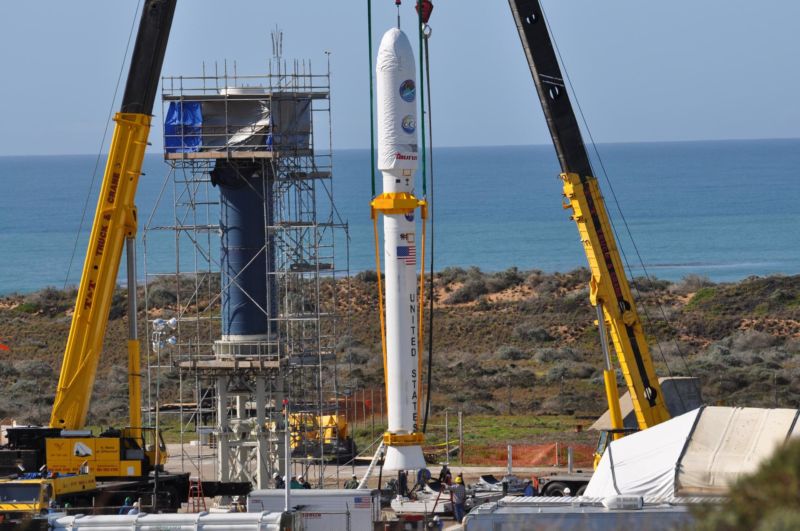
Enlarge/ At Vandenberg Air Force Base in 2009, two cranes have raised NASA's Orbiting Carbon Observatory, or OCO, spacecraft to vertical. OCO would later be lifted and attached to the waiting Stage 0 motor of the Taurus XL launch vehicle in the tower.
NASA
A little more than a decade ago, on February 24, 2009, a Taurus XL rocket launched from Vandenberg Air Force Base in California carrying a NASA satellite designed to measure carbon dioxide levels in the atmosphere. However, the payload never properly separated from the rocket, and due to the extra mass the combined spacecraft and rocket failed to reach orbit.
Two years after this, on March 4, 2011, another Taurus XL rocket launched from Vandenberg, again carrying a science payload for NASA. This Glory satellite would have measured the properties of sulfate and other aerosols in the atmosphere. Again, the payload failed to properly separate from the rocket, and it was a total loss.
Combined, the loss of NASA's Orbiting Carbon Observatory and Glory satellites cost the space agency $700 million. In the years since, the space agency's Launch Services Program and the rocket's manufacturer, Orbital Sciences—which has since been acquired by Northrop Grumman—have been conducting investigations into just what happened.
Over time, some information has come out. Shortly after the launches, it was clear the payload fairing had failed to separate from the two rockets. And in 2015, the company that supplied aluminum extrusions for the four-stage, solid-rocket Taurus XL booster, Sapa Profiles Inc. (SPI), admitted that it had falsified quality control test results for its products.
But only now has the story emerged in greater detail. This week, NASA posted a summary of its decade-long investigation into the mission failures. Long story short: faulty aluminum extrusions used in the mechanism by which the payload separates from the rocket, known as a frangible joint, prevented the separation from fully occurring. Much of the report drills down into the process by which NASA reached and then substantiated this conclusion.
The investigation found that SPI had falsified records about the materials used in its extrusions for about a decade. Internal, handwritten accounts of SPI's material properties tests revealed that the company made alterations to more than 2,000 test results between about 1996 and 2006, affecting more than 200 customers.
To protect the government supply chain, SPI has been excluded from government contracting since Sept. 30, 2015. NASA also has proposed debarment for Hydro Extrusion Portland, Inc., formerly known as SPI, and this company also is currently excluded from contracting throughout the federal government.
“Due in large part to the hard work and dedication of many highly motivated people in the NASA Launch Services program, we are able to close out the cause of two extremely disappointing launch vehicle failures and protect the government aerospace supply chain,” said Amanda Mitskevich, LSP program manager at NASA’s Kennedy Space Center in, Florida. “It has taken a long time to get here, involving years of investigation and testing, but as of today, it has been worth every minute, and I am extremely pleased with the entire team’s efforts.”
COLLEGE PARK, Md. — The solar system has a sense of humor: A decade from now, on Friday, April 13, 2029, a large asteroid will streak across the sky — but it's a cause for excitement, not fear, scientists say.
That asteroid, called Apophis, stretches about 1,100 feet (340 meters) across and will pass within 19,000 miles (31,000 kilometers) of Earth's surface. That might sound scary, but scientists are positive that it will not hit Earth. Instead, it's a once-in-a-lifetime chance for scientists to truly understand asteroids near Earth.
"The excitement is that an object this large comes this close about once per thousand years, so it's all about, What's the opportunity?" Richard Binzel, a planetary scientist at MIT, said yesterday (April 30) during the International Academy of Aeronautics' Planetary Defense Conference, which is being held here this week. The asteroid's proximity and size will also add to the encounter's brightness, so Apophis will capture eyeballs — about 2 billion people should be able to see it pass by with their naked eyes, he said.
The near Earth asteroid Apophis, shown in yellow, will pass by Earth in 2029 within the distance that some satellites (shown in blue) orbit Earth. The purple line represents the International Space Station's orbit.
And of course, scientists have a full 10 years to plan before the space rock makes its closest approach. That means they have time to draw up a wish list of what they'd like to learn, sort out what can be tackled from Earth and dream up spacecraft designs that could give them a front-row seat to the flyby.
Although scientists are positive Apophis won't hit Earth in 2029, they can't yet rule out possible collisions many decades in the future, and there are plenty of other large space rocks orbiting the sun in Earth's neighborhood. Experts in planetary defense track these objects and prepare techniques that could divert any that do pose a threat. And data gathered about Apophis could inform what scientists know about these other asteroids, since this particular space rock seems superficially similar to about 80% of the potentially hazardous asteroids scientists have identified to date.
Asteroid scientists and planetary defense experts have already begun that work, with a series of presentations at the conference here highlighting topics they'd like to consider between now and the 2029 Apophis flyby.
Those proposed investigations bridge the two disciplines, asking questions applicable both to humanity's self-interest and to our greater understanding of the solar system we live in. Take, for example, the interior structure of Apophis, which would be a vital piece of information for engineers to understand if they want to try to break apart the space rock or push its collision course away from Earth. But that information would also likely offer clues to how Apophis formed.
"You could argue, is this science or planetary defense?" Binzel said. "But there is no argument, it's all one and the same."
A key topic of interest is the degree to which Earth's gravitational pull may distort Apophis during the 2029 close approach. Some scientists believe that previous flybys would have also stretched the space rock, and that other asteroids could be similarly affected during their own close approaches.
One question that asteroid scientists have that is also vital for planetary defense experts is the extent to which the sun's radiation nudges Apophis' orbit. That phenomenon, called the Yarkovsky effect, results from the temperature differential between the day and night sides of the asteroid.
The tweaks the Yarkovsky effect cause in an asteroid's orbit are so small that scientists struggle to distinguish the nudges from instrument hiccups. Although scientists have pinpointed Apophis' trajectory in 2029 to within a path just 7.4 miles (12 km) wide that stays thousands of miles away from Earth, they can't quite rule out possible impacts decades in the future — and that's in part because of uncertainty about the Yarkovsky effect.
In addition to flagging some key priorities for the next decade, scientists also discussed some top-level mission concepts that could lay the groundwork for spacecraft to visit Apophis before, during or after its close approach.
The successes of the past year or so have put engineers on a strong footing for such missions: NASA's Mars InSight mission placed the first robotically deployed seismometer on another planet. The first interplanetary cubesats flew with that spacecraft as the MarCO mission. And both NASA's OSIRIS-REx and Japan's Hayabusa2 have excelled at operating close to small asteroids.
Pieces of all those missions showed up in discussions about what scientists could send to Apophis. Several speakers discussed the possibilities offered by cubesat missions, including missions that paired twin spacecraft, as MarCO did.
Scientists also advanced the idea of putting a seismometer on the space rock — one design would impale Apophis like a harpoon — to pick up tiny vibrations through the space rock that could help scientists understand the interior structure of Apophis and how it's affected by Earth's gravity. Also among the ideas is a mission that would create an artificial crater on Apophis, as Hayabusa2 just did at an asteroid called Ryugu, in order to see below the weathered surface of the asteroid.
Some of those ideas may be too risky to be worthwhile, however, since scientists would need to be positive the manhandling wouldn't risk meddling in Apophis' current, safe trajectory. "We've got to be really careful, because this specific object will have intense public and even political pressure to avoid doing anything to change its orbit," James Bell, a planetary scientist at Cornell University, said during his presentation. "That said, it's an opportunity for NASA and other space agencies, for it to be the PR event of the decade."
And that's the careful balance that asteroid scientists and planetary defense experts will need to achieve over the course of the next decade — making the most of the scientific and outreach opportunities Apophis' close flyby offers without causing panic, or still worse, accidentally creating a truly dangerous situation where there wasn't one before.
"The world will be watching," Binzel said. "It's up to us to get ready."
NASA has ruled out a collision with earth during another flyby near earth in 2036.
(NASA)
A 1,110-foot-wide asteroid named for the Egyptian god of chaos will fly past earth in 2029 within the distance of some orbiting spacecraft, according to reports.
The asteroid, 99942 Apophis, will come within 19,000 miles of earth on April 13, a decade from now, but scientists at the Planetary Defense Conference are already preparing for the encounter, Newsweek reported. They plan to discuss the asteroid’s effects on earth’s gravity, potential research opportunities and even how to deflect an incoming asteroid in a theoretical scenario.
Scientists say most asteroids that pass near earth aren’t more than 30 feet wide, making Apophis, named for an Egyptian god of chaos, a rare opportunity for research.
The asteroid will be visible to the naked eye and will look like a moving star point of light, according to NASA. It will pass over the United States in the early evening, according to WUSA 9.
Apophis was discovered in 2004 and, after tracking it for 15 years, scientists say the asteroid has a 1 in 100,000 chance of striking earth decades in the future – after 2060, Newsweek reported.