Following a successful May 4th launch atop Falcon 9, SpaceX’s latest Cargo Dragon spacecraft is just a few hours away from starting its International Space Station (ISS) berthing sequence.
Scheduled to begin around 5:30 am EDT (09:30 UTC), SpaceX operations staff will command Dragon to continue a cautious ISS approach. Several hours later, the spacecraft will be quite literally grabbed by station astronauts and gently berthed with one of the space station’s several Common Berthing Mechanism (CBM) ports. Once Cargo Dragon has been safely joined with the ISS, the station’s crew of astronauts can begin the intensive process of unpacking more than 1500 kg (3300 lb) of pressurized cargo, including dozens of time-sensitive and complex science experiments.
Aside from the 1.5 tons of cargo contained inside Dragon’s climate-controlled cabin, ISS astronauts and ground-based NASA controllers will again use the space station’s robotic Canadarm2 manipulator to extract two large unpressurized payloads from Dragon’s trunk. The ‘flagship’ instrument of CRS-17 is NASA’s Orbiting Carbon Observatory-3 (OCO-3), an upgraded follow-on to OCO-2 that should dramatically improve the quantity and quality of data available on the distribution of carbon in the Earth’s atmosphere. The second trunk-stashed payload is known as STP-H6 and is carrying around half a dozen distinct experiments.
The CRS-17 spacecraft departed Falcon 9’s upper stage at the crack of orbital dawn and offered a well-lit view of OCO-3 and STP-H6 in its trunk. (SpaceX)
Both STP-H6 and OCO-3 will be installed on the outside of the space station with the help of Canadarm2, an extremely useful capability that limits the need for astronauts to suit up and perform risky and time-consuming EVAs (extra-vehicular activities) outside the ISS. With its trunk emptied, Cargo Dragon will eventually discard the section to burn up in Earth’s atmosphere just before the reusable capsule begins its own reentry.
Unlike several other spacecraft with service sections, both proposed, flying, or retired, SpaceX’s Dragon spacecraft strive to minimize the complexity and cost of their expendable service sections. For both Cargo and Crew Dragon, the trunk serves as a structural adapter for unpressurized payloads and the Falcon-Dragon interface, hosts solar arrays and radiators, and doesn’t do much else. All propulsion, plumbing, and major avionics are kept within the capsule to maximize reusability.
Defining “slow and steady”
The process of berthing or docking with the ISS is a fundamentally cautious thing, developed by NASA, Roscosmos, and other international partners through forced and painful trial and error. In short, the road to today’s cautious procedures has been paved with countless failures and close calls over decades of space activity. For Cargo Dragon, the process involves berthing, more passive and less complex than docking. Outside of a dozen or so meters, the processes begin quite similarly. Cargo Dragon (Dragon 1) will very slowly approach the station’s several-hundred-meter keep out zone, typically no faster than a few m/s (mph).
Then follows a back-and-forth process of stop and go, in which SpaceX commands Dragon forward, halts at set locations, verifies performance and station readiness with NASA, and repeat. Once within 10 or so meters of the ISS, Dragon will begin carefully stationkeeping, essentially a version of formation flying without a hint of aerodynamic forces. ISS astronauts will then command the Canadarm2 robotic arm toward a sort of target/handle combo located on the spacecraft. The arm follows similar stop-start procedures before finally grappling Dragon, at which point the astronauts in command are legally required (/s) to quip something along the lines of “We’ve caught ourselves a Dragon!”
CRS-17 Cargo Dragon capsule C113 has flown once before, completing the CRS-12 orbital resupply mission in September 2017. (NASA)
From start to finish, the process takes about 1.5 hours under optimal conditions. Around 2.5 hours after that, Canadarm2 will physically berth Dragon with one of several ISS berthing ports. Soon after, station astronauts can open Dragon’s hatch, snag some fresh goodies, and begin the unpacking process. CRS-17’s ISS arrival operations will be covered live on NASA TV.
Check out Teslarati’s newsletters for prompt updates, on-the-ground perspectives, and unique glimpses of SpaceX’s rocket launch and recovery processes
SpaceX’s Cargo Dragon spacecraft nears space station with 2.5 tons of cargo
Holes forming. Credit: Edward S. Parsons et al. UCL
To kill bacteria in the blood, our immune system relies on nanomachines that can open deadly holes in their targets. UCL scientists have now filmed these nanomachines in action, discovering a key bottleneck in the process which helps to protect our own cells.
The research, published in Nature Communications, provides us with a better understanding of how the immune system kills bacteria and why our own cells remain intact. This may guide the development of new therapies that harness the immune system against bacterial infections, and strategies that repurpose the immune system to act against other rogue cells in the body.
In earlier research, the scientists imaged the hallmarks of attack in live bacteria, showing that the immune system response results in 'bullet holes' spread across the cell envelopes of bacteria. The holes are incredibly small with a diameter of just 10 nanometres.
For this study, the researchers mimicked how these deadly holes are formed by the membrane attack complex (MAC) using a model bacterial surface. By tracking each step of the process, they found that shortly after each hole started to form, the process stalled, offering a reprise for the body's own cells.
"It appears as if these nanomachines wait a moment, allowing their potential victim to intervene in case it is one of the body's own cells instead of an invading bug, before they deal the killer blow," explained Dr. Edward Parsons (UCL London Centre for Nanotechnology).
So-called membrane attack complexes -- imaged on the back of a bacterium. The scale bars correspond to 800 (left) and 30 (right) nanometres. Credit: EMBO Journal (2019), 10.15252/embj.201899852.
The team say the process pauses as 18 copies of the same protein are needed to complete a hole. Initially, there's only one copy which inserts into the bacterial surface, after which the other copies of the protein slot into place much more rapidly.
"It is the insertion of the first protein of the membrane attack complex which causes the bottleneck in the killing process. Curiously, it coincides with the point where hole formation is prevented on our own healthy cells, thus leaving them undamaged," said Professor Bart Hoogenboom (UCL Physics & Astronomy).
A video sequence of the formation of a hole in a bacterial surface, recorded at 6.5 seconds per frame. The scale bar (see first frame) corresponds to 30 nanometres. Credit: Edward S. Parsons et al.
To film the immune system in action at nanometre resolution and at a few seconds per frame, the scientists used atomic force microscopy. This type of microscopy uses an ultrafine needle to feel rather than see molecules on a surface, similar to a blind person reading Braille. The needle repeatedly scans the surface to produce an image that refreshes fast enough to track how immune proteins get together and cut into the bacterial surface.
More information:
Edward S. Parsons, George J. Stanley, Alice L.B. Pyne, Adrian W. Hodel, Adrian P. Nievergelt, Anaïs Menny, Alexander R. Yon, Ashlea Rowley, Ralf P. Richter, Georg E. Fantner, Doryen Bubeck, and Bart W. Hoogenboom, Single-molecule kinetics of pore assembly by the membrane attack complex, Nature Communications (2019). DOI: 10.1038/s41467-019-10058-7
Citation:
Filming how our immune system kill bacteria (2019, May 6)
retrieved 6 May 2019
from https://phys.org/news/2019-05-immune-bacteria.html
This document is subject to copyright. Apart from any fair dealing for the purpose of private study or research, no
part may be reproduced without the written permission. The content is provided for information purposes only.
Astronomers have created the largest and most comprehensive "history book" of 265,000 galaxies into one single image, stretching back through 13.3 billion years of time to just 500 million years after the big bang.
They used 16 years of observations from the U.S. space agency NASA's Hubble Space Telescope, chronicling the universe's evolutionary history in one sweeping view, with nearly 7,500 exposures.
The portrait shows how galaxies change over time, building themselves up to become the giant galaxies, and the faintest and farthest galaxies are just one ten-billionth the brightness of what the human eye can see, according to a press release of NASA this week.
Galaxies allow astronomers to trace the expansion of the universe, offer clues to the underlying physics of the cosmos, show when the chemical elements originated, and enable the conditions that eventually led to the appearance of our solar system and life.
"This one image contains the full history of the growth of galaxies in the universe, from their time as 'infants' to when they grew into fully fledged 'adults'," said Garth Illingworth of the University of California, Santa Cruz, leader of the team that assembled the image.
This new image mosaic is the first in a series of Hubble Legacy Field images. The team is working on a second set of images, totaling more than 5,200 Hubble exposures, in another area of the sky.
In "The Matrix," Neo realizes he can bend the simulation in which he lives.Warner Bros.
The Hollywood blockbuster "The Matrix" celebrated its 20th anniversary in March.
The movie centers around the philosophical concept that our reality may not be real. The film's protagonist discovers that his world is a vast simulation run by hyper-intelligent AI.
Nick Bostrum — an Oxford philosopher whose ideas have been echoed by Elon Musk — has argued that more likely than not, everyone on Earth today is living in a simulation.
When the film "The Matrix" came out 20 years ago (yes, it premiered in March 1999), many moviegoers pegged its premise as entertaining but fully implausible.
The movie's protagonist, Neo, discovers that his reality isn't actually real. Instead, Neo's world is a vast simulation orchestrated by hyper-evolved AI that harvest humans for their energy.
While this vision of robot overlords probably strikes most people as a stretch, the idea that we're living in a simulation is totally plausible, according to some philosophers, and maybe even likely.
Though Neo's bullet-dodging, gravity-defying antics may now seem dated to movie-goers, the concepts put forward in "The Matrix" remain perennial. Here's why some scientists think we're living in a simulation.
The odds of us living in reality are a billion to one, some say
In 2001, Nick Bostrom, a philosopher at the University of Oxford, circulated the first draft of a paper suggesting that a highly advanced supercomputer — with a mass on the order of a planet — would be capable of running a simulation on a humanity-size scale. (Bostrum told Vulture that he hadn't seen "The Matrix" before publishing the paper.)
Bostrom said this computer would be capable of doing 1042calculations per second, and it could simulate the entire history of humankind (including all our thoughts, feelings, and memories) by using less than one-millionth of its processing power for just one second.
By this logic, all of humanity and our entire physical universe are just blips of data stored in the hard drive of a massive supercomputer.
He concluded: "We are almost certainly characters living in a computer simulation."
About 15 years later, Elon Musk — the founder of Tesla and SpaceX — echoed Bostrum's ideas. Musk said at a 2016 Recode conference that he thinks "the odds that we're in base reality is one in billions."
Elon Musk speaks near a Falcon 9 rocket during his announcement that Japanese billionaire Yusaku Maezawa will be the first private passenger to fly around the moon aboard a SpaceX spaceship, September 17, 2018.David McNew/AFP/Getty Images
Today, Bostrum is still thinking and talking about the fraught relationship between humans and computers — in a speech at this year's TED conference, he put forward the frightening idea that humanity could destroy itself with a technology of our own creation.
Bostrom went on to suggest that the way to save us from ourselves is simple: mass surveillance using AI.
One scientist argues that our reality is akin to a giant multiplayer video game
Rizwan Virk, a computer scientist and the author of the new book "The Simulation Hypothesis," told Vox that he also thinks "there's a very good chance we are, in fact, living in a simulation."
Virk imagines this as "the video game of life," which he calls "the Great Simulation."
"You can think of it like a high resolution or high-fidelity video game in which we are all characters," he told Vox.
Virk, who is also a video game designer, said the simulated video game-like universe that we might be living in — which is indistinguishable from reality for us — is far more sophisticated than the giant multiplayer online games that humans currently create, like World of Warcraft and Fortnite.
World of Warcraft, produced by Blizzard Entertainment, is a massively multiplayer online role-playing game in which players control a character avatar to explore and complete quests.Blizzard
He acknowledged, of course, that nobody can me 100% confident that we're living in a simulation, but said "there is plenty of evidence that points in that direction."
Some researchers are trying to test Bostrum's theory
Since Bostrum's paper came out, academics have been trying to test the idea that humanity is living in a simulation.
In 2017, a study in the journal Science Advances argued that one type of limited simulation couldn't work due to hardware issues. Essentially, the study authors said that classical computers don't have enough memory to simulate certain scenarios in our lives and store the information.
A group of physicists also tried to address these questions by studying cosmic rays. Physicists simulate space, and the subatomic particles in it, using coordinates on a grid. So nuclear physicist Silas Beane and some colleagues suggested in a 2014 paper that perhaps the mass simulation we could be living in would use that same coordinate system. Their logic was that if certain particles — like high-energy cosmic rays — always exhibit a maximum energy level (which, it turns out, they do), then the constraints on their behavior could be due to the simulation's underlying grid.
"There always remains the possibility for the simulated to discover the simulators," the authors said in the paper.
But we may never know the answer
Many scientists argue, however, that we'll never be able to figure out whether or not we're living in a simulation.
Marcelo Gleiser, a physicist and philosopher at Dartmouth College, told New Scientist that trying to address Bostrum's question based on our current knowledge and technological capabilities is pretty hopeless. That's because if we were really living in a simulation, scientists wouldn't have any idea about the laws of physics in the "real world" outside. They also wouldn't know what kinds of computations would be possible outside the bounds of our simulation, Gleiser said.
So everything that we think we know about what's possible in terms of computing power or the laws of physics could just be another aspect of the simulation.
Beane has expressed similar skepticism.
"If we're indeed a simulation, then that would be a logical possibility, that what we're measuring aren't really the laws of nature, they're some sort of attempt at some sort of artificial law that the simulators have come up with," he told Discover Magazine.
Bostrum, however, remains convinced of his theory that we are most likely in a simulation.
"At the meta level, I haven't really seen any convincing objections or attempts at refutation," he told Vulture. "So the absence of that also, I guess, strengthens my confidence that the reasoning is sound."
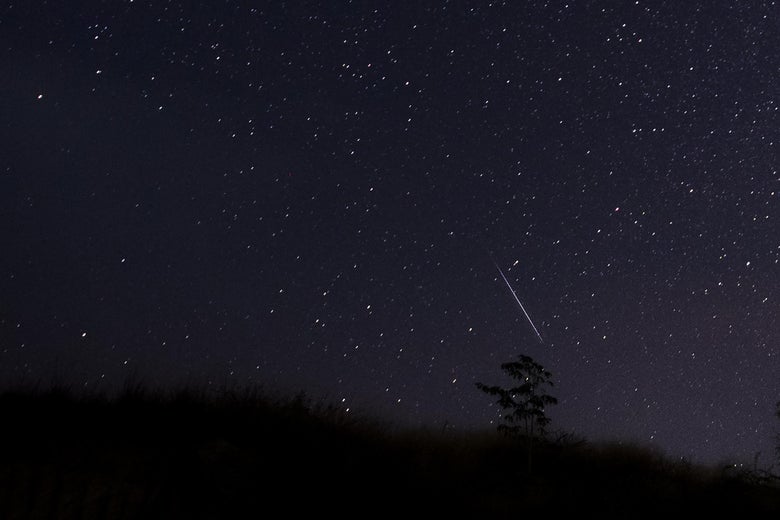
The Earth will pass through a trail of debris left behind by Halley's Comet this weekend, sparking the second meteor shower in as many weeks.
View full coverage on Google News
https://www.accuweather.com/en/weather-news/tonight-eta-aquarid-meteor-shower-to-dazzle-onlookers-around-the-globe/70008159
A meteor streaking through the night sky on December 14, 2018.
Ye Aung Thu/Getty Images
The annual Eta Aquarids meteor shower is expected to occur this weekend, reaching its peak on Monday, according to NASA.
The meteor shower is a result of debris left behind by Halley’s Comet. Every year, when the earth passes through the trail the comet left behind, some of the material burns up in our atmosphere, giving us a flash of light.
While the shower will be more visible for viewers in the Southern Hemisphere, those in the Northern Hemisphere should still be able to catch some of the display. Luckily, there will be no bright moon to get in the way of viewing, so if you can find a clear patch of sky, you should position yourself to face eastward between 3 a.m. and dawn. It’ll take about half an hour in the dark for your eyes to adjust, but then you should be able to spot some shooting stars.
And, according to NASA, even if you can’t take the time to go star-gazing Sunday or Monday morning, you should still be able to catch some for up to a week after.
Help us continue covering the news and issues important to you—and
get ad-free podcasts and bonus segments,
members-only content, and other great benefits.
SpaceX’s Falcon 9 rocket lifted off from Cape Canaveral’s Complex 40 launch pad at 2:48:58 a.m. EDT (0648:58 GMT) Saturday. Credit: SpaceX
With a thundering, sky-lighting predawn blastoff from Cape Canaveral, a Falcon 9 rocket fired into orbit early Saturday with a Dragon cargo capsule in pursuit of the International Space Station.
Less than nine minutes later, the rocket’s first stage booster fell from the sky and executed a pinpoint propulsive landing just offshore, setting the stage for another resupply mission for NASA using the same rocket this summer using the same vehicle.
The 213-foot-tall (65-meter) rocket lifted off with a flash from its nine Merlin 1D main engines at 2:48:58 a.m. EDT (0648:58 GMT), roughly the moment Cape Canaveral rotated under space station’s orbital plane.
The Falcon 9 tilted toward the northeast to align with the space station’s flight path, riding 1.7 million pounds of thrust as roared into a starry sky. Less than two-and-a-half minutes later, the rocket’s first stage booster shut down and separated to begin a descent back to Earth, targeting SpaceX’s drone ship “Of Course I Still Love You” parked around 14 miles (22 kilometers) east of Cape Canaveral in the Atlantic Ocean.
The first stage lit three of its engines to begin a boost-back burn to reverse course and head back toward Florida’s Space Coast, while the Falcon 9’s upper stage continued with the primary objective of Saturday’s mission — the delivery into orbit of a Dragon cargo craft packed with 5,472 pounds (2,482 kilograms) of supplies, provisions and experiments for the station and its six-person crew.
The interaction exhaust plumes from the Falcon 9’s first and second stage Merlin engines produced a spectacular lighting effect, giving the appearance of a cosmic nebula high above the Florida spaceport.
The Falcon 9’s first and second stages, appearing as two bright dots in the night sky, simultaneously fire their engines to return to landing and head into orbit, respectively. Credit: Steven Young/Spaceflight Now
The second stage fired for six minutes to place the Dragon supply ship in a preliminary orbit. Moments later, the automated spaceship deploy from the Falcon 9’s upper stage and unfurled two power-generating solar panels, setting the stage for a sequence of thruster firings over the next two days, culminating in the spacecraft’s approach to the space station early Monday.
Astronauts on the station will use a robotic arm to grapple the Dragon spacecraft, which will be berthed to a port on the Harmony module for a nearly one-month stay.
The Dragon cargo craft, which uses the same pressurized section that previously flew to the space station in August 2017, is carrying crew supplies, spare parts, and a host of experiments, ranging from biological investigations into spaceflight’s effects on the body, to an instrument measuring carbon dioxide in Earth’s atmosphere, to a U.S. military experiment developed in concert with NASA to demonstrate X-ray communications in space for the first time.
The resupply mission is the 17th cargo launch to the station by SpaceX under a $3.04 billion contract for 20 cargo deliveries through early 2020. SpaceX has a separate follow-on contract for at least six more resupply missions to the station through 2024, along with a $2.6 billion contract to build an upgraded Crew Dragon spaceship to ferry astronauts to and from the space station.
The Dragon spacecraft is scheduled to depart the space station June 3 and head for splashdown in the Pacific Ocean, bringing home research specimens and other equipment.
In this infrared camera view, SpaceX’s Falcon 9 first stage booster executes its landing burn to slow down for touchdown on the drone ship “Of Course I Still Love You” roughly 14 miles east of Cape Canaveral. Credit: SpaceX
The successful landing on the drone ship of the Falcon 9 rocket’s first stage booster after Saturday’s liftoff signaled the start of SpaceX’s launch campaign for the next resupply flight to the space station, currently scheduled for no earlier than July 8 from Cape Canaveral.
NASA and SpaceX have agreed to use the same first stage that flew Saturday on the next cargo mission, designated SpaceX CRS-18, and possibly on the following CRS-19 launch in December, officials said in a press conference Saturday morning.
The rocket’s first stage, which stands 15 stories tall, made its first trip to the edge of space and back on Saturday’s flight. SpaceX has reused first stage boosters up to three times before, and the company says the latest generation of Falcon 9 boosters can fly up to 10 times before requiring major refurbishment.
SpaceX called off a launch attempt early Friday to resolve an electrical issue on the drone ship, a football field-sized ocean-going platform used for rocket landings at sea. It was the first time SpaceX delayed a launch to ensure the recovery of the first stage for reuse, a practice the company says reduces costs and eases the cadence of rocket production at the company’s headquarters in Hawthorne, California.
“This is a case-by-case decision,” said Hans Koenigsmann, SpaceX’s vice president of build and flight reliability. “This is a new vehicle. The booster is worth a lot of money. We want to recover it, obviously. This is more and more part of the mission, and important to keep the manifest going. This particular one is planned, right now, for the next CRS mission. We’ll see how it goes, depending on inspection and some other refurbishment items.”
SpaceX has given up on landing its Falcon 9 boosters before, most recently on a mission last year. Bad weather and rough seas prevented SpaceX’s drone ship from reaching a distant offshore landing site in the Atlantic Ocean for a launch in March 2018 carrying the Hispasat 30W-6 communications satellite.
SpaceX elected to proceed with the launch on schedule without recovering the first stage booster.
After the abort of Friday’s launch attempt, SpaceX returned the drone ship to Port Canaveral for repairs. The vessel depart port again Friday afternoon.
The landing location for the Falcon 9’s first stage on Saturday’s mission was unusual. Most resupply missions to the space station do not use the full capability of SpaceX’s Falcon 9 rocket, leaving ample leftover propellant for the first stage to reverse course and return to Cape Canaveral for an onshore landing.
But SpaceX’s Landing Zone 1, located at Cape Canaveral Air Force Station, is unavailable for this launch after the explosion April 20 of SpaceX’s Crew Dragon capsule during a ground test. Parts of the landing zone are still off-limits for safety reasons, according to Hans Koenigsmann, SpaceX’s vice president of build and flight reliability.
Read our earlier story for the latest details on the Crew Dragon accident.
For heavier missions that require more of a boost from the first stage, SpaceX typically positions the drone ship hundreds of miles offshore, allowing the rocket to arc on a ballistic trajectory downrange, then slow down for landing without having to return to Florida.
The parking spot for the drone ship in the Atlantic Ocean around 17 miles (28 kilometers) southeast of launch pad 40 allowed the Falcon 9 first stage to follow a return profile similar to the one originally planned to bring the booster back to Landing Zone 1.
A “close-in” drone ship landing had been accomplished before, after a launch from Vandenberg Air Force Base in California in December.
Because the drone ship was so close to shore, SpaceX had time to resolve the electrical issue on the landing platform in time for another launch attempt Saturday.
NASA agreed with the decision.
Kenny Todd, NASA’s manager of space station operations, told reporters after Saturday’s launch that the one-day delay would have no meaningful impact to the station’s science or maintenance schedules.
“In the end, when they said this is what they wanted to do, knowing that we had today (and) the (weather) conditions were going to look much better today, I certainly thought it was an OK trade,” Todd said. “From a space station program standpoint, if we got off the pad today, it would be OK for our research and we would be able to move forward with our mission.
“Had the situation been different from a station perspective, we certainly would have engaged that conversation at a different level,” Todd said. “But it certainly didn’t feel like it was necessary yesterday.”
SpaceX’s launch team also contended with the threat of storms during Friday’s countdown, and a helium link in ground equipment at the launch pad. It turned out neither issue would have likely prevented launch Friday, but SpaceX wanted to recover the first stage booster.
The Falcon 9’s first stage on the previous cargo launch, SpaceX CRS-16, in December suffered a malfunction during descent, forcing it to autonomously divert from a planned return to Landing Zone 1 at Cape Canaveral to a water landing offshore.
The booster landed intact, but it tipped over in the sea. SpaceX towed the stage back to port, but the rockets are not designed to be reused after landing in salt water.
SpaceX planned to re-fly that booster earlier this year from Vandenberg Air Force Base in California on a mission to deploy three Canadian Radarsat observation satellites into orbit. That launch was scheduled for February, but the booster’s landing mishap in December forced SpaceX to find a different rocket for the Radarsat mission, delaying its liftoff by months.
The Radarsat Constellation Mission’s launch from California is now scheduled for June 11, using a Falcon 9 booster that first flew in March on a launch from Florida.
Todd said NASA had a “vested interest” in a successful first stage recovery after Saturday’s cargo launch.
“We’re going to require it, and the intent is to use it for us for SpaceX-18, for sure, and potentially 19,” Todd said. “So from our standpoint, it made a difference. That was in the back of minds as well.”