Rabu, 08 Mei 2019

Never underestimate a wasp -- new study shows they're smarter than we thought - CNN

Now, a new study out of the University of Michigan reveals that the striped critters aren't just pesky -- they're smart.
The research found that wasps can use a form of logical reasoning to infer unknown relationships from known relationships, according to a press release.
Essentially this means they can work out that if is X is greater than Y, and Y is greater than Z, X is greater than Z -- an ability that was thought to be a key human trait for thousands of years.
In recent decades, however, scientists have shown that vertebrate animals such as birds, monkeys and fish also have this ability, known as transitive inference (TI).
And Elizabeth Tibbetts, an evolutionary biologist at the University of Michigan, has found the first evidence of TI in an invertebrate animal -- namely the paper wasp.
The insects, which are found around the world, are known for making distinctive nests out of chewed wood mixed with saliva that look like paper.
While the paper wasp's sting is toxic to humans, it is less painful than those of other wasp species.
Researchers from the University of Michigan found the wasps could infer unknown relationships from known ones.
A previous study investigated TI in honeybees, which failed the test, with their small nervous system thought to be a possible explanation.
Paper wasps have a similar-sized nervous system to honeybees, and both insects have brains about the same size as a grain of rice.
However paper wasps show more complex social behaviors.
Tibbetts was intrigued to discover whether these behaviors had any bearing on TI, and investigated by training wasps to discriminate between different pairs of colors.
She found the wasps quickly and accurately learned the pairs, and were later able to use what they had learned to organize a hierarchy of colors when confronted with new pairs of colors.
"This study adds to a growing body of evidence that the miniature nervous systems of insects do not limit sophisticated behaviors," Tibbetts said in the release.
"We're not saying that wasps used logical deduction to solve this problem, but they seem to use known relationships to make inferences about unknown relationships."
Tibbetts believes the explanation may lie in the differing social behaviors of paper wasps and honeybees.
All wasps are scary, but this one is definitely the scariest
While a honeybee colony has a single queen and multiple female workers of equal rank, paper wasp colonies are home to multiple reproductive females, called foundresses, which compete for dominance.
In such a situation, TI would help wasps make quick deductions about social interactions.
This means they can build and manipulate an implicit hierarchy, helping them to live in the colony, the press release said.
"Our findings suggest that the capacity for complex behavior may be shaped by the social environment in which behaviors are beneficial, rather than being strictly limited by brain size," said Tibbetts, who has been researching wasp behavior for 20 years.
In a previous study, Tibbets showed paper wasps can recognize variations in facial markings and are more aggressive toward wasps with unfamiliar markings.
And another piece of her research found the insects use memories of previous social interactions with other wasps to determine their behavior, relying on surprisingly long memories.
The full results of the research are published in the journal Biology Letters.

Let's block ads! (Why?)


https://www.cnn.com/2019/05/08/us/paper-wasps-logic-scli-intl-scn/index.html

2019-05-08 11:29:00Z
52780289327454

Move over, silicon switches: There's a new way to compute - Phys.org

computer chip
Credit: CC0 Public Domain

Logic and memory devices, such as the hard drives in computers, now use nanomagnetic mechanisms to store and manipulate information. Unlike silicon transistors, which have fundamental efficiency limitations, they require no energy to maintain their magnetic state: Energy is needed only for reading and writing information.

One method of controlling magnetism uses that transports spin to write information, but this usually involves flowing charge. Because this generates heat and , the costs can be enormous, particularly in the case of large server farms or in applications like artificial intelligence, which require massive amounts of memory. Spin, however, can be transported without a charge with the use of a topological insulator—a material whose interior is insulating but that can support the flow of electrons on its surface.

In a newly published Physical Review Applied paper, researchers from New York University introduce a voltage-controlled topological spin switch (vTOPSS) that requires only electric fields, rather than currents, to switch between two Boolean logic states, greatly reducing the heat generated and energy used. The team is comprised of Shaloo Rakheja, an assistant professor of electrical and at the NYU Tandon School of Engineering, and Andrew D. Kent, an NYU professor of physics and director of the University's Center for Quantum Phenomena, along Michael E. Flatté, a professor at the University of Iowa.

Rakheja employs a simple analogy to explain the impact of switching between two states more effectively. "Imagine if you were preparing a recipe and had to go into a different room anytime you needed an ingredient before returning to the kitchen to add it," she says. "It's just as inefficient when the portions of computing hardware needed to do a calculation and the portions needed to store it are not well integrated."

While heterostructure devices like theirs, composed of a magnetic insulator and topological insulator, are still slightly slower than , vTOPSS increases functionality and circuit design possibilities, as it has integrated logic and non-volatile memory. "This is ultimately a matter of user experience and added features," Rakheja says.

Because vTOPPS will reduce reliance on cloud memory, it also holds the potential for making computing safer, as hackers will have greater difficulty gaining access to a system's hardware. Next steps will include further optimization at the materials and design level to improve the switching speed, as well as developing prototypes.


Explore further

Spin current detection in quantum materials unlocks potential for alternative electronics

More information: Shaloo Rakheja et al, Voltage-Controlled Topological Spin Switch for Ultralow-Energy Computing: Performance Modeling and Benchmarking, Physical Review Applied (2019). DOI: 10.1103/PhysRevApplied.11.054009

Citation: Move over, silicon switches: There's a new way to compute (2019, May 8) retrieved 8 May 2019 from https://phys.org/news/2019-05-silicon.html

This document is subject to copyright. Apart from any fair dealing for the purpose of private study or research, no part may be reproduced without the written permission. The content is provided for information purposes only.

Let's block ads! (Why?)


https://phys.org/news/2019-05-silicon.html

2019-05-08 07:19:31Z
CAIiEDW3g7ROPxGy9-1Iuj2YeIsqFwgEKg8IACoHCAowpbDpAzCm_hwwj9kp

Selasa, 07 Mei 2019

NASA simulated the terrifying scenario of a 260-meter-wide asteroid hurtling towards Earth, exploring what would happen if a fragment broke off and hit New York - INSIDER

  • NASA ran a terrifying simulation to see how it would prevent an asteroid from hitting the planet.
  • Participants managed to deflect it, but knocked a chunk off that headed towards New York.
  • The fragment was just 165 to 260 feet wide (50 to 80 meters), but would create more energy than multiple nuclear bombs on impact, and the only way to keep people safe was to evacuate the entirety of New York City.
  • NASA said this situation is unlikely, but the exercise was necessary to "help key decision makers practice for a real asteroid impact."
  • Visit Business Insider's homepage for more stories.

NASA simulated the terrifying scenario of attempting to stop an asteroid from hitting earth, but in process breaking off a fragment that hurtles towards New York and forces an evacuation of the entire city.

In an exercise at April's Planetary Defense Conference, participants from NASA, the Federal Emergency Management Agency (FEMA), and other federal agencies were given eight years to try and stop an asteroid from hitting the earth. But when NASA and space agencies around the world came together to deflect the asteroid, they caused a chunk to split off.

During the simulation, the 500 to 850 foot wide (140 to 260 meter) asteroid was on course to hit the earth near Denver, Colorado, when the space agencies deflected it using "kinetic impactors" — a type of fast-moving spacecraft designed specifically to knock asteroids off course.

Read more: NASA will attempt to knock an asteroid out of orbit for the first time in 2022

However, that deflection resulted in a 165 to 260 foot (50 to 80 meter) fragment breaking off the asteroid. This then ended up "on a certain collision course with Earth," and scientists were forced to watch from the ground to try and figure out where it would hit the planet.

They learned 10 days before it hit that it was headed for New York City, and that would come into the atmosphere at 43,000 miles per hour (19 kilometers per second).

The simulation described an asteroid headed towards Denver, Colorado.
Vadim Sadovski/Shutterstock

This would produce" a large fireball or 'megabolide'" and would release between five and 20 megatons of energy on impact. For comparison, the nuclear bombs dropped on Hiroshima and Nagasaki combined created 0.04 megatons of energy.

Those involved in the simulation determined that the only way to keep people safe was to evacuate the entire city of New York, USA Today reported.

NASA says the risk of such a disaster is low, but but they need to be prepared

NASA said that the simulation "is designed to help key decision makers practice for a real asteroid impact," but reassured people that: "Currently, there is no known asteroid with a significant probability of impacting Earth in the next century."

Paul Chodas, the director of NASA's Center for Near Earth Object Studies and the author of the simulation, said: "We need to challenge ourselves and ask the tough questions."

Read more: 'No image will surpass this': Hubble telescope astronomers created a stunning picture of the deep universe with 16 years' worth of photos

He said that a scenario where an asteroid hit a major city was unlikely, and that an asteroid that hits earth would likely hit the ocean.

Chodas said that, at NASA: "Each day we ask, what if?"

"You don't learn anything if you don't study the worst possible case each day."

FEMA also said that such simulations are important in helping the agency be prepared for major disasters.

Leviticus Lewis from FEMA's Response Operations Division said: "Bringing together the disaster management community and the scientific community is critical to preparing for a potential asteroid impact in the future."

NASA Administrator Jim Bridenstine at the Planetary Defense Conference in Washington, DC, on April 29, 2019.
Solar System Exploration Research Virtual Institute/YouTube

NASA is taking the threat of an asteroid impact seriously. NASA Administrator Jim Bridenstine told the conference that people need to take the idea that an asteroid could crash into the earth more seriously.

He said that people often dismiss it because of the "'giggle factor,'" or scientific theories that seem too ridiculous to be likely."

But he said that the risk was real, even if people tend to think of Hollywood films when they consider the possibility.

Read more: NASA chief warns that people need to take the threat of a meteor crashing into Earth much more seriously

"We have to make sure that people understand that this is not about Hollywood. It's not about movies. This is about ultimately protecting the only planet we know right now to host life, and that is the planet Earth," he said.

NASA and other space agencies around the world scan the skies for ear-Earth objects (NEOs) like asteroids and comets.

It says that the real work preparing for an impact "goes on mostly out of the public eye."

Let's block ads! (Why?)


https://www.insider.com/nasa-simulated-stopping-asteroid-fragment-hitting-new-york-city-2019-5

2019-05-07 12:58:41Z
52780287444614

Mind-Machine Meld: How Computer-Assisted Telepathy Helps Humans Communicate - NPR

Communicating through your thoughts alone is possible — with a little technical assistance.

Scientists at the University of Washington's Center for Neurotechnology have figured out how to network human minds together to collaborate to move Tetris-like shapes on a computer screen using only thoughts.

It works like this: Three players, including one main player, sit in separate rooms and watch game pieces cascade down a computer screen. Using telepathy (and a lot of hardware, including a heavily wired brain cap), two players "tell" the main player which way to move the pieces to clear the bottom row.

I know because I put on the funky cap and played this mind game — as part of the first video in NPR's new exploration of the future.

The video series, Future You, with Elise Hu, will look at what it means to be human by 2050. Our journey starts with the future of the human body: The next phase of human evolution seems headed to merging our biological bodies with machines — reshaping who we are, inside ourselves.

In the past couple of years, the world's most prominent innovators and entrepreneurs have begun projects aimed at decoding what's in our brains and augmenting human intelligence in ways previous generations never dreamed of.

Elon Musk founded Neuralink, which is dedicated to increasing cognition with devices implanted in the brain. Bryan Johnson, the billionaire who founded Braintree — the payments program powering Venmo — started Kernel, which is working on similar projects. And Facebook is making a brain-machine interface that lets people type with their thoughts.

It's still early days, and most ideas to upgrade human bodies and brains are in the research phase. But scientists expect that what we think of as "human" is likely to undergo a revolution in the coming decades.

"In ... studies where we did [mind] control of robotic arms, in a few hours the robotic arm was being assimilated by the brain of the subjects as an extension of the sense of self, an extension of the body of these subjects," says Duke University neuroscientist Miguel Nicolelis. "That is affecting the definition that the brain creates for our own bodies, of our own sense of self. What is the border that calls us human?"

The question means there's no better moment for us to begin a dedicated reporting journey asking the biggest questions about who we are and who we will be.

In episodes that will drop monthly, Future You will test the possibility of supercharging our brains to learn faster, go to a lab trying to make our neural code programmable and continue to trace this moment in human evolution that's pushing the limits of who we are today.

Have an idea for us to explore about upgrading humans? Please send them by email or through Twitter, Instagram or Facebook. We want to know what "superpowers" you think are worth exploring or the questions that this kind of augmentation raises for you.

Let's block ads! (Why?)


https://www.npr.org/2019/05/07/716410633/mind-machine-meld-how-computer-assisted-telepathy-helps-humans-communicate

2019-05-07 09:05:00Z
CAIiELiJFoyGc9cWtg2CxAPWfKEqFggEKg4IACoGCAow9vBNMK3UCDDq0Rc

Senin, 06 Mei 2019

SpaceX cargo ship reaches space station - Spaceflight Now

Credit: NASA TV

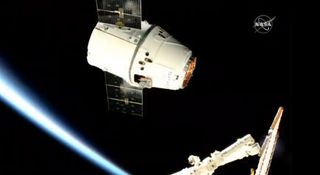
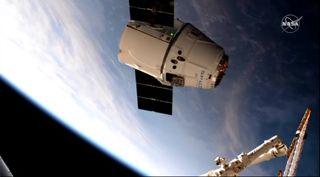
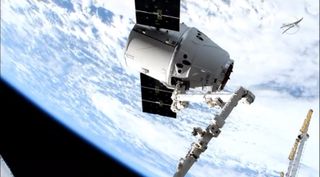
A SpaceX Dragon cargo ship caught up with the International Space Station early Monday and then stood by while Canadian astronaut David Saint-Jacques, operating the lab’s robot arm, locked onto the spacecraft to wrap up a two-day rendezvous.

“Well done, well captured,” a flight controller radioed from the Johnson Space Center in Houston. “Way to make it look easy.”

“To all the teams around the world, we welcome to the ISS the Dragon spacecraft,” Saint-Jacques replied. “Dragon left Cape Canaveral two days ago and brings to ISS more than 2,500 kilos (5,500 pounds) of supplies and scientific equipment for institutions and companies around the world.”

With the Dragon safely in hand, flight controllers at the Johnson Space Center in Houston planned to take over, operating the Canadian-built space crane by remote control to pull the Dragon in for berthing at the Earth-facing port of the station’s forward Harmony module.

“As a Canadian, I’m proud every time we use the Canadarm2 for capture. There’s not always a Canadian crew member on board ISS, but in a way, the Canadian engineers and technicians who built and support Canadarm2 are always on board, if not in body at least in spirit. Their ingenuity … is an inspiration to us all.”

Making its second visit to the space station, the reusable Dragon capsule’s pressurized cabin was packed with food, clothing and personal items for the crew, spare parts, computer gear and 1,600 pounds of science equipment and research material.

Another 2,128 pounds of hardware was mounted in the ship’s unpressurized trunk section, including a sophisticated instrument that will be mounted on a deck outside the Japanese Kibo lab module to monitor carbon dioxide levels in Earth’s atmosphere.

The Dragon is the third cargo ship launched to the space station so far this year following a Russian Progress that reached the lab April 4 and a Northrop Grumman Cygnus that was attached to the central Unity module on April 19. The next cargo run, by another SpaceX Dragon, is planned for July.

Let's block ads! (Why?)


https://spaceflightnow.com/2019/05/06/spacex-cargo-ship-reaches-space-station/

2019-05-06 19:24:22Z
52780285054294

Scientists Think They've Found the Ancient Neutron Star Crash That Showered Our Solar System in Gold - Live Science

[unable to retrieve full-text content]

Scientists Think They've Found the Ancient Neutron Star Crash That Showered Our Solar System in Gold  Live Science

Two astronomers think they've pinpointed the ancient stellar collision that gave our solar system its cache of precious gold and platinum — some of it, anyway.


https://www.livescience.com/65411-neutron-star-collision-rains-bling-on-solar-system.html

2019-05-06 13:02:00Z
CBMiWWh0dHBzOi8vd3d3LmxpdmVzY2llbmNlLmNvbS82NTQxMS1uZXV0cm9uLXN0YXItY29sbGlzaW9uLXJhaW5zLWJsaW5nLW9uLXNvbGFyLXN5c3RlbS5odG1s0gFZaHR0cHM6Ly9hbXAubGl2ZXNjaWVuY2UuY29tLzY1NDExLW5ldXRyb24tc3Rhci1jb2xsaXNpb24tcmFpbnMtYmxpbmctb24tc29sYXItc3lzdGVtLmh0bWw

SpaceX Dragon Delivers NASA Cargo to Space Station - Space.com

A SpaceX Dragon cargo ship arrived at the International Space Station (ISS) today (May 6) to deliver nearly 3 tons of NASA supplies to the orbiting laboratory. 

Astronauts on the station captured the uncrewed Dragon cargo ship with a robotic arm at 7:01 a.m. EDT (1101 GMT) as both spacecraft sailed 254 miles (508 kilometers) above the north Atlantic Ocean. The spacecraft is carrying about 5,500 lbs. ( 2,495 kilograms) of experiments and other supplies for the station's six-person Expedition 59 crew.

"We welcome to ISS the Dragon spacecraft as part of the SpaceX-17 cargo mission," station astronaut David Saint-Jacques of the Canadian Space Agency radioed Mission Control making the catch with the station's Canadian-built Canadarm2 robot arm.

Related: See the Evolution of SpaceX's Rockets in Pictures 

"As a Canadian, I'm proud every time we use Canadarm2 for free-flyer capture," Saint-Jacques added. "My crew and I are proud to be part of this today, representing the dedicated teams of talented people who every day make the seemingly impossible a reality." 

Later today, flight controllers on Earth will wield the station's robotic arm remotely to attach Dragon to an open berth on the station so astronauts can begin unloading supplies.

Image 1 of 8

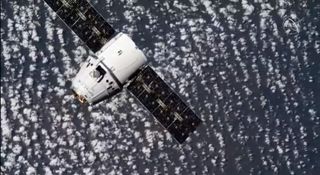
An uncrewed SpaceX Dragon cargo ship makes its second trip to the International Space Station for NASA on the CRS-17 mission in this view captured during rendezvous operations on May 6, 2019.

A SpaceX Dragon cargo ship arrived at the International Space Station on Monday, May 6, 2019 to deliver 5,500 lbs. of supplies.
(Image: © NASA TV)
Image 2 of 8

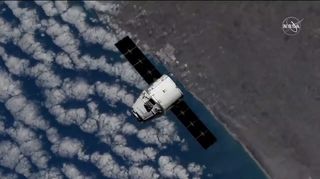
An uncrewed SpaceX Dragon cargo ship makes its second trip to the International Space Station for NASA on the CRS-17 mission in this view captured during rendezvous operations on May 6, 2019.

Mottled clouds and a shoreline form a spectacular background for SpaceX's Dragon cargo ship arrival.
(Image: © NASA TV)
Image 3 of 8

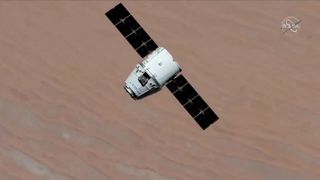
An uncrewed SpaceX Dragon cargo ship makes its second trip to the International Space Station for NASA on the CRS-17 mission in this view captured during rendezvous operations on May 6, 2019.

SpaceX's Dragon soars over a desert region on Earth just before arriving at the International Space Station on May 6, 2019.
(Image: © NASA TV)
Image 4 of 8

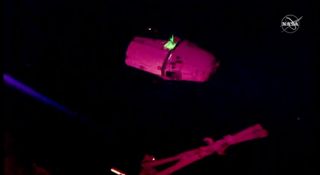
An uncrewed SpaceX Dragon cargo ship makes its second trip to the International Space Station for NASA on the CRS-17 mission in this view captured during rendezvous operations on May 6, 2019.

SpaceX's Dragon is seen in darkness in this nighttime view from the International Space Station during rendezvous activities on May 6, 2019. SpaceX Dragons have red and green indicator lights.
(Image: © NASA TV)
Image 5 of 8

An uncrewed SpaceX Dragon cargo ship makes its second trip to the International Space Station for NASA on the CRS-17 mission in this view captured during rendezvous operations on May 6, 2019.

Sunrise is coming as the Earth's limb shines blue while SpaceX's Dragon is bathed in light. Space station astronauts waited until sunrise for a better view of the Dragon capture.
(Image: © NASA TV)
Image 6 of 8

An uncrewed SpaceX Dragon cargo ship makes its second trip to the International Space Station for NASA on the CRS-17 mission in this view captured during rendezvous operations on May 6, 2019.

A stunning view of Dragon and Earth's clouds painted different colors by an orbital sunrise.
(Image: © NASA TV)
Image 7 of 8

An uncrewed SpaceX Dragon cargo ship makes its second trip to the International Space Station for NASA on the CRS-17 mission in this view captured during rendezvous operations on May 6, 2019.

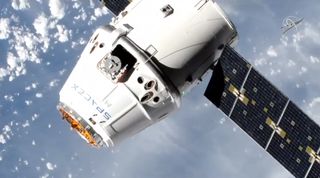
This close-up of the SpaceX-17 Dragon cargo ship shows its lineage. The International Space Station emblem visible just under the "P" in the SpaceX logo indicates it has flown to the station before on the 2017 SpaceX-12 mission.
(Image: © NASA TV)
Image 8 of 8

An uncrewed SpaceX Dragon cargo ship makes its second trip to the International Space Station for NASA on the CRS-17 mission in this view captured during rendezvous operations on May 6, 2019.

Capture! Canadian Space Agency astronaut David Saint-Jacques captured the Dragon spacecraft with the station's Canadarm2 at 7:01 a.m. EDT (1101 GMT) on May 6, 2019.
(Image: © NASA TV)

SpaceX launched the Dragon cargo ship early Saturday (May 4) atop a Falcon 9 rocket from Cape Canaveral Air Force Station in Florida following just over a week of delays. As the spacecraft neared the station today, astronauts spotted a small cable on the craft that was supposed to detach during launch, but it posed no problem for docking, NASA officials said. 

"It's noteworthy that this is the second flight of this particular capsule, which flew the SpaceX-12 mission," Saint-Jacques said. The spacecraft has a small space station emblem on its side indicating that previews flight in 2017.

Dragon's current delivery mission is called CRS-17 by NASA and SpaceX-17 by the company. As that name suggests, it is the seventeenth cargo run for NASA by SpaceX since commercial resupply flights began in 2012.

The spacecraft is carrying a host of new science payloads for use inside and outside the International Space Station.

Among those experiments are NASA's Orbiting Carbon Observatory-3, an instrument to be installed on the station's exterior to track carbon dioxide levels in Earth's atmosphere. The spacecraft is also carrying so-called "tissue chips" to simulate the behavior or human organs in space, as well series of student-designed Genes in Space experiments to study you yeast DNA repairs itself in space.

Dragon will stay linked to the station for about a month before being packed up with experiment samples and other gear and returning to Earth. The spacecraft has a heat shield and parachutes that allow it to survive reentry.

SpaceX is also developing a crewed version of the Dragon spacecraft. The company launched its first Crew Dragon capsule test flight earlier this year and hopes to begin astronaut flights by the end of 2019.

But before those crewed flights can begin, SpaceX must complete an investigation into why its Crew Dragon spacecraft exploded during a ground test of its emergency abort system last month. The April 20 test at a SpaceX landing pad at Cape Canaveral Air Force Station was uncrewed and no injuries were reported. 

Once SpaceX completes that investigation, the Hawthorne, California-based company also plans to launch an in-flight abort test of an uncrewed Crew Dragon spacecraft before attempting its first astronaut mission test flight for NASA.

 Email Tariq Malik at tmalik@space.com or follow him @tariqjmalik. Follow us @Spacedotcom and Facebook.  

Let's block ads! (Why?)


https://www.space.com/spacex-dragon-space-station-arrival-nasa-crs17.html

2019-05-06 11:49:00Z
52780285054294