Kamis, 09 Mei 2019

Giant lasers crystallize water with shockwaves, revealing the atomic structure of superionic ice - Phys.org

Giant lasers crystallize water with shockwaves, revealing the atomic structure of superionic ice
In this artistic rendering of the laser compression experiment, high power lasers focus on the surface of a diamond, generating a sequence of shock waves that propagate throughout the sample assembly (from left to right), simultaneously compressing and heating the initially liquid water sample, forcing it to freeze into the superionic water ice phase. Credit: Millot, Coppari, Hamel, Krauss (LLNL)

Scientists from Lawrence Livermore National Laboratory (LLNL) used giant lasers to flash-freeze water into its exotic superionic phase and record X-ray diffraction patterns to identify its atomic structure for the very first time—all in just a few billionths of a second. The findings are reported today in Nature.

In 1988, scientists first predicted that would transition to an exotic state of matter characterized by the coexistence of a solid lattice of oxygen and liquid-like hydrogen—superionic ice—when subjected to the and temperatures that exist in the interior of water-rich giant planets like Uranus and Neptune. These predictions remained in place until 2018, when a team led by scientists from LLNL presented the first experimental evidence for this strange state of water.

Now, the LLNL scientists describe new results. Using laser-driven shockwaves and in-situ X-ray diffraction, they observe the nucleation of a crystalline lattice of oxygen in a few billionths of a second, revealing for the first time the microscopic structure of superionic ice.

The data also provides further insight into the interior structure of ice giant planets.

"We wanted to determine the atomic structure of superionic water," said LLNL physicist Federica Coppari, co-lead author of the paper. "But given the at which this elusive state of matter is predicted to be stable, compressing water to such pressures and temperatures and simultaneously taking snapshots of the atomic structure was an extremely difficult task, which required an innovative experimental design."

The researchers performed a series of experiments at the Omega Laser Facility at the University of Rochester's Laboratory for Laser Energetics (LLE). They used six giant laser beams to generate a sequence of shockwaves of progressively increasing intensity to compress a of initially liquid water to extreme pressures (100-400 gigapascals (GPa), or 1-4 million times Earth's atmospheric pressure) and temperatures (3,000-5,000 degrees Fahrenheit).

"We designed the experiments to compress the water so that it would freeze into solid ice, but it was not certain that the ice crystals would actually form and grow in the few billionths of a second that we can hold the pressure-temperature conditions," said LLNL physicist and co-lead author Marius Millot.

Giant lasers crystallize water with shockwaves, revealing the atomic structure of superionic ice
In this time-integrated photograph of an X-ray diffraction experiment, giant lasers focus on the water sample, sitting on the front plate of the diagnostic used to record diffraction patterns, to compress it into the superionic phase. Additional laser beams generate an X-ray flash off an iron foil that allows the researchers to take a snapshot of the compress/hot water layer. Diagnostics monitor the time history of the laser pulses and the brightness of the emitted X-ray source. Credit: Millot, Coppari, Kowaluk (LLNL)

To document the crystallization and identify the atomic structure, the team blasted a tiny iron foil with 16 additional laser pulses to create a hot plasma, which generated a flash of X-rays precisely timed to illuminate the compressed water sample once brought into the predicted stability domain of superionic ice.

"The X-ray diffraction patterns we measured are an unambiguous signature for dense ice crystals forming during the ultrafast shockwave compression demonstrating that nucleation of solid ice from liquid water is fast enough to be observed in the nanosecond timescale of the experiment," Coppari said.

"In the previous work we could only measure macroscopic properties such as internal energy and temperature," Millot added. "Therefore, we designed a new and different experiment to document the atomic structure. Finding direct evidence for the existence of crystalline lattice of oxygen brings the last missing piece to the puzzle regarding the existence of superionic water ice. This gives additional strength to the evidence for the existence of superionic ice we collected last year."

Analyzing how the X-ray diffraction patterns varied for the different experiments probing increased pressure and temperature conditions, the team identified a phase transition to a previously unknown face-centered-cubic (f.c.c.) for dense water ice.

"Water is known to have many different crystalline structures known as ice Ih, II, III, up to XVII," Coppari said. "So, we propose to call the new f.c.c. solid form 'ice XVIII.' Computer simulations have proposed a number of different possible crystalline structures for superionic ice. Our study provides a critical test to numerical methods."

The team's data has profound implications for the interior structure of ice giant planets. Since superionic ice is ultimately a solid, the idea of these planets having a uniform rapidly convecting fluid layer no longer holds.

"Because water ice at Uranus and Neptune's interior conditions has a crystalline lattice, we argue that superionic ice should not flow like a liquid such as the fluid iron outer core of the Earth. Rather, it's probably better to picture that superionic ice would flow similarly to the Earth's mantle, which is made of solid rock, yet flows and supports large-scale convective motions on the very long geological timescales," Millot said. "This can dramatically affect our understanding of the internal structure and the evolution of the icy giant planets, as well as all their numerous extrasolar cousins."


Explore further

First experimental evidence for superionic ice

More information: Marius Millot et al. Nanosecond X-ray diffraction of shock-compressed superionic water ice, Nature (2019). DOI: 10.1038/s41586-019-1114-6

Marius Millot et al. Experimental evidence for superionic water ice using shock compression, Nature Physics (2018). DOI: 10.1038/s41567-017-0017-4

Citation: Giant lasers crystallize water with shockwaves, revealing the atomic structure of superionic ice (2019, May 9) retrieved 9 May 2019 from https://phys.org/news/2019-05-giant-lasers-crystallize-shockwaves-revealing.html

This document is subject to copyright. Apart from any fair dealing for the purpose of private study or research, no part may be reproduced without the written permission. The content is provided for information purposes only.

Let's block ads! (Why?)


https://phys.org/news/2019-05-giant-lasers-crystallize-shockwaves-revealing.html

2019-05-09 08:41:42Z
CAIiEC2zE7jOsWIzftXNgRr5AJUqFwgEKg8IACoHCAowpbDpAzCm_hwwj9kp

Scientists Just Revealed a Brand New Type of Endlessly Recyclable Plastic - ScienceAlert

In a perfect world, plastic would never be on a one-way trip into landfill - it's a vision we've strived to realise for decades. Unfortunately, some plastics just don't recycle as easily as others, limiting how well we can reuse them in new products. But a new kind of plastic might help change all that.

Researchers at the US Department of Energy's Lawrence Berkeley National Laboratory have designed a new kind of plastic polymer that can be broken down and built up again with the simplicity of a molecular Lego brick.

"Most plastics were never made to be recycled," says chemist Peter Christensen.

"But we have discovered a new way to assemble plastics that takes recycling into consideration from a molecular perspective."

All plastics are more or less repeating units – or monomers – of compounds derived from an organic substance like petroleum.

That stringy web of molecules can be mixed with a wide variety of chemicals, giving plastics diverse properties that allow us to use them for just about anything from shopping bags to clothing, to straws, and furniture.

To the eternal confusion of consumers everywhere, some of those plastics can be broken down into components and recycled relatively easily. But not all. We might be able to throw our polyethylene terephthalate (PET) drink bottles into the recycling bin, but not a tough, thermoset plastic toy or utensil.

Many plastics suffer from those additives that cling to the molecular chains to colour, soften, or harden them, making for an unpredictable mess of ingredients to convert into a durable product we can easily afford.

Researchers have made some headway on redesigning thermoset plastics to become recyclable, but to really solve our growing plastics crisis we need to make the process as efficient and simple as possible, and the new type of plastic developed at the Berkeley Lab has the potential to meet such demands.

Its building block is a monomer called diketoenamine: a compound formed by sticking a triketone to an amine.

Condensing these units into a long string forms a plastic called poly(diketoenamine) – or PDK – and the bonds can be dissolved with ease using nothing more than a 12-hour soak in a strong acid bath.

"With PDKs, the immutable bonds of conventional plastics are replaced with reversible bonds that allow the plastic to be recycled more effectively," says chemist and team leader Brett Helms.

By breaking the polymers down easily, the plastic's core units can be separated from any additives over and over again in what is described as a closed-loop cycle.

The researchers tested the recovery process by contaminating PDK and acid solutions with other substances, including fibreglass and flame-retardant chemicals, finding the additives had little impact on their diketoenamine harvest.

The end result is a plastic ingredient that can shake off any colours or strengthening agents in several easy steps to be turned back into another product.

"We're interested in the chemistry that redirects plastic lifecycles from linear to circular," said Helms.

"We see an opportunity to make a difference for where there are no recycling options."

Right now, most of our recycling efforts are abysmal. While some countries are doing all they can, countries like the US are barely managing to recycle a quarter of their PET waste.

Governments can always do their bit to enforce action, but at the end of the day, money talks. Earlier this year, researchers showed how we might be able to turn plastic into a far more lucrative resource: fuel.

Any methods we can find to make recycling easy for the consumer and appealing to the manufacturer are worth investigating.

We're of course a long way from sending our PDK forks to an acid tank at our local recycling plant. Further research is needed to test the polymer's suitability for various applications. Nobody wants a bendy plastic knife or a brittle shopping bag, no matter how recyclable it is.

But whatever the results, this is what the future of plastics looks like – and we need it urgently.

This research was published in Nature Chemistry.

Let's block ads! (Why?)


https://www.sciencealert.com/at-last-we-have-a-plastic-that-can-be-efficiently-recycled-over-and-over-again

2019-05-09 06:41:43Z
52780288899040

$2.5 trillion 'Holy Grail' found? Breakthrough discovery could lead to 100 percent recyclable plastics, scientists say - Fox News

Plastic pollution in the world's oceans may have a $2.5 trillion impact, negatively affecting "almost all marine ecosystem services," including areas such as fisheries, recreation and heritage. But a breakthrough from scientists at Berkeley Lab could be the solution the planet needs for this eye-opening problem – recyclable plastics.

The study, published in Nature Chemistry, details how the researchers were able to discover a new way to assemble the plastics and reuse them "into new materials of any color, shape, or form."

“Most plastics were never made to be recycled,” said lead author Peter Christensen, a postdoctoral researcher at Berkeley Lab’s Molecular Foundry, in the statement. “But we have discovered a new way to assemble plastics that takes recycling into consideration from a molecular perspective.”

PLASTIC POLLUTION IN WORLDS' OCEANS COULD HAVE $2.5 TRILLION IMPACT, STUDY SAYS

Known as poly(diketoenamine), or PDK, the new type of plastic material could help stem the tide of plastics piling up at recycling plants, as the bonds PDK forms are able to be reversed via a simple acid bath, the researchers believe.

"Poly(diketoenamine)s ‘click’ together from a wide variety of triketones and aromatic or aliphatic amines, yielding only water as a by-product," the study's abstract reads. "Recovered monomers can be re-manufactured into the same polymer formulation, without loss of performance, as well as other polymer formulations with differentiated properties. The ease with which poly(diketoenamine)s can be manufactured, used, recycled and re-used—without losing value—points to new directions in designing sustainable polymers with minimal environmental impact."

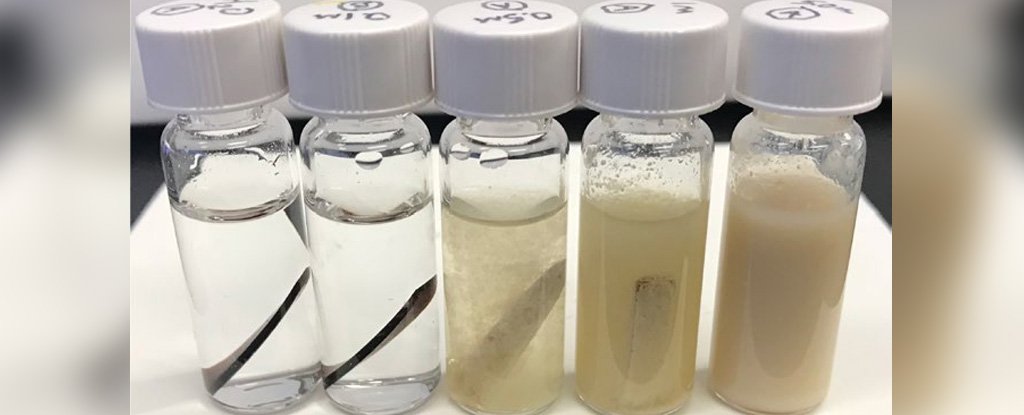
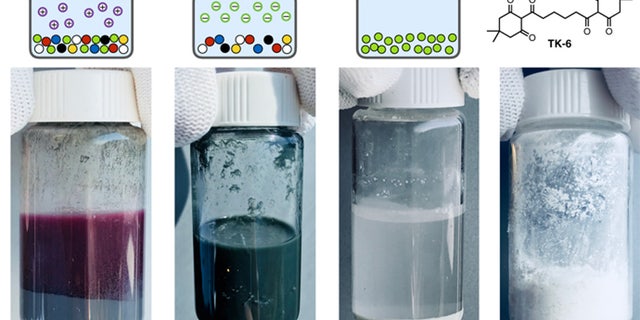
Unlike conventional plastics, the monomers of PDK plastic could be recovered and freed from any compounded additives simply by dunking the material in a highly acidic solution. (Credit: Peter Christensen et al./Berkeley Lab)

Unlike conventional plastics, the monomers of PDK plastic could be recovered and freed from any compounded additives simply by dunking the material in a highly acidic solution. (Credit: Peter Christensen et al./Berkeley Lab)

A byproduct of petroleum, plastic is inherently made up of molecules known as polymers that are composed of carbon-containing compounds known as monomers. Once chemicals are added to the plastic for use and consumption, the monomers bind with the chemicals and make it difficult to be processed at recycling plants, the researchers said.

When the plastics are chopped up in an effort to make new products, it's difficult to predict "which properties it will inherit from the original plastics," the researchers added.

Prior to the discovery, the unpredictableness of the properties had made it nearly impossible to perform what has been coined "the Holy Grail of recycling:" a "circular" material that can be used over and over again for any number of products, including adhesives, phone cases, computer cables and more.

“Circular plastics and plastics upcycling are grand challenges,” said Brett Helms, a staff scientist in Berkeley Lab’s Molecular Foundry, in the statement. “We’ve already seen the impact of plastic waste leaking into our aquatic ecosystems, and this trend is likely to be exacerbated by the increasing amounts of plastics being manufactured and the downstream pressure it places on our municipal recycling infrastructure.”

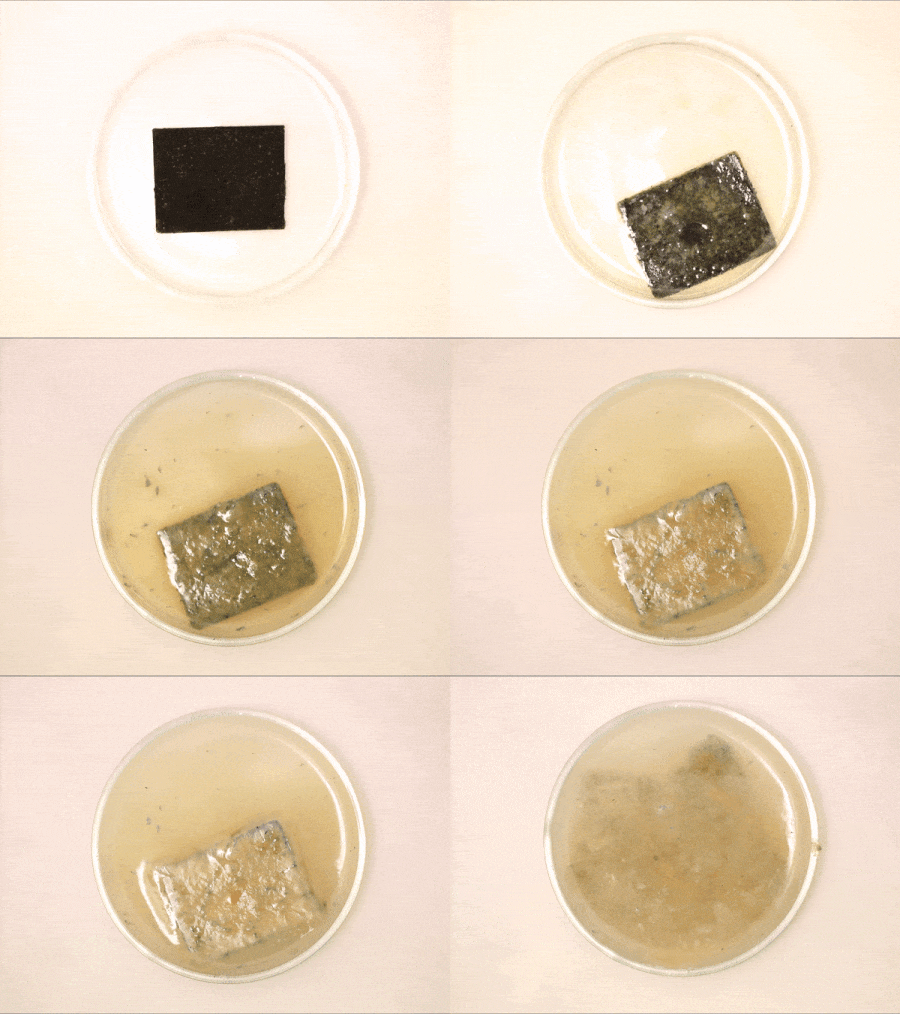
This time-lapse video shows a piece of PDK plastic in acid as it degrades to its molecular building blocks – monomers. The acid helps to break the bonds between the monomers and separate them from the chemical additives that give plastic its look and feel. (Credit: Peter Christensen/ Berkeley Lab)

This time-lapse video shows a piece of PDK plastic in acid as it degrades to its molecular building blocks – monomers. The acid helps to break the bonds between the monomers and separate them from the chemical additives that give plastic its look and feel. (Credit: Peter Christensen/ Berkeley Lab)

Though PDK only exists in the lab currently (meaning products won't be available for purchase for some time), the researchers are nonetheless excited by what they've discovered and the potential positive impact it could have.

“With PDKs, the immutable bonds of conventional plastics are replaced with reversible bonds that allow the plastic to be recycled more effectively,” Helms added. "We’re interested in the chemistry that redirects plastic lifecycles from linear to circular. We see an opportunity to make a difference for where there are no recycling options.”

MELTING PERMAFROST IN ARCTIC WILL HAVE $70 TRILLION IMPACT, NEW STUDY SAYS

Plastic reuse 

Plastic recycling figures are trending down, making breakthroughs in recyclable plastic all the more important. According to the latest publicly available data, only 9.1 percent of the plastic created in the U.S. in 2015 was recycled, down from 9.5 percent in 2014, according to the EPA.

Last month, a separate study estimated that the pollution caused by plastics in the world's oceans amounted to a $2.5 trillion problem that every country in the world has to deal with. The estimate did not take into account the impact on sectors of the global economy such as tourism, transport, fisheries and human health, the researchers wrote.

"An ecosystem impact analysis demonstrates that there is global evidence of impact with medium to high frequency on all subjects, with a medium to high degree of irreversibility," the study's abstract reads, with the researchers adding that they looked at nearly 1,200 data points to come up with their conclusions.

PREGNANT WHALE FOUND DEAD IN ITALY WITH 49 POUNDS OF PLASTIC IN STOMACH

Despite several efforts of countries around the world to reduce or stop the use of plastic altogether, the amount of plastic in the world's oceans is increasing, and spreading across the planet.

A separate study, published in Nature on April 16, is the first study "to confirm a significant increase in open ocean plastics in recent decades," going back nearly 60 years. Researchers found a plastic bag that had been snared on Ireland's coast since 1965 and is possibly the first piece of plastic pollution ever found, according to the BBC.

That study was based off a 2015 investigation that estimated there were between 4.8 trillion and 12.7 trillion pieces of plastic entering the ocean every year.

CLICK HERE FOR THE FOX NEWS APP

Let's block ads! (Why?)


https://www.foxnews.com/science/holy-grail-recyclable-plastics

2019-05-08 22:33:55Z
52780288899040

Rabu, 08 Mei 2019

In This Doctor's Office, a Physical Exam Like No Other - The New York Times

To scientists like Michael Snyder, chair of the genetics department at Stanford University, the future of medicine is data — lots and lots of data.

He and others predict that one day doctors won’t just take your blood pressure and check your temperature. They will scrutinize your genome for risk factors and track tens of thousands of molecules active in your body.

By doing so, the doctors of the future will identify diseases, and treat them, long before symptoms appear.

The approach has a number of critics, who say it will never be cost-effective and will instead lead to wild overtreatment of anxious patients.

But on Wednesday, Dr. Snyder and his colleagues published a study suggesting that big data may succeed where conventional medicine fails.

In 109 volunteers whose bodies were closely tracked and analyzed, the researchers discovered a host of hidden conditions that required medical attention, including diabetes and heart disease.

“It turns out 53 out of 109 people learned something really, really important from doing these deep profiles,” Dr. Snyder said.

The research offers an unprecedented look at how common diseases may arise in different people along different molecular paths, said Ali Torkamani, director of genome informatics at Scripps Research Translational Institute, who was not involved in the new study.

Once doctors are able to record genetic activity in their patients, “then you could start thinking about more rational ways of intervening,” he added.

[Like the Science Times page on Facebook. | Sign up for the Science Times newsletter.]

The new study is the result of a remarkable scientific journey.

For a decade, Dr. Snyder has been trying to learn everything he can about his own body, down to its molecular building blocks. He has turned himself into a big-data guinea pig.

First, he and his colleagues sequenced his genome. Dr. Snyder learned to his surprise that he had several mutations linked to diabetes. The team analyzed his blood over the course of 14 months, tracking 40,000 molecules.

In 2011, that monitoring revealed that Dr. Snyder was indeed developing diabetes. He started treating the condition, and his symptoms improved.

In 2012, when Dr. Snyder and his colleagues published a study describing these efforts, no one had seen anything quite like it.

Along with his genome (all his genes), Dr. Snyder published his transcriptome (the molecular signature of which of his genes were active), his proteome (all the new proteins his body produced), and his metabolome (all the molecules involved in his metabolism).

One colleague jokingly said that Dr. Snyder had produced something new: “the narciss-ome.”

Many scientists hailed it as a proof of principle for a new way of treating patients, an approach sometimes called precision medicine.

Image
Dr. Snyder, chair of the genetics department at Stanford University. Intense genetic analysis turned up early signs of diabetes in the researcher.CreditPaul Sakuma/Stanford School of Medicine

By vacuuming up data with the latest technologies, doctors one day may produce a razor-sharp picture of each patient’s health, and then devise individualized treatments when illness appears.

It was a seductive prospect. When Dr. Snyder decided to launch a larger project, he had little trouble attracting 108 other volunteers.

He and his colleagues started by sequencing each subject’s genome and performing in-depth physicals. Every three months, the volunteers returned to Stanford to give blood, urine, stool and cheek swabs. Some wore continuous glucose monitors, and some wore heartbeat trackers on their wrists.

The initial exams revealed a number of conditions. Eighteen people were diagnosed with Stage II hypertension. One volunteer had full-blown diabetes, without having ever been diagnosed with pre-diabetes in conventional exams.

Genome sequencing also revealed medical insights. One subject who suffered recurring strokes turned out to be taking the wrong medication, thanks to a mutation that made the drug ineffective.

Other volunteers discovered they had mutations that may cause serious illness. One had a genetic variant linked to enlarged, weakened heart muscles. An imaging test revealed the volunteer’s heart was indeed defective.

The researchers then analyzed the data they gathered from each patient to determine their healthy baselines.

In standard medicine, researchers determine baselines by taking an average across thousands of people. But while the average body temperature, for example, is around 98.6 degrees, that doesn’t mean that it’s normal for a given individual.

Some people just run hot or cold. To determine whether a patient’s temperature change might indicate illness, a doctor needs an individualized baseline.

Dr. Snyder and his colleagues worked out healthy baselines for each patient — not just for body temperature, but heart rate and balances of various proteins.

Some subjects veered from their baselines as they were struck by illnesses, the researchers found. One volunteer underwent such a shift before getting diagnosed with lymphoma.

“We were able to go back and see molecules that were clearly starting to rise months before the diagnosis and then dropped with treatment,” said Sophia Miryam Schüssler-Fiorenza Rose, an instructor in neurosurgery at Stanford who was the lead author of the study.

“We think these might be very valuable early markers of disease,” she said.

Nine volunteers developed diabetes, but they reached that diagnosis by different paths. The condition worsened in two volunteers as they gained weight, but seven developed diabetes without getting fat.

Some turned out to produce very little insulin; others produced enough insulin, but it failed to lower their levels of glucose.

“We learned that people are Type 2 diabetic in very different ways,” said Dr. Snyder.

Dr. Snyder and his colleagues argue that examining the genomes of patients and carefully tracking them will make people healthier. Doctors will be able to catch diseases earlier, and treat them more precisely.

But critics questioned whether Dr. Snyder’s big-data firehouse will actually make patients healthier — or just leave them floating in a sea of uncertainty and anxiety.

“They carpet-bomb the body with tests and basically assume that the discovery of everything they hit is beneficial,” said Dr. Henrik Vogt, a postdoctoral researcher at the University of Oslo. “But there may be lots of collateral damage they don’t consider.”

Dr. Vogt, an outspoken critic of precision medicine, also noted Dr. Snyder and his colleagues did not compare the outcomes of their volunteers to people who were getting standard medical care. The extra cost and effort might not have led to comparatively better health.

“It’s hard to know what the results mean,” Dr. Vogt said.

Those criticisms haven’t stopped scientists from starting up companies that offer “deep profiles” to people who are willing to foot the bill. Dr. Snyder, for example, co-founded a company called Q, which promises “a comprehensive picture of your health — in 75 minutes or less.”

But precision medicine is proving to be a tough sell. In April, one well-financed start-up called Arivale abruptly shut down. “The cost of providing the service exceeds what our customers can pay for it,” the company announced.

Karen Meagher, a bioethicist at the Mayo Clinic who was not involved in the new study, cautioned that these are still early days for precision medicine.

She wondered if most patients could manage constant monitoring as well as Dr. Snyder’s volunteers. “Some people are going to be really overwhelmed by the technology,” Dr. Meagher said.

Dr. Vogt was even more skeptical.

“The approach is unlikely to work for people most in need — those who are poor, are barely hanging on, and have other things to worry about than monitoring themselves constantly,” he said.

Tracking the biological workings of his own body for a decade has been enlightening for Dr. Snyder, but far from a panacea.

After learning he had diabetes in 2011, he managed to keep his blood sugar levels in check for three years. In 2014, he crossed back over the line again.

“It turns out I’m slow in releasing insulin,” he said. “We can see exactly where my defect is.”

That finding led one doctor to suggest Dr. Snyder take medications that boost the release of insulin. Another recommended a drug that helps expel sugar from the body.

Five years after his second diagnosis, he still has diabetes. For now, he is trying long walks after eating instead of new drugs.

“I like to only change one variable at a time, so I can understand what is going on,” he said.

Let's block ads! (Why?)


https://www.nytimes.com/2019/05/08/science/precision-medicine-overtreatment.html

2019-05-08 17:14:17Z
CAIiEFfJsHDFOFu6wSy9UTHQ_fgqFwgEKg8IACoHCAowjuuKAzCWrzwwpoEY

$2.5 trillion 'Holy Grail' found? Breakthrough discovery could lead to 100 percent recyclable plastics, scientists say - Fox News

Plastic pollution in the world's oceans may have a $2.5 trillion impact, negatively affecting "almost all marine ecosystem services," including areas such as fisheries, recreation and heritage. But a breakthrough from scientists at Berkeley Lab could be the solution the planet needs for this eye-opening problem – recyclable plastics.

The study, published in Nature Chemistry, details how the researchers were able to discover a new way to assemble the plastics and reuse them "into new materials of any color, shape, or form."

“Most plastics were never made to be recycled,” said lead author Peter Christensen, a postdoctoral researcher at Berkeley Lab’s Molecular Foundry, in the statement. “But we have discovered a new way to assemble plastics that takes recycling into consideration from a molecular perspective.”

PLASTIC POLLUTION IN WORLDS' OCEANS COULD HAVE $2.5 TRILLION IMPACT, STUDY SAYS

Known as poly(diketoenamine), or PDK, the new type of plastic material could help stem the tide of plastics piling up at recycling plants, as the bonds PDK forms are able to be reversed via a simple acid bath, the researchers believe.

"Poly(diketoenamine)s ‘click’ together from a wide variety of triketones and aromatic or aliphatic amines, yielding only water as a by-product," the study's abstract reads. "Recovered monomers can be re-manufactured into the same polymer formulation, without loss of performance, as well as other polymer formulations with differentiated properties. The ease with which poly(diketoenamine)s can be manufactured, used, recycled and re-used—without losing value—points to new directions in designing sustainable polymers with minimal environmental impact."

Unlike conventional plastics, the monomers of PDK plastic could be recovered and freed from any compounded additives simply by dunking the material in a highly acidic solution. (Credit: Peter Christensen et al./Berkeley Lab)

Unlike conventional plastics, the monomers of PDK plastic could be recovered and freed from any compounded additives simply by dunking the material in a highly acidic solution. (Credit: Peter Christensen et al./Berkeley Lab)

A byproduct of petroleum, plastic is inherently made up of molecules known as polymers that are composed of carbon-containing compounds known as monomers. Once chemicals are added to the plastic for use and consumption, the monomers bind with the chemicals and make it difficult to be processed at recycling plants, the researchers said.

When the plastics are chopped up in an effort to make new products, it's difficult to predict "which properties it will inherit from the original plastics," the researchers added.

Prior to the discovery, the unpredictableness of the properties had made it nearly impossible to perform what has been coined "the Holy Grail of recycling:" a "circular" material that can be used over and over again for any number of products, including adhesives, phone cases, computer cables and more.

“Circular plastics and plastics upcycling are grand challenges,” said Brett Helms, a staff scientist in Berkeley Lab’s Molecular Foundry, in the statement. “We’ve already seen the impact of plastic waste leaking into our aquatic ecosystems, and this trend is likely to be exacerbated by the increasing amounts of plastics being manufactured and the downstream pressure it places on our municipal recycling infrastructure.”

This time-lapse video shows a piece of PDK plastic in acid as it degrades to its molecular building blocks – monomers. The acid helps to break the bonds between the monomers and separate them from the chemical additives that give plastic its look and feel. (Credit: Peter Christensen/ Berkeley Lab)

This time-lapse video shows a piece of PDK plastic in acid as it degrades to its molecular building blocks – monomers. The acid helps to break the bonds between the monomers and separate them from the chemical additives that give plastic its look and feel. (Credit: Peter Christensen/ Berkeley Lab)

Though PDK only exists in the lab currently (meaning products won't be available for purchase for some time), the researchers are nonetheless excited by what they've discovered and the potential positive impact it could have.

“With PDKs, the immutable bonds of conventional plastics are replaced with reversible bonds that allow the plastic to be recycled more effectively,” Helms added. "We’re interested in the chemistry that redirects plastic lifecycles from linear to circular. We see an opportunity to make a difference for where there are no recycling options.”

MELTING PERMAFROST IN ARCTIC WILL HAVE $70 TRILLION IMPACT, NEW STUDY SAYS

Plastic reuse 

Plastic recycling figures are trending down, making breakthroughs in recyclable plastic all the more important. According to the latest publicly available data, only 9.1 percent of the plastic created in the U.S. in 2015 was recycled, down from 9.5 percent in 2014, according to the EPA.

Last month, a separate study estimated that the pollution caused by plastics in the world's oceans amounted to a $2.5 trillion problem that every country in the world has to deal with. The estimate did not take into account the impact on sectors of the global economy such as tourism, transport, fisheries and human health, the researchers wrote.

"An ecosystem impact analysis demonstrates that there is global evidence of impact with medium to high frequency on all subjects, with a medium to high degree of irreversibility," the study's abstract reads, with the researchers adding that they looked at nearly 1,200 data points to come up with their conclusions.

PREGNANT WHALE FOUND DEAD IN ITALY WITH 49 POUNDS OF PLASTIC IN STOMACH

Despite several efforts of countries around the world to reduce or stop the use of plastic altogether, the amount of plastic in the world's oceans is increasing, and spreading across the planet.

A separate study, published in Nature on April 16, is the first study "to confirm a significant increase in open ocean plastics in recent decades," going back nearly 60 years. Researchers found a plastic bag that had been snared on Ireland's coast since 1965 and is possibly the first piece of plastic pollution ever found, according to the BBC.

That study was based off a 2015 investigation that estimated there were between 4.8 trillion and 12.7 trillion pieces of plastic entering the ocean every year.

CLICK HERE FOR THE FOX NEWS APP

Let's block ads! (Why?)


https://www.foxnews.com/science/holy-grail-recyclable-plastics

2019-05-08 15:29:29Z
52780288899040

$2.5 trillion 'Holy Grail' found? Breakthrough discovery could lead to 100 percent recyclable plastics, scientists say - Fox News

Plastic pollution in the world's oceans may have a $2.5 trillion impact, negatively affecting "almost all marine ecosystem services," including areas such as fisheries, recreation and heritage. But a breakthrough from scientists at Berkeley Lab could be the solution the planet needs for this eye-opening problem – recyclable plastics.

The study, published in Nature Chemistry, details how the researchers were able to discover a new way to assemble the plastics and reuse them "into new materials of any color, shape, or form."

“Most plastics were never made to be recycled,” said lead author Peter Christensen, a postdoctoral researcher at Berkeley Lab’s Molecular Foundry, in the statement. “But we have discovered a new way to assemble plastics that takes recycling into consideration from a molecular perspective.”

PLASTIC POLLUTION IN WORLDS' OCEANS COULD HAVE $2.5 TRILLION IMPACT, STUDY SAYS

Known as poly(diketoenamine), or PDK, the new type of plastic material could help stem the tide of plastics piling up at recycling plants, as the bonds PDK forms are able to be reversed via a simple acid bath, the researchers believe.

"Poly(diketoenamine)s ‘click’ together from a wide variety of triketones and aromatic or aliphatic amines, yielding only water as a by-product," the study's abstract reads. "Recovered monomers can be re-manufactured into the same polymer formulation, without loss of performance, as well as other polymer formulations with differentiated properties. The ease with which poly(diketoenamine)s can be manufactured, used, recycled and re-used—without losing value—points to new directions in designing sustainable polymers with minimal environmental impact."

Unlike conventional plastics, the monomers of PDK plastic could be recovered and freed from any compounded additives simply by dunking the material in a highly acidic solution. (Credit: Peter Christensen et al./Berkeley Lab)

Unlike conventional plastics, the monomers of PDK plastic could be recovered and freed from any compounded additives simply by dunking the material in a highly acidic solution. (Credit: Peter Christensen et al./Berkeley Lab)

A byproduct of petroleum, plastic is inherently made up of molecules known as polymers that are composed of carbon-containing compounds known as monomers. Once chemicals are added to the plastic for use and consumption, the monomers bind with the chemicals and make it difficult to be processed at recycling plants, the researchers said.

When the plastics are chopped up in an effort to make new products, it's difficult to predict "which properties it will inherit from the original plastics," the researchers added.

Prior to the discovery, the unpredictableness of the properties had made it nearly impossible to perform what has been coined "the Holy Grail of recycling:" a "circular" material that can be used over and over again for any number of products, including adhesives, phone cases, computer cables and more.

“Circular plastics and plastics upcycling are grand challenges,” said Brett Helms, a staff scientist in Berkeley Lab’s Molecular Foundry, in the statement. “We’ve already seen the impact of plastic waste leaking into our aquatic ecosystems, and this trend is likely to be exacerbated by the increasing amounts of plastics being manufactured and the downstream pressure it places on our municipal recycling infrastructure.”

This time-lapse video shows a piece of PDK plastic in acid as it degrades to its molecular building blocks – monomers. The acid helps to break the bonds between the monomers and separate them from the chemical additives that give plastic its look and feel. (Credit: Peter Christensen/ Berkeley Lab)

This time-lapse video shows a piece of PDK plastic in acid as it degrades to its molecular building blocks – monomers. The acid helps to break the bonds between the monomers and separate them from the chemical additives that give plastic its look and feel. (Credit: Peter Christensen/ Berkeley Lab)

Though PDK only exists in the lab currently (meaning products won't be available for purchase for some time), the researchers are nonetheless excited by what they've discovered and the potential positive impact it could have.

“With PDKs, the immutable bonds of conventional plastics are replaced with reversible bonds that allow the plastic to be recycled more effectively,” Helms added. "We’re interested in the chemistry that redirects plastic lifecycles from linear to circular. We see an opportunity to make a difference for where there are no recycling options.”

MELTING PERMAFROST IN ARCTIC WILL HAVE $70 TRILLION IMPACT, NEW STUDY SAYS

Plastic reuse 

Plastic recycling figures are trending down, making breakthroughs in recyclable plastic all the more important. According to the latest publicly available data, only 9.1 percent of the plastic created in the U.S. in 2015 was recycled, down from 9.5 percent in 2014, according to the EPA.

Last month, a separate study estimated that the pollution caused by plastics in the world's oceans amounted to a $2.5 trillion problem that every country in the world has to deal with. The estimate did not take into account the impact on sectors of the global economy such as tourism, transport, fisheries and human health, the researchers wrote.

"An ecosystem impact analysis demonstrates that there is global evidence of impact with medium to high frequency on all subjects, with a medium to high degree of irreversibility," the study's abstract reads, with the researchers adding that they looked at nearly 1,200 data points to come up with their conclusions.

PREGNANT WHALE FOUND DEAD IN ITALY WITH 49 POUNDS OF PLASTIC IN STOMACH

Despite several efforts of countries around the world to reduce or stop the use of plastic altogether, the amount of plastic in the world's oceans is increasing, and spreading across the planet.

A separate study, published in Nature on April 16, is the first study "to confirm a significant increase in open ocean plastics in recent decades," going back nearly 60 years. Researchers found a plastic bag that had been snared on Ireland's coast since 1965 and is possibly the first piece of plastic pollution ever found, according to the BBC.

That study was based off a 2015 investigation that estimated there were between 4.8 trillion and 12.7 trillion pieces of plastic entering the ocean every year.

CLICK HERE FOR THE FOX NEWS APP

Let's block ads! (Why?)


https://www.foxnews.com/science/holy-grail-recyclable-plastics

2019-05-08 15:28:36Z
52780288899040

Researchers violate Bell's inequality with remotely connected superconducting qubits - Phys.org

Researchers violate Bell’s inequality with remotely connected superconducting qubits
Credit: Youpeng Zhong (2019).

The efficient generation of entanglement between remote quantum nodes is a crucial step in securing quantum communications. In past research, entanglement has often been achieved using a number of different probabilistic schemes.

Recently, some studies have also offered demonstrations of deterministic remote entanglement using approaches based on . Nonetheless, the deterministic violation of Bell's inequality (a strong measure of quantum correlation) in a superconducting quantum communication architecture has so far never been demonstrated.

A team of researchers based at the University of Chicago has recently demonstrated a violation of Bell's inequality using remotely connected superconducting qubits. Their paper, published in Nature Physics, introduces a simple and yet robust architecture for achieving this benchmark result in a superconducting system.

"There is a lot of interest and activity in developing experimental systems where can be used for information processing (e.g. communication, computation, etc.) and sensing," Andrew Cleland, one of the researchers who carried out the study, told Phys.org. "The heart of a quantum information system is a qubit, and uniqueness comes from the quantum states you can store in it, as well as the more complex quantum states you can store using multiple qubits. We were interested in exploring the transmission of quantum information and quantum states—the fundamentals for quantum communication."

Quantum states, as well as the information that is stored within them, are incredibly delicate, far more than classical states and classically stored information. Although theoretically, there are ways to correct errors in a , one can typically fix only small errors; hence, the communication of a quantum state needs to be done with very high precision. The high fidelity transmission of a quantum state has so far been achieved using a limited number of methods.

"We wanted to see if we could use some of the best qubits that are available, superconducting qubits, and the best tools for coupling superconducting qubits to communication (transmission) lines, to show we could transmit quantum states with very high precision (i.e. fidelity)," Cleland said.

In quantum physics, the 'gold standard' for testing a certain class of quantum states is Bell's inequality. Essentially, a specific set of measurements of a property of a quantum state (usually written as "S") can exceed a classically limited value of two only if the quantum state is prepared, communicated and measured with high levels of precision.

"Errors made in preparing, transmitting or measuring the quantum state will tend to make the state more classical, and make it harder to exceed the classical limit of two," Cleland explained. "Exceeding this limit is called a violation of a Bell inequality, and is a proof of 'quantum-ness'. This was the measure we set out to achieve, by measuring S for a quantum state using a very precise generation, transmission, and capture of quantum information between two qubits. Happily, we were able to do this."

In their experiment, Cleland and his colleagues used two superconducting qubits connected to one another via an approximately 1-meter-long transmission line. The quantum information was transmitted along this line using microwaves (similar to radio signals), with a frequency similar to that cell phones use to communicate.

"Very importantly, we also had electrically controlled 'couplers' between each qubit and the line," Cleland said. "These couplers are very important, because they allow us to control the coupling of the qubits to the line very rapidly, using classical electrical signals."

These electrically controlled couplers are a key component of the researchers' experiment, as they allowed them to 'shape' the coupling in time very precisely. These couplers ensured that the microwaves carrying the quantum information were transmitted between the two qubits in precisely the right way. This ultimately made sure that the quantum information was sent and received with minimal errors.

"Our experiment shows that very precise quantum information can be sent along a communication path that is quite long, in our case nearly one meter in length," Cleland explained. "The method we used would work with any length line. This demonstrates that the theoretical methods that had been worked out for this nearly error-free transmission are correct, and holds great promise for future quantum communication systems."

The study carried out by Cleland and his colleagues introduced a simple but effective method to achieve a violation in Bell's inequality using remote superconducting qubits. However, as the qubits used in their experiment communicate with microwaves, their method only works at very low temperatures. To communicate quantum information through air, the researchers would need to develop new techniques that can attain similar results using infrared or visible light.

"We are now planning on doing more complex versions of this experiment, using more qubits and more transmission lines, to test out more advanced theories for quantum communication and quantum error correction," Cleland said. "We are also developing methods to try to do the same thing with infrared light, so the signals can be sent through an optical fiber, or through space."


Explore further

Scientists connect quantum bits with sound over record distances

More information: Y. P. Zhong et al. Violating Bell's inequality with remotely connected superconducting qubits, Nature Physics (2019). DOI: 10.1038/s41567-019-0507-7

© 2019 Science X Network

Citation: Researchers violate Bell's inequality with remotely connected superconducting qubits (2019, May 8) retrieved 8 May 2019 from https://phys.org/news/2019-05-violate-bell-inequality-remotely-superconducting.html

This document is subject to copyright. Apart from any fair dealing for the purpose of private study or research, no part may be reproduced without the written permission. The content is provided for information purposes only.

Let's block ads! (Why?)


https://phys.org/news/2019-05-violate-bell-inequality-remotely-superconducting.html

2019-05-08 13:30:04Z
CAIiEOf00573UGvyCpAvXTcMqjsqFwgEKg8IACoHCAowpbDpAzCm_hwwj9kp