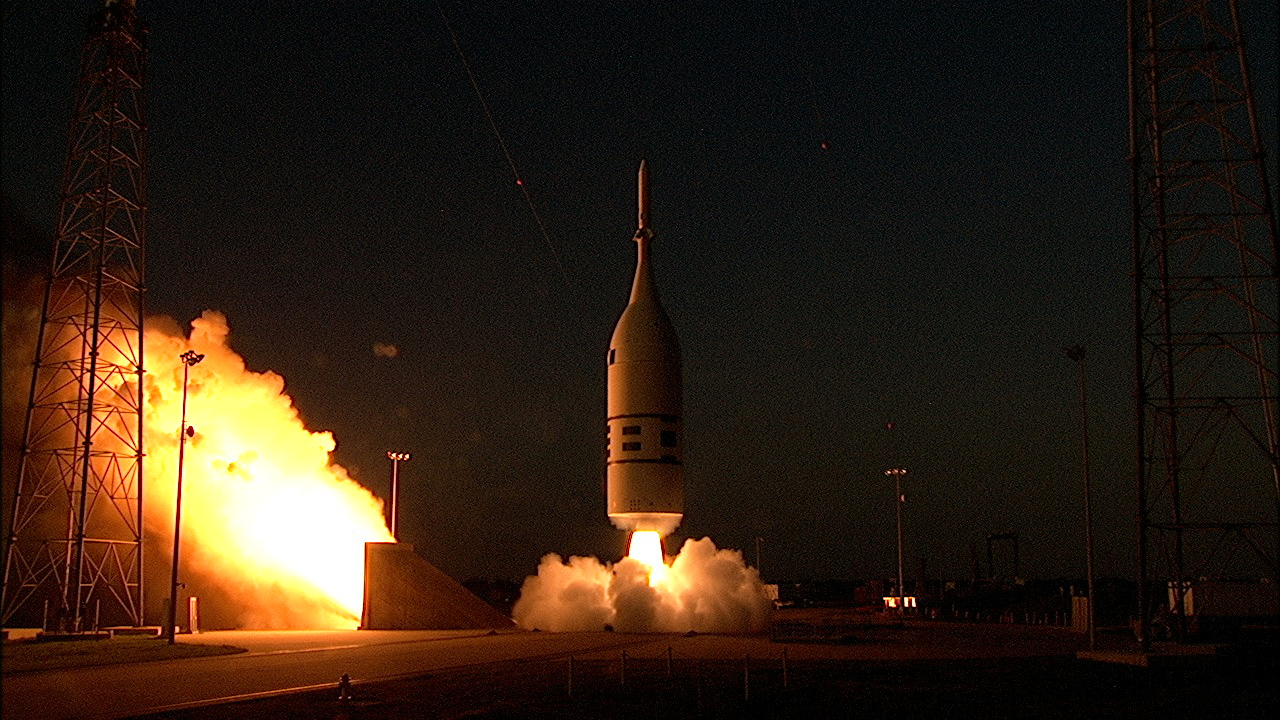
NASA has completed a key test in preparing for its planned crewed space mission to return to the Moon, successfully testing the Launch Abort System (LAS for short) for its Orion spacecraft.
This is the first full stress test of the LAS, which involved launching both an Orion test craft and the full LAS system aboard a rocket booster (smaller scale than would be used to propel the Orion craft to orbit). The goal was to show that in the case of an emergency during an actual launch, the abort system could do its intended job and jettison the Orion crew craft to a safe distance away from the rocket, very quickly.
During this test, there obviously wasn’t anyone on board, but the demonstration still seems to have gone off as planned – the booster shot the Orion and LAS up about 31,000 feet into the air, or about cruising height for commercial aircraft. At its target height, the abort system fired its own abort motor, which separates the crew module from the rocket with about 400,000 pounds of thrust.
This is designed to throw the Orion crew module clear of any potential explosion in the case of an emergency during the time the actual launch rocket is at ‘max-Q’, or the point during launch when it’s under the most stress from aerodynamic forces during the launch sequence.
As you can see above, the LAS managed to separate successfully, then turn around as planned to correctly orient the Orion test vehicle, and then separate itself from the crew capsule. The crew capsule then ejected its own onboard data recorders to provide NASA engineers with the detailed flight records they need to ensure everything went as intended with the LAS test.
The LAS is a new component of NASA’s crew launch system designed for Orion and will help to ensure that this is the safest rocket launch system ever designed by NASA. It can activate in mere milliseconds and move the crew component of the spacecraft away from the rocket at a much higher velocity than even the rocket itself can move.
NASA's next crew-carrying spaceship just took a big step toward operational flight.
The Orion capsule aced a critical launch-abort test this morning (July 2), showing that it can indeed get astronauts out of harm's way during a liftoff emergency and keeping the craft on target for a first crewed flight in 2022.
"It looked beautiful from here," Ashley Tarpley, NASA's range flight safety lead for today's test, said during a NASA broadcast of the procedure. "I think that was excellent, we could not have hoped for a better kind of day. It's just wonderful."
A test version of Orion launched at 7 a.m. EDT (1100 GMT) from Florida's Cape Canaveral Air Force Station, taking to the skies atop the refurbished first-stage motor of a Peacekeeper intercontinental ballistic missile. Fifty-two seconds later, at an altitude of about 31,000 feet (9,450 meters), the launch abort system (LAS) attached to the top of the capsule kicked into gear.
The LAS' abort motor fired, its 400,000 lbs. of thrust pulling Orion up and away from the booster and imparting about 7 Gs of force in the process. (We feel 1 G continuously on Earth's surface, thanks to our planet's gravitational pull.) At the time, Orion was projected to be moving at about 800 mph (1,300 km/h) and experiencing extreme temperatures and pressures, NASA officials said.
Just over 80 seconds into flight, at an altitude of about 44,000 feet (13,400 m), the LAS tower separated and Orion began flying freely — and soon began descending.
Everything was over by about 3 minutes after liftoff, when the capsule slammed hard into the Atlantic at roughly 300 mph (500 km/h), 7 miles (11 km) off the Florida coast. Orion likely broke apart upon impact and sank to the ocean floor, NASA officials said.
This fate was expected, because the capsule flew today without parachutes or an attitude-control system (which it will have during crew-carrying flights).
The project team went with this stripped-down approach "in order to perform this test as early as possible, because we want to get the data," Orion program manager Mark Kirasich said during a prelaunch press conference on Monday (July 1), referring to measurements of temperature, pressure and other variables made by 900 sensors flying aboard the capsule today.
"We want to inform the missions going forward," he added.
Those future missions include Artemis 1, the first flight of Orion and its partner rocket, NASA's huge Space Launch System (SLS), which is still in development. Artemis 1, targeted for launch next summer, will send an uncrewed Orion on a journey around the moon. That will be the first mission for the powerful and long-awaited SLS.
Artemis 2, the first crewed flight of the system, will follow in 2022, if all goes according to plan. This lunar flyby mission will mark the first trip astronauts have made beyond Earth orbit since the Apollo moon program ended in 1972.
Artemis is NASA's ambitious lunar-exploration program, which aims to land astronauts near the moon's south pole by 2024 and build up a long-term, sustainable presence on and around Earth's nearest neighbor in the ensuing years. Such work is envisioned to help prepare humanity to make the next giant leap — a crewed mission to Mars, which NASA aims to achieve in the 2030s.
Today's test flight is officially known as Ascent Abort-2. As that name suggests, it was the second trial for Orion's launch-escape system. The first one occurred in May 2010, when Orion's LAS lifted a test capsule off the ground in a pad abort test.
The scene at Port Canaveral in Florida after NASA's test of the Orion capsule's launch abort system.
(Image credit: NASA TV)
Escape systems are common safety features of crew-carrying spaceships. For example, Russia's Soyuz spacecraft is topped with a similar "puller" tower. This emergency equipment was pressed into service last October during a crewed launch to the International Space Station — the first time an LAS had been employed during an operational mission since another Soyuz launch in 1983. (NASA's now-retired space shuttle orbiter did not have an LAS, so the crew of the Challenger had no way to get clear of their malfunctioning solid rocket booster shortly after launch in January 1986.)
The two crew capsules in development by American companies, Boeing's CST-100 Starliner and SpaceX's Crew Dragon, have abort thrusters built into their bodies. Such a design is known as a "pusher" system, because the craft pushes itself to safety rather than being pulled by tower-mounted motors.
Mike Wall's book about the search for alien life, "Out There" (Grand Central Publishing, 2018; illustrated by Karl Tate), is out now. Follow him on Twitter @michaeldwall. Follow us on Twitter @Spacedotcom or Facebook.
Before the Orion capsule takes astronauts to the moon, NASA first has to make sure that it can keep its passengers safe in case things don't go according to plan. In fact, the agency will put the spacecraft's launch abort system to the test today, July 2nd. NASA will launch a test version of the module from Cape Canaveral in Florida this morning, letting it fly to an altitude of about six miles at more than 1,000 miles per hour before the abort process is initiated.
When it does, the abort motor will start up and pull the module away from the booster, while the attitude control monitor will be in charge of steering it into position so it can be jettisoned back to Earth. The whole process will only take three minutes, but NASA is bound to spend a lot more time than that crunching the data it collects from the capsule's 900 sensors, including microphones and temperature and pressure instruments.
Mark Kirasich, Orion's program manager, explained:
"This test is extremely important. Our Launch Abort System is a key safety feature of the spacecraft — it will protect the crew members who fly onboard Orion during the most challenging part of the mission, which is the ascent phase."
The test's launch window will begin at 7AM ET and will last for four hours until 11AM. NASA will begin its live coverage of the event at 6:40AM ET, and you can watch it all go down on the agency's website or through the video embedded below.
It was the first observed object from outside our solar system, according to a study published in the journal Nature -- and, as the researchers call it, an "oddball."
"What we found was a rapidly rotating object, at least the size of a football field, that changed in brightness quite dramatically," lead study author Karen Meech of the University of Hawaii's Institute of Astronomy and leader of the research team said in a statement.
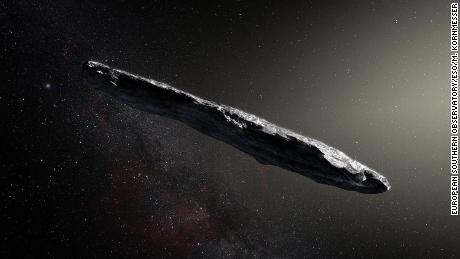
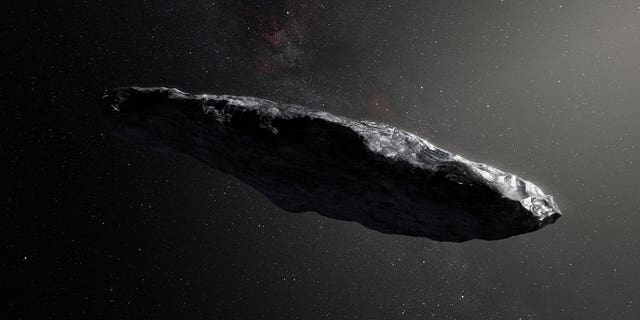
The long and rocky cigar-shaped object has a burnt dark-reddish hue due to millions of years of radiation from cosmic rays. This hue is similar to that of objects found in the Kuiper Belt, in the outer part of our solar system, but its orbit and shape firmly place it in the category of interstellar origin. It most likely has a high metal content and spins on its ownaxis every 7.3 hours.
But the shape, 10 times as long as it is wide, has never been seen before. This complex and convoluted shape means the object varies incredibly in brightness.
At first, astronomers thought the rapidly moving faint light was a comet or an asteroid that had originated in our solar system. But based on its orbit, the astronomers realized that the object came from interstellar space.
They acted fast, and multiple telescopes focused on the object for three nights to determine what it was before it moved out of sight at 85,700 miles per hour. They dubbed it 'Oumuamua. The Hawaiian name, partly coming because of the location of the telescope that discovered it, loosely means "a messenger that reaches out from the distant past."
Because the object was so difficult to classify, showing characteristics of both an asteroid and a comet, and astronomers had so little time to observe it, other theories emerged.
Last year, a Harvard paper alleged that it was an alien spacecraft sent to investigate Earth.
The theory is based on the object's "excess acceleration," or its unexpected boost in speed as it traveled through and ultimately out of our solar system in January.
"Considering an artificial origin, one possibility is that 'Oumuamua is a light sail, floating in interstellar space as a debris from an advanced technological equipment," wrote the paper's authors, suggesting that the object could be propelled by solar radiation.
The paper was written by Abraham Loeb, professor and chair of astronomy, and Shmuel Bialy, a postdoctoral scholar, at the Harvard Smithsonian Center for Astrophysics.Loeb has published four books and more than 700 papers on topics like black holes, the future of the universe, the search for extraterrestrial life and the first stars.
But a new analysis of all the existing data about 'Oumuamua was published Monday in the journal Nature Astronomy. The research suggests that the interstellar object is natural in origin and not an alien spacecraft. CNN has reached out to Loeb and Bialy for comment.
"We have never seen anything like 'Oumuamua in our solar system. It's really a mystery still," said Matthew Knight, associate research scientist at the University of Maryland's Department of Astronomy. "But our preference is to stick with analogs we know, unless or until we find something unique. The alien spacecraft hypothesis is a fun idea, but our analysis suggests there is a whole host of natural phenomena that could explain it."
'Oumuamua spins like a bottle, appearing to accelerate on its path although there is no visible evidence of shedding gas.
"The motion of 'Oumuamua didn't simply follow gravity along a parabolic orbit as we would expect from an asteroid," Knight said. "But visually, it hasn't ever displayed any of the cometlike characteristics we'd expect. There is no discernable coma--the cloud of ice, dust and gas that surrounds active comets--nor a dust tail or gas jets."
The research team considered the different ways 'Oumuamua could have ended up in our solar system and where it might have originated. It's possible that the object was in a system with a gas giant planet orbiting a star and the orbit could have ejected 'Oumuamua. This is based on the idea that Jupiter created the Oort cloud on the edge of our solar system, a shell where comets are born on the outskirts of our solar system.
Objects in the Oort cloud could very well escape the gravity of our sun to travel through other solar systems.
"We tend to assume that the physical processes we observe here, close to home, are universal," Knight said. "And we haven't yet seen anything like 'Oumuamua in our solar system. This thing is weird and admittedly hard to explain, but that doesn't exclude other natural phenomena that could explain it."
Explanations behind the shape, rotation and point of origin remain. But astronomers may have a better chance to study objects like this in the future when the Large Synoptic Survey Telescope comes online in 2022. The researchers believe 'Oumuamua is only the first of many interstellar objects that will pass through our solar system in the future.
"In the next 10 years, we expect to begin seeing more objects like 'Oumuamua. The LSST will be leaps and bounds beyond any other survey we have in terms of capability to find small interstellar visitors," Knight said. "We may start seeing a new object every year. That's when we'll start to know whether 'Oumuamua is weird, or common. If we find 10-20 of these things and 'Oumuamua still looks unusual, we'll have to reexamine our explanations."
The first interstellar object to enter the solar system is not an alien spaceship but is still 'weird' and remains a mystery, astronomers said in a new study.
It is the first known object to pass through the solar system from outside, but experts have failed to explain where the object, called 'Oumuamua' came from.
The mysterious cigar-shaped projectile - formally named the object 1I/2017 U1 - defies description with characteristics resembling both a comet and an asteroid.
Oumuamua, Hawaiian for Scout’, spins like a coke bottle and accelerates like a comet, but without the gas jets often seen trailing them.
Its movements have puzzled experts leading some to suggest it is an alien spacecraft sent to examine our solar system.
Artist's illustration of Oumuamua, the first interstellar object ever spotted in our solar system.
(M. Kornmesser/ESO)
The study’s co-author, Dr. Matthew Knight, an associate research scientist in the University of Maryland Department of Astronomy, said: “The alien spacecraft hypothesis is a fun idea, but our analysis suggests there is a whole host of natural phenomena that could explain it.
"We have never seen anything like Oumuamua in our solar system. It's really a mystery still.
"But our preference is to stick with analogs we know, unless or until we find something unique."
Professional stargazer, Dr. Robert Weryk, first spotted the interstellar traveler in October 2017 at the University of Hawaii's Haleakala Observatory.
Researchers had just weeks to collect as much data as possible before the strange visitor traveled beyond the reach of Earth's telescopes.
The object is now out of sight but could take up to 20,000 years before it leaves our solar system onto its next destination.
Dr. Knight worked with astronomer Dr. Alan Fitzsimmons from Queen's University Belfast and 14 experts from the US and Europe.
They analyzed data from the Discovery Channel Telescope (DCT) at the Lowell Observatory in Arizona from their base at the International Space Science Institute in Bern, Switzerland.
Dr. Knight added: "We tend to assume that the physical processes we observe here, close to home, are universal.
"And we haven't yet seen anything like Oumuamua in our solar system. This thing is weird and admittedly hard to explain, but that doesn't exclude other natural phenomena that could explain it."
Scientists think it could have entered our solar system after being ejected by a gas giant planet orbiting another star.
And researchers said Jupiter may have created some of its own interstellar travelers by sneaking some of its icy objects through the sun’s gravity field and into foreign solar systems.
They suspect Oumuamua could be the first of many visitors from distant solar systems.
They are awaiting fresh data from the Large Synoptic Survey Telescope (LSST) in 2022 which could reveal more.
Dr. Knight said: "In the next 10 years, we expect to begin seeing more objects like Oumuamua.
“The LSST will be leaps and bounds beyond any other survey we have in terms of capability to find small interstellar visitors.
"We may start seeing a new object every year. That's when we'll start to know whether Oumuamua is weird, or common.
“If we find 10-20 of these things and Oumuamua still looks unusual, we'll have to reexamine our explanations."
The study was published in The Astrophysical Journal.
The notion that you can smile your way to happiness is an enduring one.
Back in the 1800s, Charles Darwin was among the first to come up with what modern scientists further developed into the "facial feedback hypothesis." That's the idea that smiling can make you happier and frowning can make you sadder or angrier — that changing your facial expression can intensify or even transform your mood.
Dick Van Dyke sang about the phenomenon — and so did Nat King Cole. And it is still taught in psychology classes today.
But researchers are now finding that this phenomenon may be more complicated than they once thought. A recent study that reviewed around 50 years of data, including the results of nearly 300 experiments testing the facial feedback theory, has found that if smiling boosts happiness, it's only by a tiny bit.
After crunching all the numbers, the researchers say their results suggest that if 100 people smiled — all else equal among them — only about seven might expect to feel happier than if they hadn't smiled.
The study also looked at the effects of a number of other facial expressions, including scowling and frowning, and tried to more generally understand the extent to which positive facial expressions create positive emotions and negative facial expressions create negative emotions.
In each case, "the effects were extremely tiny," says Nick Coles, a social psychology Ph.D. candidate at the University of Tennessee, Knoxville, who led the study. The results, published in the June issue of Psychological Bulletin, add to a debate that has been ongoing "for at least 100 years — since the dawn of psychology," Coles says.
That debate over whether the simple act of moving one's facial muscles into the shape of a smile can make one feel happier has grown especially heated in the past few years. In another study, published in 2016, 17 labs around the globe failed to replicate a seminal piece of research that had originally demonstrated a link between smiling and emotion.
That original study, published in 1988, found that people who were told to hold a pen between their teeth — forcing their faces into the shape of a smile — rated cartoons as funnier than did those who held a pen between their lips to make a pouty face. The participants didn't realize they were smiling or pouting — they believed they were testing out methods that disabled people could use to write.
"It was the first study that demonstrated that smiling could influence emotions even if the participants were not aware that they were actually smiling," Coles explains.
So it was a big blow when so many labs failed to reproduce the results. Still, in 2018, when researchers in Israel reran the experiment once more, they were able to replicate the results — as long as the participants weren't being observed or filmed.
"It gets complicated," says Paula Niedenthal, a psychologist at the University of Wisconsin–Madison who was not involved in the recent research.
Part of the reason for the disparate findings may be that there are lots of different kinds of smiles, Niedenthal says. "Not all smiles are genuine smiles of joy."
Some smiles are sarcastic — more like smirks. Some smiles beam. Others simper. There are subtle differences in the dynamics of each expression, and they're hard to re-create in a lab — with or without the aid of a pen.
Moreover, though most lab studies have found that there's no harm in smiling, recent research has found that, over time, habitually forcing your expression into the shape ofa smile can have a negative effect.
For example, still another study published this year found that service workers who felt compelled to slap on a smile for customers all day had a higher risk of heavy drinking after work. That may be because disgruntled employees forced to provide service with a smile are unlikely to be wearing genuine, joyful grins, the researchers say.
"We should continue to look into this area, at the very least," Niedenthal says. All told, the cumulative research does seem to show that facial expressions have some effect on emotions. What's left to do now, she says, is to tease out the mechanisms and subtleties.
In the meantime, maybe hold back on telling people to turn their frowns upside down, Coles advises.
"Because, I know when I'm sad and people tell me to smile, it just makes me more angry," he says. And as far as the research indicates, "smiling is not going to make any important difference in your life."