Kamis, 04 Juli 2019

The rock-paper-scissors game and coexistence - Phys.org

The rock-paper-scissors game and coexistence
(Top) The selection interactions among three species. The dashed arrow indicates that species 1 is weaker than species 2 and 3. (Bottom) Some of the spatial patterns that emerge in simulations. Individuals of species 1, 2, and 3 are represented by orange, dark blue, and light blue dots, respectively. Empty spaces are represented by white dots. Credit: Menezes et al. ©2019 EPL

In 1975, R.M. May and W.J. Leonard first used the rock-paper-scissors game to model ecological scenarios in which three species cyclically dominate each other: one species dominates a second species, the second species dominates a third species, and the third species dominates the first species. The game works well, for example, for modeling different strains of cyclically dominant E. coli bacteria.

Traditionally, the rock-paper-scissors model assumes that all three have equal strength. But what if one of the species is weaker than the other two? Such a scenario may occur in nature, for example, due to seasonal variations that reduce the ability of a certain species to compete with other species.

In a new paper, associate professor Josinaldo Menezes, graduate student Tibério Pereira, and undergraduate student Bia Moura at the Federal University of the Rio Grande do Norte in Brazil have addressed this question by performing more than a million simulations of a rock-paper-scissors model in which one species attacks less than it is attacked. The model helps to explain how coexistence among different species is maintained in spite of the species' different strengths.

"The results tell us that the reason why species may coexist, even if one of them is weaker, is the special selection configuration of the rock-paper-scissors model," Pereira told Phys.org.

The model works somewhat differently than the original rock-paper-scissors model when implemented as a special case of the May-Leonard model. Individuals, which are placed on a grid, can carry out three possible interactions, no matter which of the three species they belong to. The three interactions are selection, mobility, and reproduction. Selection is like killing, in which an individual of one species can wipe out a neighboring individual of the species that it dominates. For mobility, an individual of one species can switch places with a neighboring individual of the species that it dominates, or move to a neighboring empty space. For reproduction, an individual of one species can populate an empty neighboring space with another individual of its species.

In the simulation, individuals of each species are randomly distributed on a grid. An individual is randomly selected, and then one of its eight neighboring sites (occupied or empty) is randomly selected. Next one of the three interactions (selection, mobility, or reproduction) is randomly chosen. The chosen individual carries out the interaction, if possible. In some cases, the interaction is not possible: for example, the neighboring site must be occupied by an individual of the correct species (the one being dominated) in order for selection to take place, and the neighboring site must be empty in order for reproduction to take place.

To make one species weaker than the other two, the researchers gave one species a lower probability of getting the selection interaction. The results of the simulations showed that, contrary to what might be expected, the weaker species does not necessarily die out. Instead, for some weakness levels, the weaker species initially dominates almost all of the territory. This happens because, since the weaker species selects (i.e., kills) fewer individuals of the species that it dominates, this species grows and, in turn, limits the growth of the third species. As this third species dominates the weaker species, its limited growth allows the weaker species to grow.

For these reasons, previous research has shown that the weaker species may always dominate, even in the long run. However, here the researchers found something different.

"We were surprised because the weaker species does not necessarily win the uneven rock-paper-scissors game, as it was known in the literature," Menezes said. "We found out that, in May-Leonard-type simulations, the winner species depends on the mobility and the strength of the weaker species."

Over time, new patterns appear showing exactly how the spatially coexist. In particular, emerge and travel like waves until they meet each other, at which point they result in all three species coexisting in small colonies. The spiral patterns—and resulting coexistence—are more likely to occur on larger grids, since this increases the mobility of all species and allows for the species to come in contact with each other.

"Beautiful spiral waves emerge when the lattice is almost dominated by one single species," said Moura. "The formation of spiral spatial patterns is entirely different from the standard rock-paper-scissors model. We expect that our results can be helpful to ecologists because they describe and quantify patterns which are crucial to understanding how such species coexist."

The results also revealed that coexistence has its limits: When the strength of the weaker species is less than approximately one-third of the strength of the other two species, the probability of coexistence greatly diminishes.

In the future, the researchers plan to investigate more complex scenarios, such as adaptive biological systems, where a species can change the interaction probabilities to guarantee its survival. They also plan to explore how biological interactions can balance the uneven relationships among species, as well as the effects of diseases and other predators.

"We aim to understand how a disease outbreak or a common predator mediation increases the chances of coexistence in the uneven rock-paper-scissors model," Menezes said.


Explore further

High diversity on coral reefs—a very big game of rock-paper-scissors

More information: J. Menezes, B. Moura, and T.A. Pereira. "Uneven rock-paper-scissors models: Patterns and coexistence." EPL. DOI: 10.1209/0295-5075/126/18003

© 2019 Science X Network

Citation: The rock-paper-scissors game and coexistence (2019, July 4) retrieved 4 July 2019 from https://phys.org/news/2019-07-rock-paper-scissors-game-coexistence.html

This document is subject to copyright. Apart from any fair dealing for the purpose of private study or research, no part may be reproduced without the written permission. The content is provided for information purposes only.

Let's block ads! (Why?)


https://phys.org/news/2019-07-rock-paper-scissors-game-coexistence.html

2019-07-04 13:30:01Z
CAIiEDTVYS16O4wSpmd1igvWjlcqFwgEKg8IACoHCAowpbDpAzCm_hwwj9kp

Scientists combine light and matter to make particles with new behaviors - Phys.org

light
Credit: Petr Kratochvil/public domain

Every type of atom in the universe has a unique fingerprint: It only absorbs or emits light at the particular energies that match the allowed orbits of its electrons. That fingerprint enables scientists to identify an atom wherever it is found. A hydrogen atom in outer space absorbs light at the same energies as one on Earth.

While physicists have learned how electric and magnetic fields can manipulate this fingerprint, the number of features that make it up usually remains constant. In work published July 3 in the journal Nature, University of Chicago researchers challenged this paradigm by shaking electrons with lasers to create "doppelganger" features at new energies—a breakthrough that lets scientists create hybrid particles which are part-atom and part-, with a wide variety of new behaviors.

The research is part of a greater effort in Assoc. Prof. Jonathan Simon's lab to break down the walls between matter and light, in order to investigate their fundamental properties. In addition to learning about how materials behave at the , this work could one day help create more powerful computers or virtually "unhackable" quantum communications.

One step along the way to making matter out of light is to make individual packets of light, called photons, interact with each other like matter does. (Normally photons zip along at the speed of light and don't react to each other at all.)

"In order to make photons collide with one another, we use as a go-between," said postdoctoral researcher Logan Clark, who led the research. "But we were running into a problem because the photons only interact with atoms whose electronic orbitals are at very particular energies. So we asked: What if we could make copies of the orbitals at whatever energies we wanted?"

Clark had already developed techniques to manipulate quantum matter by shaking it —called Floquet engineering—as part of his Ph.D. project. The right sort of shaking naturally produces copies of quantum states at multiple energies along the way. "We had always viewed the copies as a side effect rather than the goal," he said, "but this time, we shook our electrons with the specific intent of making the copies."

By varying the intensity of a laser field tuned precisely to an atomic resonance, the team was able to shift the orbitals of an electron. Shaking the orbitals by periodically varying this intensity produced the desired copies.

But these doppelgangers come with an important catch: "While the atomic orbital does appear at multiple distinct energies, it is important to note that these copies are actually bound to the original like puppets," explained postdoctoral researcher Nathan Schine, a co-author on the study. "When any of the copies shifts, the original and all of the other copies shift with it."

By allowing photons to interact with these shaken atoms, the team has created what they call "Floquet polaritons"—quasi-particles which are part-light and part-atom, and unlike regular photons, interact with each other quite strongly. These interactions are essential for making matter from light. Making polaritons with shaken atoms can give the polaritons much more flexibility to move around and collide with each other in new ways.

"Floquet polaritons are full of surprises; we're still continuing to understand them better," Clark said. "Our next order of business, though, will be to use these colliding photons to make topological 'fluids' of light. It is a tremendously exciting time."

Having copies of an atomic state at multiple energies also offers exciting possibilities for optical frequency conversion—a key tool in creating secure quantum communication methods.

"It turns out shaking things is not only a lot of fun, but can lead to some really fascinating science," Clark said.


Explore further

Repulsive photons

More information: Logan W. Clark et al. Interacting Floquet polaritons, Nature (2019). DOI: 10.1038/s41586-019-1354-5

Citation: Scientists combine light and matter to make particles with new behaviors (2019, July 4) retrieved 4 July 2019 from https://phys.org/news/2019-07-scientists-combine-particles-behaviors.html

This document is subject to copyright. Apart from any fair dealing for the purpose of private study or research, no part may be reproduced without the written permission. The content is provided for information purposes only.

Let's block ads! (Why?)


https://phys.org/news/2019-07-scientists-combine-particles-behaviors.html

2019-07-04 11:52:11Z
CAIiEAWin4HaL5RjLay7SbDtrDQqFwgEKg8IACoHCAowpbDpAzCm_hwwj9kp

Rabu, 03 Juli 2019

Future - Apollo in 50 numbers: Weights and measures - BBC News

362: Total mass of Moonrocks collected, in kilograms

The Apollo programme was conceived as a political challenge to beat the Russians to the Moon. It became an engineering challenge to achieve that goal and, finally, a scientific challenge to make sure the astronauts did something useful when they got there.

Key to this was training the Apollo crews in field geology. As well as classroom sessions, the astronauts took part in field trips to Hawaii, Mexico, Iceland and Germany. They learned about rock formations, volcanoes and meteorite impact craters.

“It was great fun,” says Apollo 15 command module pilot, Al Worden. “We built up a picture in our minds of what we were looking for.”

You might also like:

How to design a diet for Moonwalkers
The giant rocket for a mighty mission
The astronaut who caught a cold in space

On the Moon, astronauts were equipped with hammers, scoops and drills. Meanwhile, command module pilots in lunar orbit, like Worden, made observations over much larger areas.

“I flew over the landing areas describing the large general features that would complement what they found on the surface,” says Worden. “I think that really helped paint a picture of the Moon.”

The first (and only) geologist to visit the Moon was Harrison Schmitt. During his Apollo 17 mission, he discovered orange beads of rock – strong evidence of volcanic activity on the Moon. The crew brought back some 741 samples, weighing a massive 111kgs (244lb).

The 2,200 rock and soil samples collected on the Moon were taken to the lunar receiving laboratory in Houston. Although for Apollo 11 at least, the astronauts had to fill in a customs declaration first.

Moon rocks have since been donated to governments, museums or lent to scientific institutions for study. Others have remained sealed in their containers, untouched since they were collected.

Analysis of the samples has revealed the history of the Moon and provided compelling evidence that the Earth and Moon formed as a result of a giant impact between an early planet and another astronomical body.

60: Number of miles travelled on the Moon

Mission controllers were keen that Neil Armstrong and Buzz Aldrin didn’t stray far from the lander, their ride home. The furthest the crew walked was to a nearby crater, achieving a total distance of around half a mile.

But as the missions progressed, and the time spent on the surface increased, the astronauts walked further. Even in 1/6th gravity, however, bounding across the Moon was tiring and their range was limited.

The lunar driving record is still held by the last man on the Moon, Gene Cernan

During Apollo 15 in 1972, Dave Scott and Jim Irwin got to drive the first lunar rover. With a maximum speed of 10mph (16km/h), the electric vehicle carried them some 14 miles.

“The rover handles quite well… I can manoeuvre pretty well,” reported Scott to mission control. “It negotiates small craters quite well but it feels like we need the seatbelts.”

“Just like in the owner’s manual, Dave,” replies the ground.

The lunar driving record is still held by the last man on the Moon, Gene Cernan. During his Apollo 17 landing with Harrison Schmitt, he notched-up 22 miles (35km) on the clock – travelling a maximum of four miles from the spacecraft.   

4.5: Lunar module habitable volume, in cubic metres

After the intensity of the lunar landing and two and a half hours walking on the Moon’s surface, Neil Armstrong and Buzz Aldrin sealed the hatch on their lander and re-pressurised the cabin. They were exhausted. Before blasting-off back to the command module in orbit, they were scheduled to sleep.

“The rest period was almost a complete loss,” Armstrong later wrote in his mission report. “Noise, lighting and a lower-than-desired temperature were annoying.”

Although the lunar module proved to be a great spacecraft, as a habitation module it was far from comfortable. The bulky cylinder of the ascent engine cover – rising like a barrel in the middle of the cabin – meant there was little floor space.

Armstrong attempted to sleep on the engine cover and Aldrin on the floor.

“The window shades did not completely block out light, the cabin was illuminated by a combination of light through the shades, warning lights and display lighting,” Armstrong complained.

During later missions, astronauts slept in their underwear in hammocks

“The noise from the glycol pumps was then loud enough to interrupt sleep,” he added. “The lunar module pilot [Aldrin] estimated that he slept fitfully for perhaps two hours and the commander did not sleep at all.”

During later missions, astronauts slept in their underwear in hammocks. Nevertheless, with all the excitement of being on the Moon, only a few reported getting a good night’s sleep.

7: Maximum re-entry velocity, in miles per second

27 December 1968, the crew of Apollo 8 were about to become the fastest people in history. Having travelled to the Moon, Frank Borman, Jim Lovell and Bill Anders prepared to re-enter the Earth’s atmosphere. They were travelling at 36,303 feet per second (nearly seven miles per second).

This would be the ultimate test of the Apollo command module and its resin heat shield, designed to protect the crew from temperatures of up to 3,000C (5,432F).

“We used the atmosphere to slow us down,” Borman says. “From a physical standpoint it was the most arduous part of the mission because you’re pulling six gs for quite a long time and it becomes hard to breathe.”

“It was like flying inside of a neon light or a blowtorch – it was the most dramatic part of the flight.”

But it wasn’t the most uncomfortable. Splashing down at night in the Pacific Ocean, the spacecraft tipped upside down, leaving the astronauts hanging in their seats.

“The spacecraft was a lousy boat,” Borman says. “We had to wait about two hours till daylight because the Navy didn't want to put divers in when there were sharks.”

“I got seasick and threw-up all over Anders and Lovell,” he says. “I still hear about that to this day.”

Their speed record didn’t last for many months. The record for the fastest re-entry and, therefore, the record for the fastest speed ever attained by humans, goes to the Apollo 10 crew. In May 1968, they returned to Earth at 36,397 feet per second – that’s 24,816mph (39,705km/h).

(You can hear more about Apollo 8 here.)

238,855: Distance to the Moon, in miles

After the intensity of launch, some astronauts felt that travelling to the Moon was pretty dull.

“Three and a half days we had nothing to do,” says Apollo 15 command module pilot, Al Worden. “All we had to do was wait till we got to the Moon and that's a pretty boring time.”

The reason we know the average distance to the Moon with such accuracy is thanks to one of the experiments deployed on the surface during Worden’s mission

As the Earth receded behind them, astronauts chatted, read, listened to music or tried to exercise using resistance bands. They also took part in TV broadcasts. You could liken it to being confined to a small car with two work colleagues, occasionally livestreaming the experience.

“There are few moments during the day during the outbound trip where we would make little course corrections,” he adds. “That's the most exciting thing we did on the way out.

The reason we know the average distance to the Moon with such accuracy is thanks to one of the experiments deployed on the surface during Worden’s mission. Astronauts on Apollo 11, 14 and 15 left behind devices called Laser Ranging Retroreflectors (LRR). These special mirrors were designed to reflect lasers aimed through telescopes from Earth. (Incidentally, if you wanted to translate that distance into marathons, you’d have to run 9,186 of them to match it.)

They are still used today and have given astronomers an improved understanding of the Moon’s orbit. They have also discovered that the Moon is getting further away from Earth – it’s currently receding at 38mm a year.

--

Join more than one million Future fans by liking us on Facebook, or follow us on Twitter or Instagram.

If you liked this story, sign up for the weekly bbc.com features newsletter, called “If You Only Read 6 Things This Week”. A handpicked selection of stories from BBC Future, Culture, Capital, and Travel, delivered to your inbox every Friday

Let's block ads! (Why?)


http://www.bbc.com/future/story/20190702-apollo-in-50-numbers-weights-and-measures

2019-07-03 09:27:52Z
52780325662311

Mystery space object 'Oumuamua: What was the 'messenger from afar'? - New Zealand Herald

All of the stars Matthew Knight saw through the giant telescope in Arizona were bright with persistent light. All of them but one, which appeared to be flashing, in a way - light that went in and out, dull and then bright, every hour. He assumed that there was something wrong with his data. But days earlier, the University of Maryland research scientist heard about a strange object in space, when it was discovered by the Pan-STARRS1 telescope in Hawaii.

What he was seeing was an interstellar object - the first we have ever been able to observe from Earth - tumble through our solar system, rotating and reflecting sunlight in pulses.

When it was first discovered, many theories about the object's origin emerged. One theory suggested that the object was from an alien civilisation, sailing into our solar system. Some researchers thought it was possible that the object was an alien solar sail, relying on the sun's light to push it through space.

"I don't want to completely say it's not aliens, because we didn't actually go to it and see it up close," Knight said. "But I think that's a very unlikely possibility."

Advertisement

For a week in late-October 2017, data was collected as the object sped through the solar system. Scientists concluded that the cigar-shape object, named 'Oumuamua, was natural. It did not originate from an alien civilization. In a paper published in the journal Nature Astronomy, 14 scientists, including Knight, wrote that they found "no compelling evidence to favour an alien explanation for 'Oumuamua," to the dismay of alien hunters everywhere.

Pronounced Oh-Moo-uh-Moo-uh, the Hawaiian word roughly translates to "messenger from afar." Co-author Karen Meech, an astronomer at the Institute for Astronomy at the University of Hawaii, asked Hawaii linguists to name the object after the first week of observations.

The object's path tipped scientists off to its origins, proving it was indeed interstellar - or, in other words, having come from outside our solar system. It was not taking the kind of path that one of our own solar system's objects would take.

"It didn't actually get captured here; it was just passing through," Knight said, referring to when a solar system's gravity draws an object into orbit. "So it whizzed by us, passed the sun and then it went back out."

Scientists noticed that 'Oumuamua appeared to unexpectedly accelerate. According to Knight, this could have been because the object was a comet, with ice that was vaporizing and giving it "a little bit of a kick" as it entered the solar system. But the scientists did not see a gas tail or directly detect any ice.

Instead, the scientists categorised it more generally as planetesimal, meaning that 'Oumuamua is likely "just a leftover remnant from another solar system's birth process," Meech said, like a giant boulder that at some point could have fused with other space rocks to form a planet but didn't. After that, scientists suspect, 'Oumuamua was ejected from its own solar system.

Now it's on a road trip through the galaxy.

"It was just traveling through space, kind of minding its own business, and at some point it got close enough to our solar system that then it started feeling the gravitational tug from our sun and then it got pulled through," Knight said.

Once in our solar system, 'Oumuamua sped and tumbled into visibility. Meech's team recorded data for a week, then, from November 2018 through the first week of January, the object was only faintly visible through the Hubble Space Telescope.

'Oumuamua's brightness changed when viewing the narrow side and then the long side. Knight compared it to looking at a bottle of soda.

"If you're seeing the length of it, it's a very wide cross section," Knight said. "But if you're looking at it down the cap, you're only seeing a narrow area."

Scientists don't know exactly how big 'Oumuamua is. They could only estimate because of how it reflected sunlight. Knight said "sizes from about (650 feet) to about (3,300 feet) would all be consistent with known asteroids and comets in our solar system."

For about the past 30 years, scientists predicted that objects from another star system could be discovered. Over the past 10 years, the technology to survey for such faint and fast objects improved. 'Oumuamua is the first, but likely not the last interstellar object to be observed. Over the next 10 years, scientists could likely see one every year.

In early July, 'Oumuamua was just beyond Saturn.

"Over the next hundreds of years it will be zooming out of our solar system," Knight said. "And then eventually it will just be back out in interstellar space between stars."

Let's block ads! (Why?)


https://www.nzherald.co.nz/world/news/article.cfm?c_id=2&objectid=12246313

2019-07-03 02:50:38Z
52780324463182

Selasa, 02 Juli 2019

Total solar eclipse 2019: how to watch, live stream, and start time - Vox.com

Once every 18 months or so, the moon aligns completely with the surface of the sun, casting a narrow shadow along the surface of the Earth.

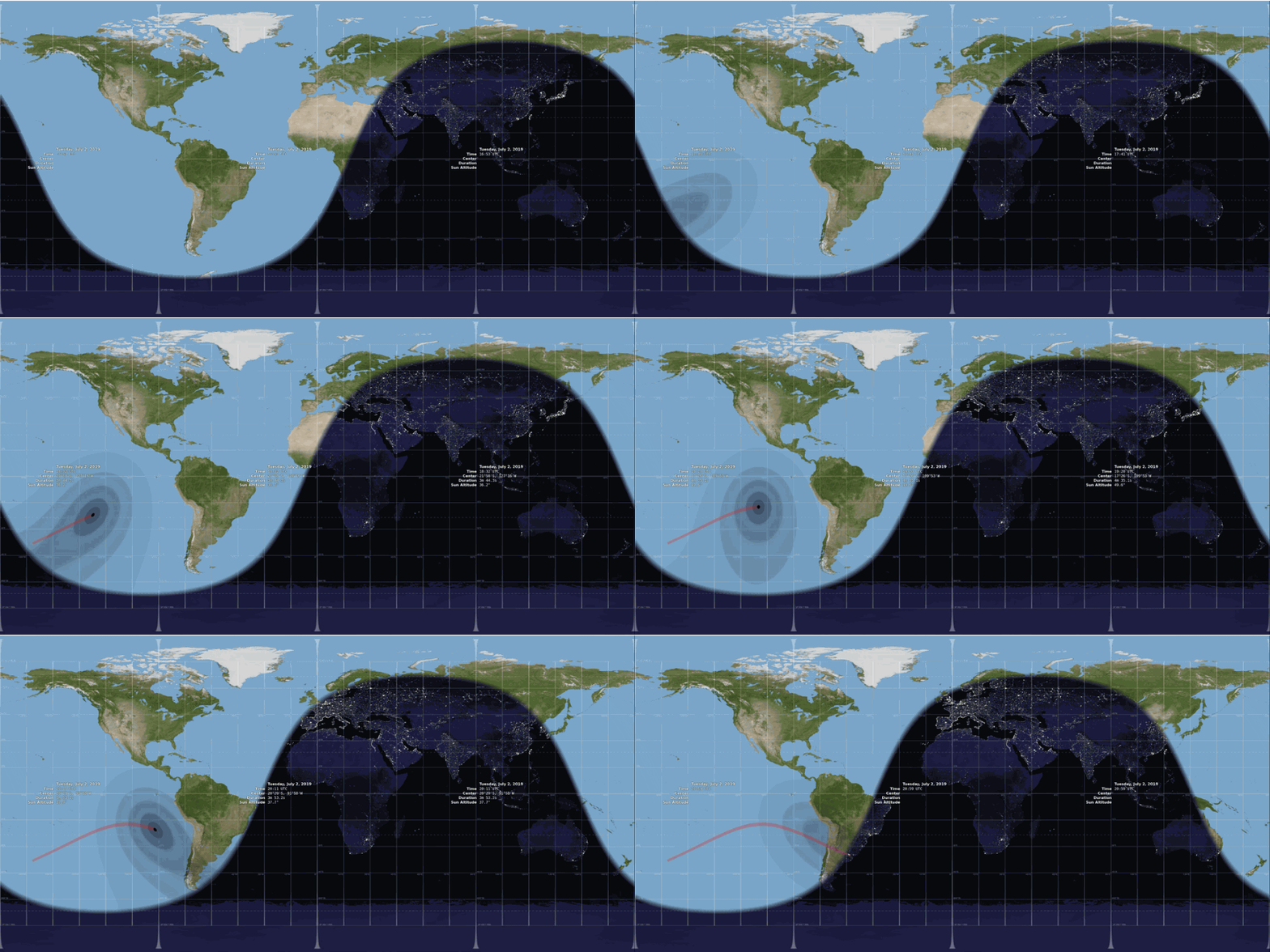
This is a total solar eclipse, and the next one happens today, Tuesday, July 2. This afternoon, a shadow will fall over the southern Pacific Ocean and parts of Chile and Argentina. It’s the first total solar eclipse since the “Great American Eclipse” of August 2017, which bisected the continental United States.

Here’s the path of totality — the region where the moon’s shadow totally blocks out the sun — that today’s eclipse will take:

The solar eclipse will fall on South America just before nightfall.
Ernie Wright/NASA

What might make this eclipse particularly beautiful is its timing near sunset hours. If you’re not in the Pacific or in South America, don’t worry. This is the year 2019, and you can live-stream the solar eclipse.

You should be able to see a totality in one of these streams between 4:38 pm Eastern (when the total eclipse begins in Chile), and 4:44 pm Eastern (when it ends in Argentina). You can also start watching an hour before to see the partial phases of the eclipse. Here are a few options, and when to tune in:

The astronomy education website Slooh is providing a webcast of the eclipse starting at 3:15 pm Eastern.

NASA will broadcast a live stream from observatories in Vicuna, Chile, from 3 to 6 pm Eastern.

Possibly the best place to view the eclipse will be at the La Silla Observatory, an astronomy facility perched high on a mountain in Chile’s Atacama Desert. There, away from light pollution and relatively safe from the threat of cloud cover, the total eclipse will begin at 4:39 pm local time, a little more than an hour before sunset.

Chile is in the same time zone as the Eastern US. And many of us will be able to follow along from afar: The European Southern Observatory, which runs La Silla, will live-stream the event starting at 3:15 pm.

A total solar eclipse is a beautiful phenomenon. When the moon covers the sun, it reveals a glowing white light surrounding the sun. That’s the solar corona, or atmosphere, and it’s only visible to our eyes during an eclipse. Here’s what it might look like on Tuesday.

People say witnessing a total solar eclipse is life-changing. Hear some of their stories here:

Let's block ads! (Why?)


https://www.vox.com/science-and-health/2019/7/2/20678735/solar-eclipse-2019-south-america-live-stream-how-to-watch-start-time-nasa

2019-07-02 15:00:00Z
52780323407411

Watch NASA launch its Orion Moon capsule atop a missile in spectacular safety test - Fox News

NASA has successfully tested the launch abort system for the Orion crew capsule designed to take astronauts to the Moon.

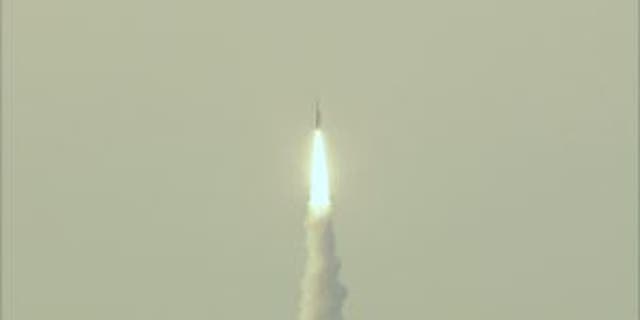
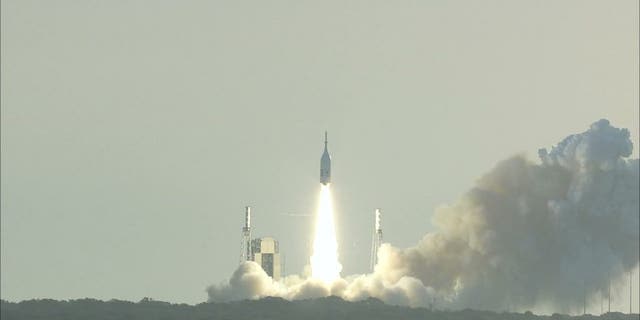
An unmanned test version of the Orion crew capsule was launched from Cape Canaveral Air Force Station in Florida atop a modified Peacekeeper missile early Tuesday. After reaching an altitude of six miles, the spacecraft’s abort sequence triggered. The capsule continued upward another two miles, then flipped to jettison the abort tower.

“The abort sequence triggered and, within milliseconds, the abort motor fired to pull the crew module away from the rocket,” explained NASA in a statement. “Its attitude control motor flipped the capsule end-over-end to properly orient it, and then the jettison motor fired, releasing the crew module for splashdown in the Atlantic Ocean.”

NASA SETS SIGHTS ON MOON MISSIONS, SELECTS 3 FIRMS FOR LUNAR DELIVERIES

NASA chose not to use parachutes to keep this test version of the capsule simple and thus save time, and so it crashed into the Atlantic at 300 mph as planned, the three-minute test complete. Twelve data recorders popped off in bright orange canisters before impact, for ocean retrieval.

Image from the Ascent Abort-2 flight test. (NASA)

Image from the Ascent Abort-2 flight test. (NASA)

The space agency confirmed Tuesday that the data recorders have been recovered. “The data recorders are a backup communication system,” it explained. “They were labeled, ejected out of canisters and floated in the water. Each recorder features a beacon and transmitter to assist boats in retrieval.”

The Ascent Abort-2 test successfully demonstrated that the launch abort system can outrun a speeding rocket and pull astronauts to safety, according to NASA.

NASA’S NEW ORION SPACECRAFT LIFTS OFF ON FIRST TEST FLIGHT

Officials were delighted with the test. "By all first accounts, it was magnificent,” said NASA's Orion Program Manager Mark Kirasich.

"Congratulations to our @NASA_Orion  team on a successful test of the launch abort system! We are one step closer to sending @NASA_Astronauts to the Moon and beyond to Mars!," tweeted NASA Administrator Jim Bridenstine.

This was the second abort test for Orion, conducted at a speed of more than 800 mph. The first, in New Mexico in 2010, was lower and slower.

APOLLO 11: 'GIANT LEAP' PHOTO SIGNED BY NEIL ARMSTRONG SELLS FOR $52G

The test is part of NASA’s preparations for Artemis missions to the Moon. The U.S. wants to land the next man and the first woman on the Moon by 2024. The astronauts will also be first humans to set foot on the Moon’s South Pole.

The Orion capsule was launched atop a modified Peacekeeper missile.

The Orion capsule was launched atop a modified Peacekeeper missile. (NASA)

Last year, NASA astronaut Nick Hague and Russian cosmonaut Alexei Ovchinin made a dramatic escape from a failed Soyuz rocket shortly after its launch from the Baikonur Cosmodrome in Kazakhstan.

The spacecraft carrying Hague and Ovchinin was about 30 miles above Earth’s surface when the crew was forced to make a dangerous “ballistic re-entry” into Earth’s atmosphere. After the successful deployment of its parachute, the rescue capsule landed safely in the steppes of Kazakhstan about 30 minutes after the rocket failure.

50 YEARS AFTER APOLLO 11, NEIL ARMSTRONG'S SONS DESCRIBE THE DAY THEIR DAD WALKED ON THE MOON

July 20, 2019, marks the 50th anniversary of the Apollo 11 Moon landing.

Only 12 men, all Americans, have walked on the Moon.

CLICK HERE TO GET THE FOX NEWS APP

The Associated Press contributed to this article. Follow James Rogers on Twitter @jamesjrogers

Let's block ads! (Why?)


https://www.foxnews.com/science/nasa-orion-moon-capsule

2019-07-02 14:22:55Z
52780324298005

NASA tests abort system for spacecraft that will carry humans to the moon in 2024 - CNN

Weather conditions at Kennedy Space Center in Florida were perfect for the launch to conduct the flight test, called Ascent Abort-2. The "stack" -- the parts comprising the rocket, abort system and capsule -- that launched is about 93 feet tall.
A test version of the Orion crew capsule launched at the beginning of a four-hour window that opened at 7 a.m. ET Tuesday. No crew was aboard.
"It was a very smooth liftoff," said Mark Kirasich, Orion program manager. "By all first accounts, it was magnificent." The abort system performed as expected. The next time the abort system is used, astronauts will be on board.
The test needed to be performed as early as possible for the Orion team to gather data and inform missions going forward.
"This test is extremely important," Kirasich said. "Our Launch Abort System is a key safety feature of the spacecraft — it will protect the crew members who fly onboard Orion during the most challenging part of the mission, which is the ascent phase."
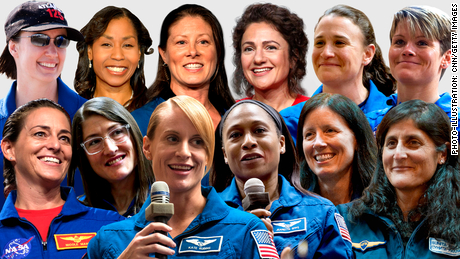
One of these 12 women astronauts will go to the moon
The test is meant to ensure that when the craft carrying humans ascends to space after launch, the abort system can pull the crew module away if there's an emergency. On Tuesday, NASA will test a full abort as well as collect data from 900 sensors on the spacecraft.
The Space Launch System rocket that will carry Orion to space will be the most powerful engine ever used, which means a more powerful launch abort system is required to keep the crew safe in the event of a problem.
To provide an idea of the power involved, here's a snapshot of the test launch on Tuesday: 500,000 pounds of thrust at liftoff that provided the craft with a speed of 800 mph. This allowed the craft to reach 31,000 feet in 55 seconds. Then, the abort was initiated, causing the abort motor and attitude control motor, which provides steering, to ignite. A peak of 45,000 feet was reached.
NASA plans to land the first woman on the moon by 2024
A little over 20 seconds later, the jettison motor pulled the capsule away from the rocket. The capsule fell into the ocean at 300 mph, likely coming apart because there weren't be any parachutes to slow it down. It's weighted down to sink. When Orion launches in 2024, parachutes will be used to slow descent and keep the capsule intact.
The motors on top of the module pull the capsule away from the rocket, rather than motors positioned at the base to push it away. The abort system is designed to automatically fire within milliseconds if an error rises so the capsule can literally outrun the rocket.
"In an abort scenario, the Launch Abort System and crew module essentially become its own aircraft," said Chuck Dingell, chief engineer for Orion. "Not only do we want to get that craft away from a dangerous scenario quickly, but we also want to control it so that it flies in a direction as far as possible from the rocket. It's also easier to control a vehicle with a forward center of gravity and that is heavier on the front end."
For the final design, the crew will also have an abort button they can use.
NASA estimates it will need $20 billion to $30 billion for moon landing, administrator says
Twelve data recorders ejected in pairs and fell into the ocean. While all of the data from the recorders will be downlinked during the flight, the team needs to be able to recover at least one data recorder to provide a full backup if data is lost.
Recorders will likely wash up on the beach because they can float. They're bright orange and are labeled with a phone number and email address in case people find them on the beach. They also feature a beacon and transmitter for recovery.
"We are incredibly excited," said Jenny Devolites, Ascent Abort-2 crew module manager and test conductor. "It's such an honor to be a part of this activity and to have this opportunity."
In 2024, Artemis 2 will carry astronauts to the Gateway, a spaceship that will go into orbit around the moon and be used as a lunar outpost. From there the astronauts can use another vehicle to descend to the lunar surface for the first time since 1972.

Let's block ads! (Why?)


https://www.cnn.com/2019/07/02/us/nasa-orion-ascent-abort-test-scn-trnd/index.html

2019-07-02 12:50:00Z
52780324298005