Senin, 03 Februari 2020

Anti-solar panel can generate electricity at night, researchers say - Inverse

One of the problems with solar panels is that they don't generate electricity at night, so we have to store the electricity they generate during the day to power things during the evening. That works fine, but what if we could develop solar panels that did generate electricity at night? It's possible, and the way it works is pretty surprising.

Researchers from the University of California, Davis explain in a new paper that was just published in the journal ACS Photonics that if you want to create a solar panel that generates electricity at night, then you just have to create one that operates the exact opposite way solar panels work during the day. It's being referred to as the "anti-solar panel."

Solar panels are cold compared to the Sun, so they absorb the Sun's light and turn it into energy. Space is very cold, so if you point a panel on Earth that is comparatively warm toward it, it will radiate heat as invisible infrared light. This allows you to generate electricity by capturing that power. The paper claims such a device could generate about a quarter of the electricity at night that a normal solar panel generates during the day.

Jeremy Munday, a professor in the Department of Electrical and Computer Engineering at UC Davis who is an author of the paper, tells Inverse that whether it's a solar panel or this anti-solar panel, these things are essentially just "heat engines."

"You have heat energy coming from the Sun towards the Earth and that normal solar cell picks off that energy as it's transmitted from the Sun to the Earth, so basically you need these two different temperature bodies and some way of converting that power," Munday says. "What this nighttime device does is a similar sort of thing—where it's just taking a hot body and a cold body—but now the relatively hot body is the Earth and space is the cold body. As this heat is flowing from the Earth to outer space, it's picking that off and converting that into power."

This kind of device uses what is called a thermoradiative cell to generate electricity, as opposed to the photovoltaic cell used by a conventional solar panel. Where a solar panel is typically made of silicon, which is good at capturing light that's largely in the visible spectrum, this device has to be made of something that can capture extremely long wavelength light. Munday is currently looking at mercury alloys that would be good for this.

Munday and his team are currently working on developing prototypes to see how well they can make this concept work.

See also: A 200-year-old technology could help millions living off the grid

Other researchers are also looking into how to make solar panels, or "anti-solar panels," that generate electricity at night. Researchers at Stanford published a paper in the journal Jouele in November showing how a thermoelectric generator that radiates heat to the sky can generate electricity.

"Unlike traditional thermoelectric generators, our device couples the cold side of the thermoelectric module to a sky-facing surface that radiates heat to the cold of space and has its warm side heated by the surrounding air, enabling electricity generation at night," the paper reads.

Our batteries have been slowly getting better for years, and so have our solar panels, so we don't necessarily need solar panels that can generate electricity at night to meet our energy needs. However, if we can devise a system that can generate clean energy 24 hours a day, we could possibly produce more energy than we need and store it for various purposes, such as an emergency. It's better to have too much energy than to come up short.

Abstract: Photovoltaics possess significant potential due to the abundance of solar power incident on earth; however, they can only generate electricity during daylight hours. In order to produce electrical power after the sun has set, we consider an alternative photovoltaic concept that uses the earth as a heat source and the night sky as a heat sink, resulting in a “nighttime photovoltaic cell” that employs thermoradiative photovoltaics and concepts from the advancing field of radiative cooling. In this Perspective, we discuss the principles of thermoradiative photovoltaics, the theoretical limits of applying this concept to coupling with deep space, the potential of advanced radiative cooling techniques to enhance their performance, and a discussion of the practical limits, scalability, and integrability of this nighttime photovoltaic concept.

Let's block ads! (Why?)


https://news.google.com/__i/rss/rd/articles/CBMicmh0dHBzOi8vd3d3LmludmVyc2UuY29tL2lubm92YXRpb24vcmVzZWFyY2hlcnMtaGF2ZS1hLWNvdW50ZXJpbnR1aXRpdmUtY29uY2VwdC1mb3Itc29sYXItcGFuZWxzLXRoYXQtd29yay1hdC1uaWdodNIBdmh0dHBzOi8vd3d3LmludmVyc2UuY29tL2lubm92YXRpb24vcmVzZWFyY2hlcnMtaGF2ZS1hLWNvdW50ZXJpbnR1aXRpdmUtY29uY2VwdC1mb3Itc29sYXItcGFuZWxzLXRoYXQtd29yay1hdC1uaWdodC9hbXA?oc=5

2020-02-03 02:49:56Z
52780587523190

When Is the Next Lunar Eclipse? - msnNOW

There are lots of exciting lunar events to look forward to this year, including four lunar eclipses.

A lot of strange lunar events are scheduled this year.© Souhayl Ben Khaled, United Arab Emirates Astronomy Group A lot of strange lunar events are scheduled this year.

First, a brief explanation of what we mean when we say "lunar eclipse." During a total lunar eclipse, when the moon passes through the innermost portion of the Earth's shadow, it takes on a coppery color A partial lunar eclipse occurs when the moon passes through even a small part of Earth's inner shadow, called the umbra. A penumbral lunar eclipse occurs when the moon passes through the penumbra, or the outermost section of Earth's shadow.

All four eclipses in 2020 are penumbral eclipses, and the moon will be cloaked in a darker-than-usual, silvery hue.

Mark Your Calendars

a tree in the snow: Super Blood Moon Panoramic© Bassador - Getty Images Super Blood Moon Panoramic

There are four lunar eclipses scheduled for 2020. All of them are penumbral eclipses, where the moon dips through Earth's shadow, casting a the moon into a darker shade of silver. The first eclipse took place on January 10. It began at 2:30 p.m. ET, and was visible in Europe, Africa, Asia, and Australia.

The next eclipse in 2020, also a penumbral eclipse, will take place on June 5 and will peak at 5:24 a.m. local time (3:24 a.m. EST) for viewers in Sydney, Australia, and will last for three hours and 18 minutes. This one will be visible throughout Europe, Africa, Asia and Australia.

a close up of a map: A map of the June 5-6, 2020, pumbral lunar eclipse. © Fred Espenak/NASA A map of the June 5-6, 2020, pumbral lunar eclipse.

The first eclipse to be visible from the U.S. will occur exactly a month later, on July 5. Viewers in New York City will see the eclipse start to take shape at 11:07 p.m. ET, peak at 12:29 a.m. ET, and end at 1:52 a.m. ET. This early morning penumbral eclipse will be visible to everyone in the Americas, southwest Europe, and Africa and will last for about two hours and 45 minutes.

a close up of a map: A map of viewing locations for the July 4-5, 2020, penumbral lunar eclipse.© Fred Espenak/NASA A map of viewing locations for the July 4-5, 2020, penumbral lunar eclipse.

The final penumbral eclipse of 2020 will occur on November 30. The four hour and 20 minute eclipse will be the longest of the year and will be visible from New York City starting at 2:32 a.m. ET., and peak will occur at 4:42 a.m. EST. The eclipse will be visible throughout Asia, Australia, most of the Pacific and the Americas.

a close up of a map: A viewing map of the Nov. 29-30, 2020, penumbral lunar eclipse. © Fred Espenak/NASA A viewing map of the Nov. 29-30, 2020, penumbral lunar eclipse.

Can't catch the eclipse? Luckily, Slooh Observatory, an online community that utilizes four telescopes stationed at the Institute of Astrophysics of the Canary Islands, will be live-streaming each eclipse.

If we're lucky, we may catch another meteorite crashing into the lunar surface.

Let's block ads! (Why?)


https://news.google.com/__i/rss/rd/articles/CBMiXmh0dHBzOi8vd3d3Lm1zbi5jb20vZW4tdXMvbmV3cy90ZWNobm9sb2d5L3doZW4taXMtdGhlLW5leHQtbHVuYXItZWNsaXBzZS9hci1CQlp6TTFZP2xpPUJCbmJmY0zSAQA?oc=5

2020-02-03 02:35:00Z
CBMiXmh0dHBzOi8vd3d3Lm1zbi5jb20vZW4tdXMvbmV3cy90ZWNobm9sb2d5L3doZW4taXMtdGhlLW5leHQtbHVuYXItZWNsaXBzZS9hci1CQlp6TTFZP2xpPUJCbmJmY0zSAQA

Minggu, 02 Februari 2020

CryoSat Discovers Antarctica’s Biggest Glacier’s Ice Loss Pattern Is Evolving - SciTechDaily

CryoSat

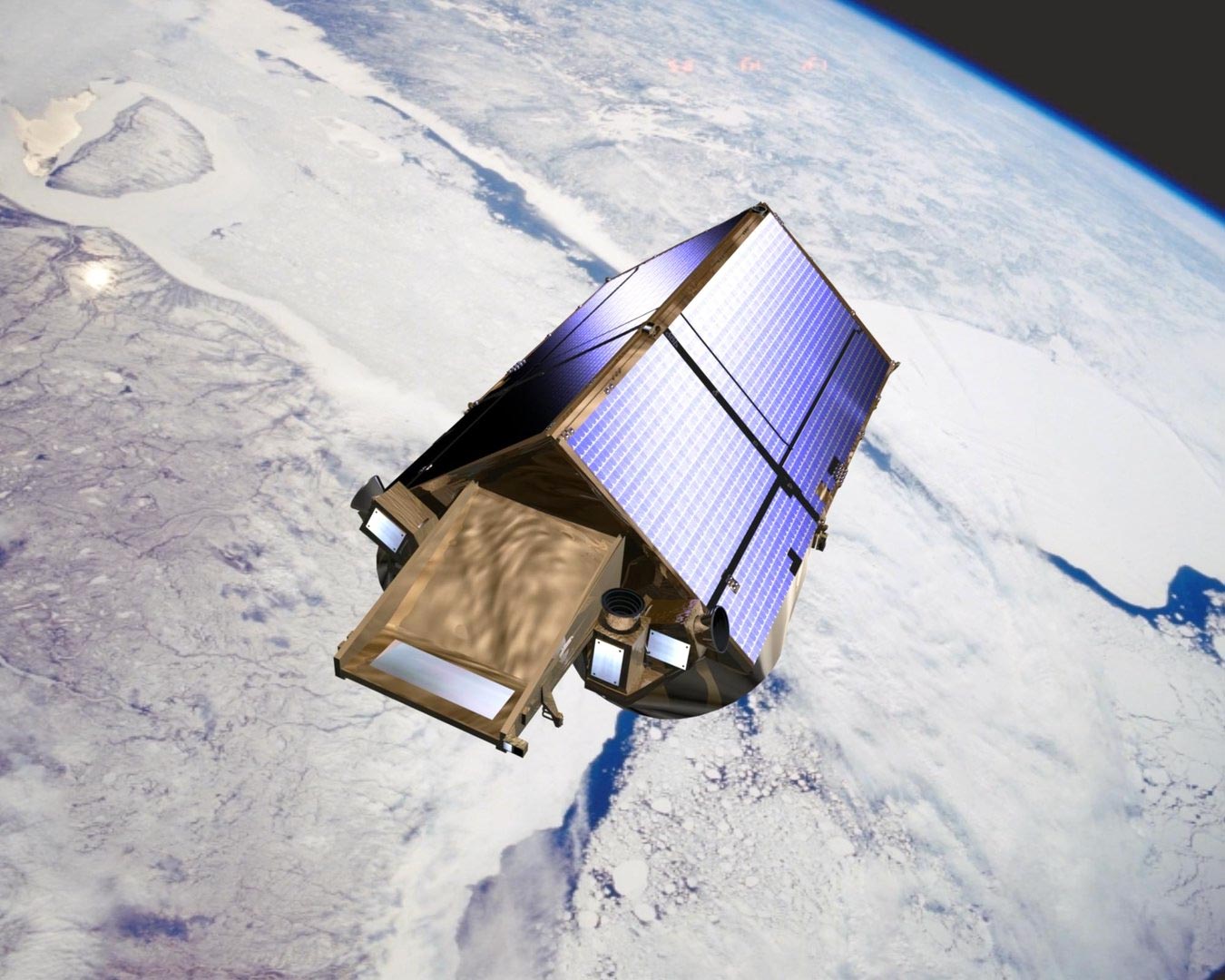
Artist’s impression of the CryoSat satellite in orbit. Credit: ESA/AOES Medialab

Ice loss from Pine Island Glacier has contributed more to sea-level rise over the past four decades than any other glacier in Antarctica. However, the way this huge glacier is thinning is complex, leading to uncertainty about how it is likely to raise sea level in the future. Thanks to ESA’s CryoSat mission, scientists have now been able to shed new light on these complex patterns of ice loss.

Although Pine Island Glacier is one of the most intensively and extensively investigated glacier systems in Antarctica, different model projections of future mass loss give conflicting results; some suggesting mass loss could dramatically increase over the next few decades, resulting in a rapidly growing contribution to sea level, while others indicate a more moderate response.

Identifying which is the more likely behavior is important for understanding future sea-level rise and how this vulnerable part of Antarctica is going to evolve over the coming decades.

Thinning of Pine Island Glacier

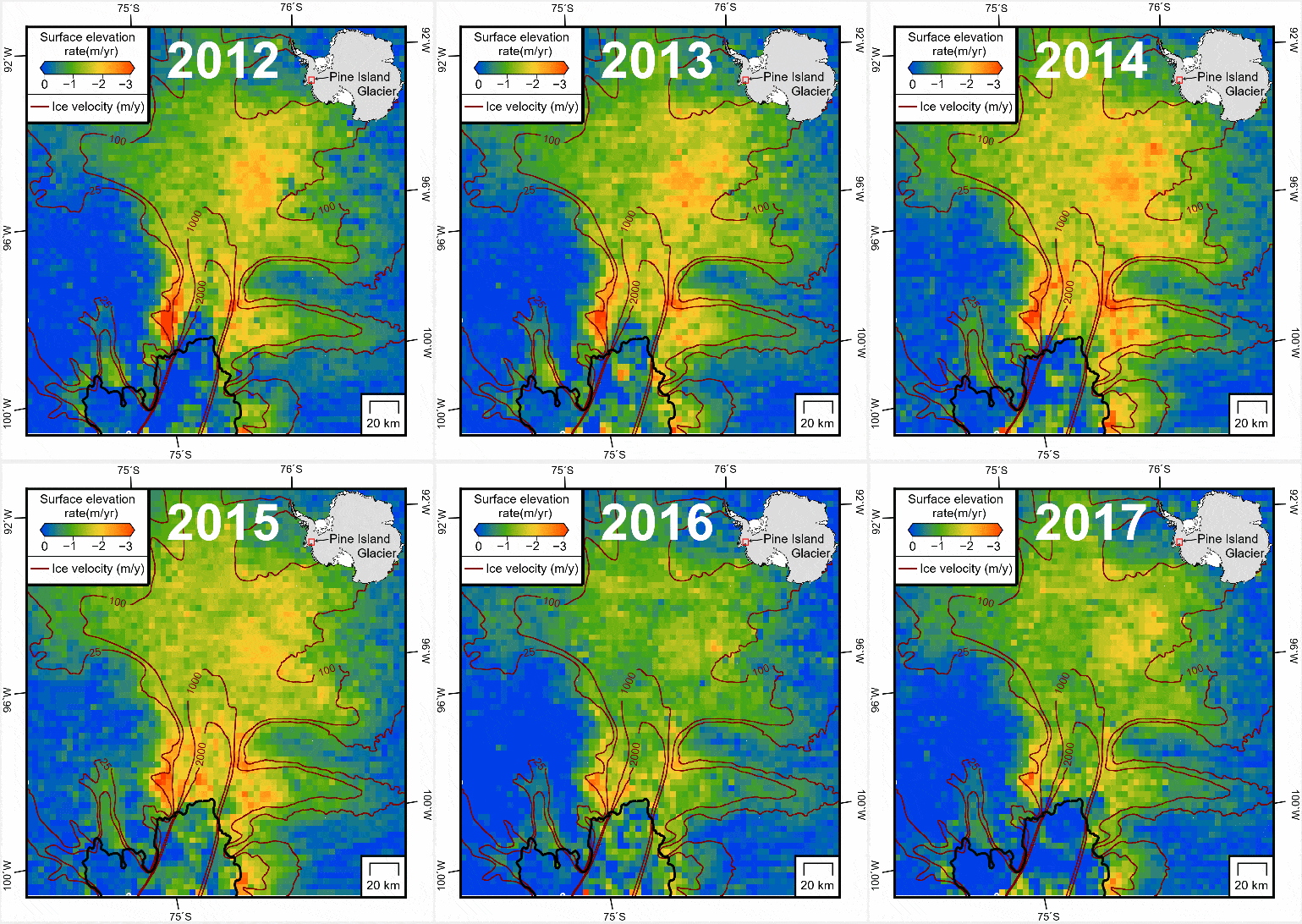
Animation of the thinning of Pine Island Glacier. Credit: University of Bristol

In a paper published in Nature Geoscience, scientists from the University of Bristol, UK, describe how they used information from CryoSat to help clarify the situation. They discovered that the pattern of ice loss is evolving in complex ways, both in space and time.

Rates in the fast-flowing central trunk of the glacier have decreased by about a factor of five since 2007 – and this is the opposite of what was observed prior to 2010.

These new results suggest that rapid migration of the grounding line, the place where the grounded ice first meets the ocean, is unlikely over the next decades, without a major change in the role of the ocean in ice loss. Instead, the results support model simulations that imply that the glacier will continue to lose mass, but not at much greater rates than present.

Lead author Prof. Jonathan Bamber from the University of Bristol’s School of Geographical Sciences, said, “This could seem like a ‘good news story’, but it’s important to remember that we still expect this glacier to continue to lose mass in the future and for that trend to increase over time, just not quite as fast as some model simulations suggested.

“It’s really important to understand why the models are producing different behavior in the future and to get a better handle on how the glacier will evolve with the benefit of these new observations.

“In our study, we didn’t make projections, but with the aid of these new data we can improve model projections for this part of Antarctica.”

Tommaso Parrinello, ESA’s CryoSat mission manger, added, “In April, CryoSat will have been in orbit for 10 years, far exceeding its expected life. We continue to be proud of the contribution to science this extraordinary satellite mission is making.

“And here, with the issue of sea-level rise a major global concern, the better equipped we are with facts the better it is. CryoSat has helped clarify the situation at Pine Island Glacier, which is not only important for our scientific understanding, but ultimately for society at large.”

For more on this story, read Antarctica’s Biggest Glacier Is Thinning in Patterns Opposite to Previously Observed.

Reference: “Complex evolving patterns of mass loss from Antarctica’s largest glacier” by Jonathan L. Bamber and Geoffrey J. Dawson, 27 January 2020, Nature Geoscience.
DOI: 10.1038/s41561-019-0527-z

Let's block ads! (Why?)


https://news.google.com/__i/rss/rd/articles/CBMiZWh0dHBzOi8vc2NpdGVjaGRhaWx5LmNvbS9jcnlvc2F0LWRpc2NvdmVycy1hbnRhcmN0aWNhcy1iaWdnZXN0LWdsYWNpZXJzLWljZS1sb3NzLXBhdHRlcm4taXMtZXZvbHZpbmcv0gFpaHR0cHM6Ly9zY2l0ZWNoZGFpbHkuY29tL2NyeW9zYXQtZGlzY292ZXJzLWFudGFyY3RpY2FzLWJpZ2dlc3QtZ2xhY2llcnMtaWNlLWxvc3MtcGF0dGVybi1pcy1ldm9sdmluZy9hbXAv?oc=5

2020-02-02 13:35:16Z
52780584570805

Sabtu, 01 Februari 2020

Asteroid That Killed the Dinosaurs Was Great for Bacteria - The New York Times

The asteroid moved 24 times faster than a rifle bullet as it struck Earth some 66 million years ago. Its supersonic shock wave flattened trees across North and South America, and its heat wave sparked incomprehensibly large forest fires.

The event lofted so much debris into the atmosphere that photosynthesis shut down. The non-avian dinosaurs disappeared. And nearly 75 percent of all species were extinguished.

At the point of impact, the picture was even more dire. The space rock left a sterile crater nearly 20 miles deep in what is now the Gulf of Mexico. Not a single living thing could have survived.

But even at ground zero, life managed to return, and quickly.

New findings published in the journal Geology last week revealed that cyanobacteria — blue-green algae responsible for harmful toxic blooms — moved into the crater a few years after the impact. That’s the blink of an eye, geologically speaking, and helps illuminate how life bounces back on Earth following cataclysmic events, even in the most devastated environments.

In 2016, scientists drilled into the heart of the so-called Chicxulub crater and excavated a 2,750-foot-long core of sediments, allowing scientists all over the world, such as Bettina Schaefer of Curtin University in Australia, to parse the rocks for their own research.

Those samples have answered a number of questions regarding the impact, but Ms. Schaefer wanted to better understand how life rebounded at ground zero. Although scientists had seen hints of early life before, the numbers were small and couldn’t capture the entire picture.

The issue is that not all micro-organisms leave behind fossils. Instead, soft-bodied organisms can be identified by the burrows they make and the molecules they deposit. Cyanobacteria, for example, produce fats that can be preserved in sedimentary rocks for hundreds of millions of years.

So when Ms. Schaefer’s team saw those preserved fats in the core near the time of the impact, they knew cyanobacteria must have been present. Crucially, the fats were deposited atop a layer of fossilized plants that were washed into the crater by the tsunami that followed, but below another layer of iridium that was deposited once the debris in the atmosphere rained back down on Earth after a few years. That suggests the bacteria began to populate the crater after the tsunami hit, but before the atmosphere cleared and the sun’s light had fully returned.

“The ones that were able to move in right away, the ambulance chasers, if you will, were these cyanobacteria,” said Sean P.S. Gulick, a marine geophysicist from the University of Texas at Austin, one of the co-chief scientists on the drilling expedition and Ms. Schaefer’s co-author.

Moreover, the team was able to detect a host of other organisms that arrived on the scene later, which helped to better characterize the toxic waters that pooled in the crater. Some of the molecular fossils they discovered, for example, can only originate from organisms that live in waters devoid of any oxygen — a so-called “dead zone” similar to what occurs every summer within the contemporary Gulf of Mexico.

Chris Lowery, a paleoceanographer at the University of Texas at Austin and an author on the recent study, suspects that the crater was only partially dead, in part because the team also saw evidence for fossils of plankton that rely on oxygen. Perhaps the crater’s oxygen-depleted waters existed within only certain layers of its water column. Or, like the dead zone in the modern gulf, maybe those waters were only seasonal.

Knowing that life thrived in the Chicxulub crater while it was still fresh could help scientists better understand how living things adapt to catastrophe today, said Jason Sylvan, an oceanographer at Texas A&M University who was not involved in the study.

Already, climate change has raised temperatures, depleted oxygen and acidified waters in the world’s oceans. But scientists remain unsure how microbial communities — which help control the amount of oxygen in the atmosphere — will respond.

To better forecast our future, they will continue to dig up fossils of the past — particularly those from one of the greatest extinctions on Earth.

Let's block ads! (Why?)


https://news.google.com/__i/rss/rd/articles/CBMiUmh0dHBzOi8vd3d3Lm55dGltZXMuY29tLzIwMjAvMDIvMDEvc2NpZW5jZS9hc3Rlcm9pZC1kaW5vc2F1cnMtY3JhdGVyLWJhY3RlcmlhLmh0bWzSAVZodHRwczovL3d3dy5ueXRpbWVzLmNvbS8yMDIwLzAyLzAxL3NjaWVuY2UvYXN0ZXJvaWQtZGlub3NhdXJzLWNyYXRlci1iYWN0ZXJpYS5hbXAuaHRtbA?oc=5

2020-02-01 10:00:00Z
CAIiEI1VSr5wWGQwrPVOwWN1Bd4qFwgEKg8IACoHCAowjuuKAzCWrzwwxoIY

NASA kills one of its most trusted satellites - BGR

With so many pieces of high-tech hardware at its disposal, it’s easy to forget that some of NASA’s most impressive machines are rapidly aging. The Spitzer Space Telescope is one of those machines, and after over 16 long years in space, the trusty spacecraft is now finally being retired.

NASA announced on Thursday that Spitzer had officially be placed in safe mode, effectively halting all science observations. This was the final step toward decommissioning the spacecraft, and Spitzer’s Project Manager Joseph Hunt made the final declaration that the mission was completed.

The Spitzer mission was originally slated to last around 2.5 years with the possibility of extending it to five years. Once it became clear that Spitzer was still capable of offering stunning glimpses of distant objects in space, NASA continued to extend the mission. In fact, the only reason the Spitzer project is now coming to an end is that it’s drifted so far from Earth that it’s difficult to keep the spacecraft powered up.

Spitzer doesn’t orbit Earth, but rather the Sun. It travels in a path similar to Earth but it doesn’t move as fast, meaning that Earth is constantly outpacing it. This wasn’t a problem for many years, as Spitzer could make its observations then turn and direct its antenna at Earth to fire its data back home.

However, these days the spacecraft is so far away from Earth that it has very little time to transmit data before it has to spin back around and gather energy from sunlight on its solar panels. With its efficiency approaching zero, NASA decided it was finally time to pull the plug and let Spitzer rest in cosmic peace.

Image Source: NASA/JPL-Caltech

Mike Wehner has reported on technology and video games for the past decade, covering breaking news and trends in VR, wearables, smartphones, and future tech. Most recently, Mike served as Tech Editor at The Daily Dot, and has been featured in USA Today, Time.com, and countless other web and print outlets. His love of reporting is second only to his gaming addiction.

Let's block ads! (Why?)


https://news.google.com/__i/rss/rd/articles/CBMiRmh0dHBzOi8vYmdyLmNvbS8yMDIwLzAxLzMxL3NwaXR6ZXItdGVsZXNjb3BlLWRlYWQtbmFzYS1kZWNvbW1pc3Npb25lZC_SAUpodHRwczovL2Jnci5jb20vMjAyMC8wMS8zMS9zcGl0emVyLXRlbGVzY29wZS1kZWFkLW5hc2EtZGVjb21taXNzaW9uZWQvYW1wLw?oc=5

2020-02-01 03:33:00Z
52780585235166

'Really, Really Bad': Scientists Raise Alarm Over Warm Ocean Water Beneath 'Doomsday Glacier' in Antarctica - Common Dreams

A study by British and American scientists revealed that a massive sheet of ice known as the "doomsday glacier" is melting faster than experts previously believed—edging the world closer to a possible sea level rise of more than 10 feet.

Researchers at New York University and the British Antarctic Survey drilled through nearly 2,000 feet of ice in the Thwaites glacier in West Antarctica, to measure temperatures at the 75-mile wide ice sheet's "grounding line," where the ice meets the ocean.

The water just beneath the ice was found to be 32º Fahrenheit—more than 2º above freezing temperature in the Antarctic region.

The findings have "huge implications for global sea level rise," NYU scientist David Holland said in a statement.

350.org co-founder and author Bill McKibben was among the climate action campaigners who expressed alarm over the new study.

"Oh, damn," McKibben wrote on social media.

The researchers expressed concern that the water beneath the glacier could be even warmer in other areas.

SCROLL TO CONTINUE WITH CONTENT

Get our best delivered to your inbox.

Scientists refer to Thwaites as the "doomsday glacier" due to the dire implications its rapid melting could have for the planet. Though a 10-foot sea level rise would likely take years, the melting of the glacier could eventually mean the U.S. would lose 28,800 square miles of coastal land—pushing 12.3 million people currently living in those areas out of their homes.

"Warm waters in this part of the world, as remote as they may seem, should serve as a warning to all of us about the potential dire changes to the planet brought about by climate change," Holland said.

The Thwaites glacier has lost 600 billion tons of ice over the past several decades, accelerating to as many as 50 billion tons per year in recent years.

"There is very warm water there, and clearly, it could not have been there forever, or the glacier could not be there," Holland told the Washington Post of the recent findings, suggesting the water has gotten warmer recently.

Scientists are especially concerned about the Thwaites because its configuration is an example of "marine ice sheet instability."

As Chris Mooney wrote at the Post:

Thwaites gets deeper and thicker from its oceanfront region back into its interior in the heart of West Antarctica. This is known to be an unstable configuration for a glacier, because as the ocean continues to eat away at its base, the glacier becomes thicker, so more ice is exposed to the ocean. In turn, that ice flows outward faster.

BBC released a short video detailing the scientists' journey to the Thwaites glacier and their findings.

"The ice rises almost a mile from the sea bed and it's collapsing into the sea at two miles a year," the narration explains. "If Thwaites melts, it will increase sea levels worldwide by half a meter. But it sits in the middle of the Antarctic ice sheet and there's three meters more of sea level rise locked up in there."

"That is really, really bad," Holland told the Post of the most recent discovery. "That's not a sustainable situation for that glacier."

Let's block ads! (Why?)


https://news.google.com/__i/rss/rd/articles/CBMifGh0dHBzOi8vd3d3LmNvbW1vbmRyZWFtcy5vcmcvbmV3cy8yMDIwLzAxLzMxL3JlYWxseS1yZWFsbHktYmFkLXNjaWVudGlzdHMtcmFpc2UtYWxhcm0tb3Zlci13YXJtLW9jZWFuLXdhdGVyLWJlbmVhdGgtZG9vbXNkYXnSAYABaHR0cHM6Ly93d3cuY29tbW9uZHJlYW1zLm9yZy9uZXdzLzIwMjAvMDEvMzEvcmVhbGx5LXJlYWxseS1iYWQtc2NpZW50aXN0cy1yYWlzZS1hbGFybS1vdmVyLXdhcm0tb2NlYW4td2F0ZXItYmVuZWF0aC1kb29tc2RheT9hbXA?oc=5

2020-01-31 22:30:00Z
52780584570805

Jumat, 31 Januari 2020

Scientists Snap Closest-Ever View of the Sun - ExtremeTech

This site may earn affiliate commissions from the links on this page. Terms of use.

Researchers have snapped the best-resolution view of the sun ever, courtesy of the Daniel K. Inouye 4-meter solar telescope. The image, which resolves features as small as 18 miles wide (30km), is an unprecedented glimpse of what the surface of the sun really looks like.

Typical images of the sun look like this, as captured by NASA’s Solar Dynamics Observatory (SDO), in geosynchronous orbit above Earth.

NASA-Sun

Image by NASA, via Wikipedia

This sort of image shows us a certain amount of detail, but it’s missing a lot — partly as a consequence of being shot from 93 million miles away. Then again, the SDO is also in orbit, which we know typically allows for much better viewing conditions than any ground-based telescope.

What allows the Inouye Solar Telescope to see in such detail compared with the SDO? Adaptive optics, location, and sheer size. At four meters (technically 4.24), the Inouye is the largest solar telescope on Earth and its location at Hawaii is one of the best-known locations for clear-sky viewing during the day. The situation appears to be analogous to the relationship between Hubble and some of our largest ground-based telescopes. Hubble has a 2.4-meter lens, while the European Extremely Large Telescope currently under construction in Chile will have a 39.3-meter lens upon completion. Hubble isn’t important because it presents us with the largest window on the heavens, but because the specific characteristics of space-based observation give us an additional level of bit-depth in areas other than the additional light-gathering capability from scaling up a lens. The Inouye Solar Telescope is expected to cooperate on observations with the already in-orbit NASA Parker Solar Probe and the joint ESA/NASA Solar Orbiter (currently prepping for launch).

In this case, the 4-meter telescope was able to make out what looks a lot like peanut brittle.

Super-Close-up-Sun

Image by AURA/NASA/NSO

Here’s how NASA/AURA/NSO describe the image:

The cell-like structures – each about the size of Texas – are the signature of violent motions that transport heat from the inside of the sun to its surface. Hot solar material (plasma) rises in the bright centers of “cells,” cools off and then sinks below the surface in dark lanes in a process known as convection. In these dark lanes we can also see the tiny, bright markers of magnetic fields. Never before seen to this clarity, these bright specks are thought to channel energy up into the outer layers of the solar atmosphere called the corona. These bright spots may be at the core of why the solar corona is more than a million degrees!

These images have been lightly processed to remove noise and enhance the shape of the structures; the full data set is still undergoing scientific analysis. Still, seeing the fine-scale structure of the sun is a reminder that it isn’t actually “just” a ball of burning gas. The science of how heat is theorized to move through a star and the large-scale structures we observe has implications for stellar theory. It could tell us something about how our own sun is evolving over its own lifespan, and might even have implications for our attempts to create sustainable fusion power generation on Earth. A better understanding of solar dynamics might also enable us to predict coronal mass ejections in the future — and that could be critically important, given the risk they pose.

I’m downright curious to see what kind of new data we’ll learn once the Parker Solar Probe, Solar Orbiter, and the Inouye Solar Telescope are online simultaneously.

Now Read:

Let's block ads! (Why?)


https://news.google.com/__i/rss/rd/articles/CBMiV2h0dHBzOi8vd3d3LmV4dHJlbWV0ZWNoLmNvbS9leHRyZW1lLzMwNTU2NC1zY2llbnRpc3RzLXNuYXAtY2xvc2VzdC1ldmVyLXZpZXctb2YtdGhlLXN1btIBAA?oc=5

2020-01-31 12:21:08Z
52780581500879