Selasa, 04 Februari 2020

NASA's Parker Solar Probe spotted 'stealth' outburst on the sun - Space.com

Coronal mass ejections aren't known for being subtle: Each such event can fling huge amounts of the soup of charged particles called plasma off the sun and out into the solar system.

In November 2018, as seen from Earth and certain spacecraft, the sun seemed to be calm. But it wasn't: The sun was experiencing what scientists call a "stealth" coronal mass ejection. And conveniently, NASA's Parker Solar Probe was completing its first close pass behind the sun, putting its instruments in a perfect position to see what was happening on Nov. 11 and 12 during this usually cryptic event.

"If you've ever seen a coronal mass ejection image, you normally see a lot of activity in these images," Kelly Korreck, a solar physicist at the Smithsonian Astrophysical Observatory, said during a presentation last month at the 235th meeting of the American Astronomical Society in Honolulu. "You would see a large blowout, you would probably see one of these exploding. But as you saw in this video, there wasn't much there."

Related: See the sun flip out in wild new satellite view

Even in some of the Parker Solar Probe data, it wasn't obvious at first what was happening during the incident, Korreck said. "When we looked at this initially, just the thermal data, we didn't necessarily think that there was a coronal mass ejection there," she said.

But other observations targeting energetic particles did include the fingerprint of a shock, a phenomenon that usually accompanies a coronal mass ejection. Scientists could also confirm the probe was flying through a coronal mass ejection based on data its instruments were gathering about the magnetic field.

The Parker Solar Probe is flying closer to the sun than any spacecraft ever has, which means it can study coronal mass ejections earlier in their development than other probes can. That means scientists hope the probe's data could help better pinpoint where on the sun an individual coronal mass ejection is born.

But just seeing a stealth coronal mass ejection is a step in the right direction, according to Korreck. "They're something that we're not traditionally able to see in the ways that we've previously detected coronal mass ejections," she said. "We're starting to see hints of them with better and better telescope resolution. However, at the same time, we've kind of reached the end where we actually have to go in situ to do a better measurement." And there's nothing more in situ than Parker Solar Probe.

Within our solar system, coronal mass ejections are important because they can interfere with communications and navigation satellites orbiting Earth. And the farther astronauts venture from Earth, the more vulnerable they will be to the potential health impacts of such blasts. That's when learning to see coronal mass ejections we currently miss would become particularly important.

Such phenomena are also intriguing because our sun is a star like any other. Scientists have spotted coronal mass ejections produced by other stars, but they'll never be able to see all such distant events.

"This is another class that definitely can't be seen on other stars," Korreck said. "Is there a way that we can do this with Parker [Solar Probe] to better understand what's going on in other star systems?"

Email Meghan Bartels at mbartels@space.com or follow her @meghanbartels. Follow us on Twitter @Spacedotcom and on Facebook.

Let's block ads! (Why?)


https://news.google.com/__i/rss/rd/articles/CBMiSmh0dHBzOi8vd3d3LnNwYWNlLmNvbS9wYXJrZXItc29sYXItcHJvYmUtc3BvdHRlZC1zdGVhbHRoLXN1bi1lcnVwdGlvbi5odG1s0gFOaHR0cHM6Ly93d3cuc3BhY2UuY29tL2FtcC9wYXJrZXItc29sYXItcHJvYmUtc3BvdHRlZC1zdGVhbHRoLXN1bi1lcnVwdGlvbi5odG1s?oc=5

2020-02-04 12:17:00Z
52780589628920

Climate change: Scientists find another threat to Greenland's glaciers lurking beneath the ice - msnNOW

Another view of the 50-mile-long glacier tongue shows torrential meltwater streams making their way toward the ocean.© Janin Schaffer/Alfred Wegener Institute Another view of the 50-mile-long glacier tongue shows torrential meltwater streams making their way toward the ocean.

Scientists have long known that higher air temperatures are contributing to the surface melting on Greenland's ice sheet.

But a new study has found another threat that has begun attacking the ice from below: Warm ocean water moving underneath the vast glaciers is causing them to melt even more quickly.

The findings were published Monday in the journal Nature Geoscience by researchers who studied one of the many "ice tongues" of the Nioghalvfjerdsfjorden Glacier -- also known as the 79° North Glacier -- in northeast Greenland.

An ice tongue is a strip of ice that floats on the water without breaking off from the ice on land. The massive one these scientists studied is nearly 50 miles long.

The survey revealed an underwater current more than a mile wide where warm water from the Atlantic Ocean is able to flow directly towards the glacier, bringing large amounts of heat into contact with the ice and accelerating the glacier's melting.

"The reason for the intensified melting is now clear," said Janin Schaffer, an oceanographer from the Alfred Wegener Institute in Germany who led the team of researchers, in a release about the findings.

The scientists also found a similar current flowing near another of Greenland's glaciers, where a large ice tongue had recently broken off into the ocean.

What warmer oceans mean for the planet

Mass loss from Greenland's ice sheet is currently the single largest driver of sea level rise globally, and according to a study published in December in the journal Nature, Greenland's ice sheet is currently melting seven times faster than it was in 1992.

This ice sheet holds enough water to raise global sea levels by more than 24 feet.

Much of the Arctic experienced record temperatures last summer, which caused Greenland's ice sheet to lose 11 billion tons of surface ice to the ocean in just one day, scientists said. That is the equivalent of 4.4 million Olympic swimming pools.

In July alone, Greenland's ice sheet lost 197 billion tons of ice, or the equivalent of around 80 million Olympic swimming pools, according to Ruth Mottram, a climate scientist with the Danish Meteorological Institute.

Water temperatures also broke records in 2019. A study published in the journal Advances in Atmospheric Sciences says the ocean temperature last year was 0.075 degrees Celsius above the 1981-2010 average. The study's authors said the heat absorbed today by the world's oceans is now equivalent to dropping roughly five Hiroshima bombs into them every second over the past 25 years.

Warmer oceans as a result of the climate crisis also make extreme weather events such as hurricanes capable of producing more rainfall.

And ocean heat impacts the stability of sea life, which could lead to declining fish catches in many parts of the world dependent on the ocean as a primary food source.

a close up of a rock: These measuring instruments study ocean temperatures and are strung together on rope and fixed to the ocean floor.© Andreas Preußer/Alfred Wegener Institute These measuring instruments study ocean temperatures and are strung together on rope and fixed to the ocean floor.

Let's block ads! (Why?)


https://news.google.com/__i/rss/rd/articles/CBMinwFodHRwczovL3d3dy5tc24uY29tL2VuLXVzL3dlYXRoZXIvdG9wc3Rvcmllcy9jbGltYXRlLWNoYW5nZS1zY2llbnRpc3RzLWZpbmQtYW5vdGhlci10aHJlYXQtdG8tZ3JlZW5sYW5kcy1nbGFjaWVycy1sdXJraW5nLWJlbmVhdGgtdGhlLWljZS9hci1CQlpDcE5kP2xpPUJCbmI3S3rSAQA?oc=5

2020-02-04 06:23:00Z
CBMinwFodHRwczovL3d3dy5tc24uY29tL2VuLXVzL3dlYXRoZXIvdG9wc3Rvcmllcy9jbGltYXRlLWNoYW5nZS1zY2llbnRpc3RzLWZpbmQtYW5vdGhlci10aHJlYXQtdG8tZ3JlZW5sYW5kcy1nbGFjaWVycy1sdXJraW5nLWJlbmVhdGgtdGhlLWljZS9hci1CQlpDcE5kP2xpPUJCbmI3S3rSAQA

Senin, 03 Februari 2020

New Research Explains How Solar Panels Could Soon Be Generating Power at Night - ScienceAlert

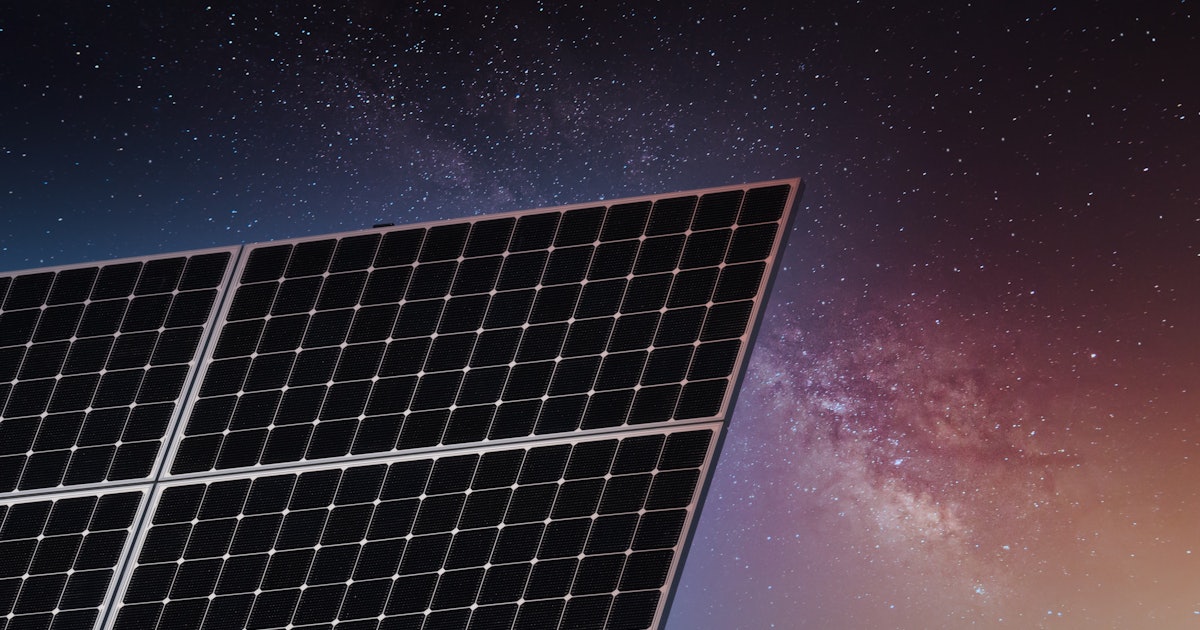
As beneficial as current solar panel technology has been in our quest to switch to renewable energy, such panels can't generate electricity at night. Now, new research suggests it could be possible to design panels that can operate around the clock.

Under optimum conditions, at night these specially designed photovoltaic cells could generate a quarter of the energy they produce during the day, according to the new study.

To achieve this, we'd need to incorporate thermoradiative cells - devices that generate energy thanks to radiative cooling, where infrared or heat radiation leaves the cell and produces a small amount of energy in the process.

Thermoradiative cells are already being tested in fields such as manufacturing, where they are used to convert waste heat, such as the high temperatures generated by an engine.

In the case of a night-time solar panel, pointing such a cell at the cold night sky is a way to harness this process.

night power 2How thermoradiative cells (right) compare to solar cells (left). (Tristan Deppe/Jeremy Munday)

"We were thinking, what if we took one of these devices and put it in a warm area and pointed it at the sky," says electrical and computer engineer Jeremy Munday, from the University of California, Davis.

To achieve this effect with infrared radiation, we'd require different kinds of materials to regular solar panels, which tend to focus on visible light (though researchers have also experimented with cells that can capture both).

The next step is to figure out what mix of materials and electronics might produce an effective panel that can use the night sky and space as a heat sink. The underlying maths, however, checks out.

"A regular solar cell generates power by absorbing sunlight, which causes a voltage to appear across the device and for current to flow," says Munday. "In these new devices, light is instead emitted and the current and voltage go in the opposite direction, but you still generate power."

"You have to use different materials, but the physics is the same."

Solar farms could produce up to 50 watts of power per square metre (around 10 square feet) under ideal conditions, according to the researchers' calculations – boosting energy production by about 12 percent overall in open, arid environments where a lot of solar farms are already based.

It's an idea that several groups are looking into. Last year we saw an experimental system, set up by researchers from Stanford University, which also used the heat imbalance between the night-time sky and the Earth to generate electricity from infrared radiation.

While there's a long way to go to properly scale up this technology so that it's practically useful – right now Munday and his colleagues only have prototypes in development – this is potentially a relatively cheap and inexpensive way to keep solar cells operating 24 hours a day.

"Deep space offers an intriguing low-temperature thermal sink that has the potential to help provide electrical power at night and day through the clever use of photonics, optics, and materials science," conclude the researchers in their published paper.

The research has been published in ACS Photonics.

Let's block ads! (Why?)


https://news.google.com/__i/rss/rd/articles/CBMiXGh0dHBzOi8vd3d3LnNjaWVuY2VhbGVydC5jb20vaGVyZS1zLWhvdy1zb2xhci1wYW5lbHMtY291bGQtc29vbi1iZS1nZW5lcmF0aW5nLXBvd2VyLWF0LW5pZ2h00gFgaHR0cHM6Ly93d3cuc2NpZW5jZWFsZXJ0LmNvbS9oZXJlLXMtaG93LXNvbGFyLXBhbmVscy1jb3VsZC1zb29uLWJlLWdlbmVyYXRpbmctcG93ZXItYXQtbmlnaHQvYW1w?oc=5

2020-02-04 01:14:09Z
52780589628920

Max Q: SpaceX’s Starlink constellation grows again - TechCrunch

TechCrunch ist Teil von Verizon Media. Klicken Sie auf 'Ich stimme zu.', um Verizon Media und dessen Partnern Ihre Einwilligung zu geben, Cookies und ähnliche Technik zu nutzen, um auf Ihr Gerät zuzugreifen und Ihre Daten (einschließlich Standort) zu nutzen, um mehr über Ihre Interessen zu erfahren, personalisierte Anzeigen bereitzustellen und deren Effektivität zu messen. Wir stellen außerdem personalisierte Anzeigen für Partnerprodukte bereit. Weitere Informationen, wie wir Ihre Daten nutzen, finden Sie in unserem Datenschutzcenter. Sie können Ihre Datenschutz Einstellungen künftig in Ihrem Datenschutz-Dashboard ändern.

Klicken Sie auf 'Weitere Informationen', um zu erfahren, wie Verizon Media und dessen Partner Daten erfassen und verwenden, und um dies anzupassen.

Let's block ads! (Why?)


https://news.google.com/__i/rss/rd/articles/CBMiU2h0dHBzOi8vdGVjaGNydW5jaC5jb20vMjAyMC8wMi8wMy9tYXgtcS1zcGFjZXhzLXN0YXJsaW5rLWNvbnN0ZWxsYXRpb24tZ3Jvd3MtYWdhaW4v0gFXaHR0cHM6Ly90ZWNoY3J1bmNoLmNvbS8yMDIwLzAyLzAzL21heC1xLXNwYWNleHMtc3RhcmxpbmstY29uc3RlbGxhdGlvbi1ncm93cy1hZ2Fpbi9hbXAv?oc=5

2020-02-03 17:07:04Z
52780586529790

Mystery deepens over 42 oddly buried skeletons found on UK farm - Livescience.com

[unable to retrieve full-text content]

Mystery deepens over 42 oddly buried skeletons found on UK farm  Livescience.com
https://news.google.com/__i/rss/rd/articles/CBMiOGh0dHBzOi8vd3d3LmxpdmVzY2llbmNlLmNvbS80Mi1taXNzaW5nLXNrZWxldG9ucy11ay5odG1s0gE8aHR0cHM6Ly93d3cubGl2ZXNjaWVuY2UuY29tL2FtcC80Mi1taXNzaW5nLXNrZWxldG9ucy11ay5odG1s?oc=5

2020-02-03 14:13:00Z
CBMiOGh0dHBzOi8vd3d3LmxpdmVzY2llbmNlLmNvbS80Mi1taXNzaW5nLXNrZWxldG9ucy11ay5odG1s0gE8aHR0cHM6Ly93d3cubGl2ZXNjaWVuY2UuY29tL2FtcC80Mi1taXNzaW5nLXNrZWxldG9ucy11ay5odG1s

Anti-solar panel can generate electricity at night, researchers say - Inverse

One of the problems with solar panels is that they don't generate electricity at night, so we have to store the electricity they generate during the day to power things during the evening. That works fine, but what if we could develop solar panels that did generate electricity at night? It's possible, and the way it works is pretty surprising.

Researchers from the University of California, Davis explain in a new paper that was just published in the journal ACS Photonics that if you want to create a solar panel that generates electricity at night, then you just have to create one that operates the exact opposite way solar panels work during the day. It's being referred to as the "anti-solar panel."

Solar panels are cold compared to the Sun, so they absorb the Sun's light and turn it into energy. Space is very cold, so if you point a panel on Earth that is comparatively warm toward it, it will radiate heat as invisible infrared light. This allows you to generate electricity by capturing that power. The paper claims such a device could generate about a quarter of the electricity at night that a normal solar panel generates during the day.

Jeremy Munday, a professor in the Department of Electrical and Computer Engineering at UC Davis who is an author of the paper, tells Inverse that whether it's a solar panel or this anti-solar panel, these things are essentially just "heat engines."

"You have heat energy coming from the Sun towards the Earth and that normal solar cell picks off that energy as it's transmitted from the Sun to the Earth, so basically you need these two different temperature bodies and some way of converting that power," Munday says. "What this nighttime device does is a similar sort of thing—where it's just taking a hot body and a cold body—but now the relatively hot body is the Earth and space is the cold body. As this heat is flowing from the Earth to outer space, it's picking that off and converting that into power."

This kind of device uses what is called a thermoradiative cell to generate electricity, as opposed to the photovoltaic cell used by a conventional solar panel. Where a solar panel is typically made of silicon, which is good at capturing light that's largely in the visible spectrum, this device has to be made of something that can capture extremely long wavelength light. Munday is currently looking at mercury alloys that would be good for this.

Munday and his team are currently working on developing prototypes to see how well they can make this concept work.

See also: A 200-year-old technology could help millions living off the grid

Other researchers are also looking into how to make solar panels, or "anti-solar panels," that generate electricity at night. Researchers at Stanford published a paper in the journal Jouele in November showing how a thermoelectric generator that radiates heat to the sky can generate electricity.

"Unlike traditional thermoelectric generators, our device couples the cold side of the thermoelectric module to a sky-facing surface that radiates heat to the cold of space and has its warm side heated by the surrounding air, enabling electricity generation at night," the paper reads.

Our batteries have been slowly getting better for years, and so have our solar panels, so we don't necessarily need solar panels that can generate electricity at night to meet our energy needs. However, if we can devise a system that can generate clean energy 24 hours a day, we could possibly produce more energy than we need and store it for various purposes, such as an emergency. It's better to have too much energy than to come up short.

Abstract: Photovoltaics possess significant potential due to the abundance of solar power incident on earth; however, they can only generate electricity during daylight hours. In order to produce electrical power after the sun has set, we consider an alternative photovoltaic concept that uses the earth as a heat source and the night sky as a heat sink, resulting in a “nighttime photovoltaic cell” that employs thermoradiative photovoltaics and concepts from the advancing field of radiative cooling. In this Perspective, we discuss the principles of thermoradiative photovoltaics, the theoretical limits of applying this concept to coupling with deep space, the potential of advanced radiative cooling techniques to enhance their performance, and a discussion of the practical limits, scalability, and integrability of this nighttime photovoltaic concept.

Let's block ads! (Why?)


https://news.google.com/__i/rss/rd/articles/CBMicmh0dHBzOi8vd3d3LmludmVyc2UuY29tL2lubm92YXRpb24vcmVzZWFyY2hlcnMtaGF2ZS1hLWNvdW50ZXJpbnR1aXRpdmUtY29uY2VwdC1mb3Itc29sYXItcGFuZWxzLXRoYXQtd29yay1hdC1uaWdodNIBdmh0dHBzOi8vd3d3LmludmVyc2UuY29tL2lubm92YXRpb24vcmVzZWFyY2hlcnMtaGF2ZS1hLWNvdW50ZXJpbnR1aXRpdmUtY29uY2VwdC1mb3Itc29sYXItcGFuZWxzLXRoYXQtd29yay1hdC1uaWdodC9hbXA?oc=5

2020-02-03 03:51:32Z
52780587523190

Mars’ water may have been packed with minerals and salt, possibly supporting life, study says - Fox News

NASA has already found evidence of an oasis on Mars, but a new study notes that ancient waters on the Red Planet had the right conditions to support life.

The research, published in Nature Communications, suggests the water that once resided in the Gale Crater on Mars contained salt, had a mild pH level capable of supporting life and had a redox state (the measure of gases such as hydrogen or oxygen) reminiscent of a semiarid climate.

"Assuming that post-depositional sulfate-rich fluids interacted with the sediments, the redox disequilibria in secondary minerals suggest infiltration of oxidizing fluids into reducing sediments," researchers wrote in the study's abstract.

The annotated area in this illustration shows where water ice is located near the surface of Mars.

The annotated area in this illustration shows where water ice is located near the surface of Mars. (Credits: NASA/JPL-Caltech)

ALIEN BREAKTHROUGH AS WATER ON MARS CONTAINED JUST THE RIGHT INGREDIENTS TO SUPPORT LIFE, SCIENTISTS SAY

The Curiosity rover is exploring the Gale Crater, having celebrated its seventh anniversary on the Red Planet in August. Last month, it got stuck on Mars during a set of activities, but it has since begun operating normally.

The Gale Crater is believed to be between 3.5 and 3.8 billion years old and previous studies have looked at it to show the difference between the wet climate on ancient Mars and the desolate, arid climate it has today.

The Curiosity rover has made several remarkable discoveries, including finding "unusually high" levels of methane and a "shiny" object believed to be a meteorite.

NASA: ANCIENT MARS OASIS COULD HAVE SUPPORTED LIFE

NASA hopes the Curiosity rover, which "has a few more years before its nuclear power system degrades enough to significantly limit operations," can provide additional clues about the planet prior to the launch of the Mars 2020 rover mission.

In November, NASA announced that it has selected the location where its Mars 2020 rover will land on the Red Planet. The rover is expected to reach the Martian surface on Feb. 18, 2021. NASA’s long-term goal is to send a manned mission to Mars in the 2030s.

CLICK HERE TO GET THE FOX NEWS APP

Let's block ads! (Why?)


https://news.google.com/__i/rss/rd/articles/CBMiSGh0dHBzOi8vd3d3LmZveG5ld3MuY29tL3NjaWVuY2UvbWFycy13YXRlci1taW5lcmFscy1zYWx0LXN1cHBvcnRpbmctbGlmZdIBTGh0dHBzOi8vd3d3LmZveG5ld3MuY29tL3NjaWVuY2UvbWFycy13YXRlci1taW5lcmFscy1zYWx0LXN1cHBvcnRpbmctbGlmZS5hbXA?oc=5

2020-02-03 13:05:32Z
52780587955027