Sabtu, 27 April 2019

NASA will simulate an asteroid impact scenario with live tweeting - Mashable

What would happen if an asteroid impacted Earth sorta like a comet did in 1998's 'Deep Impact?"
Image: Dreamworks/Paramount/Kobal/REX/Shutterstock

If an asteroid were ever to be come hurtling towards Earth, what would be the plan to stop it from impacting the planet?

That's the question NASA and its partners, including the European Space Agency and the U.S.'s Federal Emergency Management Agency (FEMA), are gathering at the 2019 Planetary Defense Conference in early May to investigate.

During the five day conference, NASA and its partners plan to engage in a "tabletop exercise" that simulates what would happen if scientists and authorities were to learn of a near-Earth Object (NEO) impact scenario.

"A tabletop exercise of a simulated emergency commonly used in disaster management planning to help inform involved players of important aspects of a possible disaster and identify issues for accomplishing a successful response," says NASA.

In the exercise (detailed by the ESA here), NASA and its partners have to respond to a "realistic — but fictional — scenario" involving a NEO named "2019 PDC," which has a 1 in 100 chance of impacting Earth in 2027.

Armed with all of the hypothetical information about "2019 PDC," the exercise is intended to see how the various organizations and governments would handle the situation as it unfolds.

"The first step in protecting our planet is knowing what’s out there," said RĂ¼diger Jehn, the ESA’s Head of Planetary Defence. "Only then, with enough warning, can we take the steps needed to prevent an asteroid strike altogether, or minimize the damage it does on the ground."

In such a situation, the ESA says it would live tweet details "so you’ll find out the ‘news’ as the experts do." And for the hypothetical 2019 PDC asteroid exercise at the conference, the agency will indeed live tweet the series of decided actions as if they are made.

"These exercises have really helped us in the planetary defense community to understand what our colleagues on the disaster management side need to know," said Lindley Johnson, NASA's Planetary Defense Officer. "This exercise will help us develop more effective communications with each other and with our governments."

Despite NASA having participated in six NEO impact exercises before, each scenario is different and the agency says it's learned that the focus is not always on the asteroid details, even though that's still crucial to creating a plan to either deflect it or reduce its impact.

"What emergency managers want to know is when, where and how an asteroid would impact, and the type and extent of damage that could occur," said Leviticus Lewis of the Response Operations Division for FEMA.

Well, you know what they say...it's better to be prepared. At the very least, NASA and friends won't be panicking as hard if an asteroid were ever to really hit Earth.

Uploads%252fvideo uploaders%252fdistribution thumb%252fimage%252f91006%252fbc8be35c 14ed 4e21 9aa4 2e0064c1d0b9.jpg%252foriginal.jpg?signature=eiul1gluktirjpa5mvpdpaxvxjy=&source=https%3a%2f%2fblueprint api production.s3.amazonaws

Let's block ads! (Why?)


https://mashable.com/article/nasa-esa-fema-asteroid-impact-earth-simulation-response/

2019-04-27 17:09:00Z
52780277812415

The universe is younger and expanding faster than we thought, a new study found — and we may need new physics as a result - INSIDER

  • A new study led by a Nobel Prize winner found that the universe is younger and expanding faster than scientists thought.
  • Astronomer Adam Riess used measurements from NASA's Hubble Space Telescope to conclude that the universe is expanding 9% faster than previous calculations said.
  • Reiss and other scientists think that both calculations could be right, which means that the rate of the universe's expansion has increased
  • They think that "new physics" may be necessary to explain the difference.
  • Riess also calculated that the universe is between 12.5 billion and 13 billion years old — younger than the previous estimates of between 13.6 billion and 13.8 billion years old.
  • Visit Business Insider's homepage for more stories/

The universe is younger and expanding faster than we thought, a new study found, scientists think we may have to work on new physics as a result.

A new study lead by Nobel Prize-winning scientist, Adam Riess, found that the universe is expanding 9% faster than previous calcultions that were based on studying the aftermath of the Big Bang.

The study by Riess, an astronomer at Johns Hopkins University, was published in Astrophysical Journal this week, and used new measurements from NASA's Hubble Space Telescope to calculate the new expansion rate, which scientist have theorized for years.

But Reiss, and other scientists, think that the expansion rates concluded by both studies could be correct, which means that the rate of the universe's expansion has increased — and they say that "new physics" may be necessary to explain the discrepancy.

Reiss said that the universe "is outpacing all our expectations in its expansion, and that is very puzzling."

Read more: NASA has discovered that meteoroids are causing water to leak off the moon

NASA astrophysicist John Mather, who has also won a Nobel Prize, said that the two different expansion rates could be down to two things, The Associated Press reported: "1. We're making mistakes we can't find yet. 2. Nature has something we can't find yet."

But Reiss downplayed the idea that the results could be the result of human error. He said that the "mismatch" between the two rates "has been growing and has now reached a point that is really impossible to dismiss as a fluke," he said. "This is not what we expected."

Riess said: "This is not just two experiments disagreeing."

NASA's Hubble Space Telescope.
NASA/Getty Images

"We are measuring something fundamentally different. One is a measurement of how fast the universe is expanding today, as we see it. The other is a prediction based on the physics of the early universe and on measurements of how fast it ought to be expanding. If these values don't agree, there becomes a very strong likelihood that we're missing something in the cosmological model that connects the two eras."

Read more: A photographer recorded Saturn 'touching' the moon with his smartphone, and the pictures are stunning

"It's looking more and more like we're going to need something new to explain this," he said.

One theory suggested by Reiss is that the mysterious "dark energy" substance could have sped up the expansion of the universe.

University of Chicago astrophysicist Wendy Freedman also said that both calculations seem valid, and that "nobody can find anything wrong at this point" with either of the studies or their results.

Using measurements captured though the Hubble telescope, Riess also calculated that the universe is between 12.5 billion and 13 billion years old — younger than the previous estimates of between 13.6 billion and 13.8 billion years old.

Let's block ads! (Why?)


https://www.thisisinsider.com/universe-younger-expanding-faster-than-thought-study-new-physics-2019-4

2019-04-27 14:04:57Z
CAIiELw7behnk0lFF9CHjGyNxh4qGQgEKhAIACoHCAow9qOFCzDSvIIDMLD-hQY

Important Threshold Crossed in Mystery of the Universe's Expansion Rate - SciTechDaily

Mystery of the Universe’s Expansion Rate Widens

This is a ground-based telescope’s view of the Large Magellanic Cloud, a satellite galaxy of our Milky Way. The inset image, taken by the Hubble Space Telescope, reveals one of many star clusters scattered throughout the dwarf galaxy. The cluster members include a special class of pulsating star called a Cepheid variable, which brightens and dims at a predictable rate that corresponds to its intrinsic brightness. Once astronomers determine that value, they can measure the light from these stars to calculate an accurate distance to the galaxy. When the new Hubble observations are correlated with an independent distance measurement technique to the Large Magellanic Cloud (using straightforward trigonometry), the researchers were able to strengthen the foundation of the so-called “cosmic distance ladder.” This “fine-tuning” has significantly improved the accuracy of the rate at which the universe is expanding, called the Hubble constant. Credits: NASA, ESA, A. Riess (STScI/JHU) and Palomar Digitized Sky Survey

Astronomers using NASA’s Hubble Space Telescope say they have crossed an important threshold in revealing a discrepancy between the two key techniques for measuring the universe’s expansion rate. The recent study strengthens the case that new theories may be needed to explain the forces that have shaped the cosmos.

A brief recap: The universe is getting bigger every second. The space between galaxies is stretching, like dough rising in the oven. But how fast is the universe expanding? As Hubble and other telescopes seek to answer this question, they have run into an intriguing difference between what scientists predict and what they observe.

Hubble measurements suggest a faster expansion rate in the modern universe than expected, based on how the universe appeared more than 13 billion years ago. These measurements of the early universe come from the European Space Agency’s Planck satellite. This discrepancy has been identified in scientific papers over the last several years, but it has been unclear whether differences in measurement techniques are to blame, or whether the difference could result from unlucky measurements.

The latest Hubble data lower the possibility that the discrepancy is only a fluke to 1 in 100,000. This is a significant gain from an earlier estimate, less than a year ago, of a chance of 1 in 3,000.

These most precise Hubble measurements to date bolster the idea that new physics may be needed to explain the mismatch.

“The Hubble tension between the early and late universe may be the most exciting development in cosmology in decades,” said lead researcher and Nobel laureate Adam Riess of the Space Telescope Science Institute (STScI) and Johns Hopkins University, in Baltimore, Maryland. “This mismatch has been growing and has now reached a point that is really impossible to dismiss as a fluke. This disparity could not plausibly occur just by chance.”

Tightening the bolts on the ‘cosmic distance ladder’

Scientists use a “cosmic distance ladder” to determine how far away things are in the universe. This method depends on making accurate measurements of distances to nearby galaxies and then moving to galaxies farther and farther away, using their stars as milepost markers. Astronomers use these values, along with other measurements of the galaxies’ light that reddens as it passes through a stretching universe, to calculate how fast the cosmos expands with time, a value known as the Hubble constant. Riess and his SH0ES (Supernovae H0 for the Equation of State) team have been on a quest since 2005 to refine those distance measurements with Hubble and fine-tune the Hubble constant.

In this new study, astronomers used Hubble to observe 70 pulsating stars called Cepheid variables in the Large Magellanic Cloud. The observations helped the astronomers “rebuild” the distance ladder by improving the comparison between those Cepheids and their more distant cousins in the galactic hosts of supernovas. Riess’s team reduced the uncertainty in their Hubble constant value to 1.9% from an earlier estimate of 2.2%.

As the team’s measurements have become more precise, their calculation of the Hubble constant has remained at odds with the expected value derived from observations of the early universe’s expansion. Those measurements were made by Planck, which maps the cosmic microwave background, a relic afterglow from 380,000 years after the big bang.

The measurements have been thoroughly vetted, so astronomers cannot currently dismiss the gap between the two results as due to an error in any single measurement or method. Both values have been tested multiple ways.

“This is not just two experiments disagreeing,” Riess explained. “We are measuring something fundamentally different. One is a measurement of how fast the universe is expanding today, as we see it. The other is a prediction based on the physics of the early universe and on measurements of how fast it ought to be expanding. If these values don’t agree, there becomes a very strong likelihood that we’re missing something in the cosmological model that connects the two eras.”
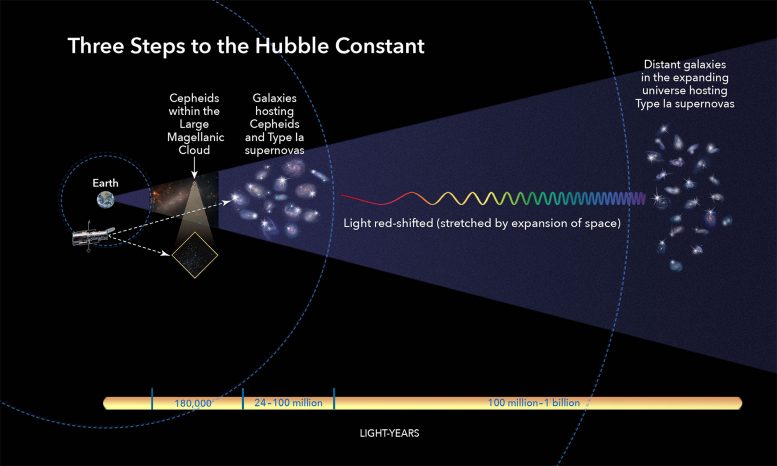
Universe’s Expansion Rate Widens With New Hubble Data

This illustration shows the three basic steps astronomers use to calculate how fast the universe expands over time, a value called the Hubble constant. All the steps involve building a strong “cosmic distance ladder,” by starting with measuring accurate distances to nearby galaxies and then moving to galaxies farther and farther away. This “ladder” is a series of measurements of different kinds of astronomical objects with an intrinsic brightness that researchers can use to calculate distances. Among the most reliable for shorter distances are Cepheid variables, stars that pulsate at predictable rates that indicate their intrinsic brightness. Astronomers recently used the Hubble Space Telescope to observe 70 Cepheid variables in the nearby Large Magellanic Cloud to make the most precise distance measurement to that galaxy. Astronomers compare the measurements of nearby Cepheids to those in galaxies farther away that also include another cosmic yardstick, exploding stars called Type Ia supernovas. These supernovas are much brighter than Cepheid variables. Astronomers use them as “milepost markers” to gauge the distance from Earth to far-flung galaxies. Each of these markers build upon the previous step in the “ladder.” By extending the ladder using different kinds of reliable milepost markers, astronomers can reach very large distances in the universe. Astronomers compare these distance values to measurements of an entire galaxy’s light, which increasingly reddens with distance, due to the uniform expansion of space. Astronomers can then calculate how fast the cosmos is expanding: the Hubble constant. Credits: NASA, ESA and A. Feild (STScI)

How the new study was done

Astronomers have been using Cepheid variables as cosmic yardsticks to gauge nearby intergalactic distances for more than a century. But trying to harvest a bunch of these stars was so time-consuming as to be nearly unachievable. So, the team employed a clever new method, called DASH (Drift And Shift), using Hubble as a “point-and-shoot” camera to snap quick images of the extremely bright pulsating stars, which eliminates the time-consuming need for precise pointing.

“When Hubble uses precise pointing by locking onto guide stars, it can only observe one Cepheid per each 90-minute Hubble orbit around Earth. So, it would be very costly for the telescope to observe each Cepheid,” explained team member Stefano Casertano, also of STScI and Johns Hopkins. “Instead, we searched for groups of Cepheids close enough to each other that we could move between them without recalibrating the telescope pointing. These Cepheids are so bright, we only need to observe them for two seconds. This technique is allowing us to observe a dozen Cepheids for the duration of one orbit. So, we stay on gyroscope control and keep ‘DASHing’ around very fast.”

The Hubble astronomers then combined their result with another set of observations, made by the Araucaria Project, a collaboration between astronomers from institutions in Chile, the U.S., and Europe. This group made distance measurements to the Large Magellanic Cloud by observing the dimming of light as one star passes in front of its partner in eclipsing binary-star systems.

The combined measurements helped the SH0ES Team refine the Cepheids’ true brightness. With this more accurate result, the team could then “tighten the bolts” of the rest of the distance ladder that extends deeper into space.

The new estimate of the Hubble constant is 74 kilometers (46 miles) per second per megaparsec. This means that for every 3.3 million light-years farther away a galaxy is from us, it appears to be moving 74 kilometers (46 miles) per second faster, as a result of the expansion of the universe. The number indicates that the universe is expanding at a 9% faster rate than the prediction of 67 kilometers (41.6 miles) per second per megaparsec, which comes from Planck’s observations of the early universe, coupled with our present understanding of the universe.

So, what could explain this discrepancy?

One explanation for the mismatch involves an unexpected appearance of dark energy in the young universe, which is thought to now comprise 70% of the universe’s contents. Proposed by astronomers at Johns Hopkins, the theory is dubbed “early dark energy,” and suggests that the universe evolved like a three-act play.

Astronomers have already hypothesized that dark energy existed during the first seconds after the big bang and pushed matter throughout space, starting the initial expansion. Dark energy may also be the reason for the universe’s accelerated expansion today. The new theory suggests that there was a third dark-energy episode not long after the big bang, which expanded the universe faster than astronomers had predicted. The existence of this “early dark energy” could account for the tension between the two Hubble constant values, Riess said.

Another idea is that the universe contains a new subatomic particle that travels close to the speed of light. Such speedy particles are collectively called “dark radiation” and include previously known particles like neutrinos, which are created in nuclear reactions and radioactive decays.

Yet another attractive possibility is that dark matter (an invisible form of matter not made up of protons, neutrons, and electrons) interacts more strongly with normal matter or radiation than previously assumed.

But the true explanation is still a mystery.

Riess doesn’t have an answer to this vexing problem, but his team will continue to use Hubble to reduce the uncertainties in the Hubble constant. Their goal is to decrease the uncertainty to 1%, which should help astronomers identify the cause of the discrepancy.

The team’s results have been accepted for publication in The Astrophysical Journal.

The Hubble Space Telescope is a project of international cooperation between NASA and ESA (European Space Agency). NASA’s Goddard Space Flight Center in Greenbelt, Maryland, manages the telescope. The Space Telescope Science Institute (STScI) in Baltimore, Maryland, conducts Hubble science operations. STScI is operated for NASA by the Association of Universities for Research in Astronomy in Washington, D.C.

Let's block ads! (Why?)


https://scitechdaily.com/important-threshold-crossed-in-mystery-of-the-universes-expansion-rate/

2019-04-27 13:52:38Z
52780276911842

Astrophysicists simulate the sounds of stars to reveal their secrets - Phys.org

stars
Credit: CC0 Public Domain

Sound may not be able to travel through the vacuum of space.

But that doesn't stop stars from unleashing a symphony of subsonic notes as their nuclear furnaces power complex vibrations. Telescopes can spot these vibrations as fluctuations in the brightness or temperature on the surface of a star.

Understand these vibrations, and we can learn more about the inner structure of the star that is otherwise hidden from view.

"A cello sounds like a cello because of its size and shape," says Jacqueline Goldstein, a graduate student in the University of Wisconsin–Madison astronomy department. "The vibrations of stars also depend on their size and structure."

In her work, Goldstein studies the connection between and vibrations by developing software that simulates diverse stars and their frequencies. As she compares her simulations to real stars, Goldstein can refine her model and improve how astrophysicists like her peer under the surface of stars by surveying their subtle sounds.

With frequencies repeating on the order of minutes to days, you'd have to speed up stellar vibrations by a thousand or a million times to bring them within the range of human hearing. These reverberations might most accurately be called starquakes after their seismic cousins on Earth. The field of study is called astroseismology.

As stars fuse hydrogen into in their cores, hot plasma gas vibrates and causes stars to flicker. These fluctuations can tell researchers about a star's structure and how it will change as the star ages. Goldstein studies stars that are larger than our own sun.

"Those are the ones that explode and make black holes and neutron stars and all the heavy elements in the universe that form planets and, essentially, new life," says Goldstein. "We want to understand how they work and how they affect the evolution of the universe. So these really big questions."

Working with astronomy professors Rich Townsend and Ellen Zweibel, Goldstein developed a program called GYRE that plugs into the star-simulating program MESA. Using this software, Goldstein constructs models of various kinds of stars to see what their vibrations might look like to astronomers. Then she checks how closely simulation and reality match.

"Since I made my stars, I know what I put inside of them. So when I compare my predicted vibration patterns against observed patterns, if they're the same, then great, the inside of my stars are like the insides of those real stars. If they're different, which is usually the case, that gives us information that we need to improve our simulations and test again," Goldstein says.

Both GYRE and MESA are open source programs, which means that scientists can freely access and modify the code. Each year, some 40 to 50 people attend a MESA summer school at the University of California, Santa Barbara to learn how to use the program and brainstorm improvements. Goldstein and her group benefit from all these users suggesting changes to and fixing errors in both MESA and their own program.

They also get a boost from another group of scientists—planet hunters. Two things can make a star's brightness fluctuate: internal vibrations or a planet passing in front of the star. As the search for exoplanets—planets that orbit stars other than our own—has ramped up, Goldstein has gained access to a trove of new data on stellar fluctuations that are caught up in the same surveys of distant stars.

The latest exoplanet hunter is a telescope named TESS, which launched into orbit last year to survey 200,000 of the brightest, closest stars.

"What TESS is doing is looking at the entire sky," says Goldstein. "So we're going to be able to say for all the we can see in our neighborhood whether or not they're pulsating. If they are, we'll be able to study their pulsations to learn about what's happening beneath the surface."

Goldstein is now developing a new version of GYRE to take advantage of the TESS data. With it, she'll start to simulate this stellar orchestra hundreds of thousands strong.

With these simulations, we might be able to glean a little more about our cosmic neighbors, just by listening in.


Explore further

Scientists prove that binary stars reflect light from one another

Citation: Astrophysicists simulate the sounds of stars to reveal their secrets (2019, April 27) retrieved 27 April 2019 from https://phys.org/news/2019-04-astrophysicists-simulate-stars-reveal-secrets.html

This document is subject to copyright. Apart from any fair dealing for the purpose of private study or research, no part may be reproduced without the written permission. The content is provided for information purposes only.

Let's block ads! (Why?)


https://phys.org/news/2019-04-astrophysicists-simulate-stars-reveal-secrets.html

2019-04-27 08:50:54Z
CAIiEJskrCFTt5Y2c7HqqWQluewqFwgEKg8IACoHCAowpbDpAzCm_hwwj9kp

Jumat, 26 April 2019

New study says universe expanding faster and is younger - ABC News

Let's block ads! (Why?)


https://abcnews.go.com/US/wireStory/study-universe-expanding-faster-younger-62656475

2019-04-26 16:46:00Z
52780276911842

NASA and FEMA Will Simulate an Impending Asteroid Strike Next Week - Gizmodo

Potential strike locations of a fictional asteroid
Photo: NASA/Google Earth

NASA, FEMA, and other national and international agencies are once again gearing up for a hypothetical asteroid impact preparedness scenario. They hope to learn the best strategies for responding to a potential strike, starting from the moment a threatening asteroid is first detected by astronomers.

Next week marks the start of the International Academy of Astronautics Planetary Defense Conference. As part of this conference, NASA’s Planetary Defense Coordination Office will team up with other partners to perform a “tabletop exercise” on how they’d handle the news of a (fictional) asteroid on a collision course with Earth.

Advertisement

Again, the following is fictional.

On March 26, 2019, astronomers discover an asteroid in the night sky, far dimmer than Pluto to their telescopes. They name it 2019 PDC. Initially, it appears that the asteroid’s eccentric orbit bring it within approximately 18 times the Moon’s distance from the Earth, with a chance of hitting the Earth at one in 50,000 in 2027.

The orbit of the fictional asteroid 2019 PDC

Advertisement

Astronomers continue to track the object as it gets closer. They learn it could be somewhere between 100 and 300 meters wide—the size of a skyscraper. After a month of tracking, the probability of collision with Earth is now 1 percent—the threshold at which international organizations have agreed they must take action.

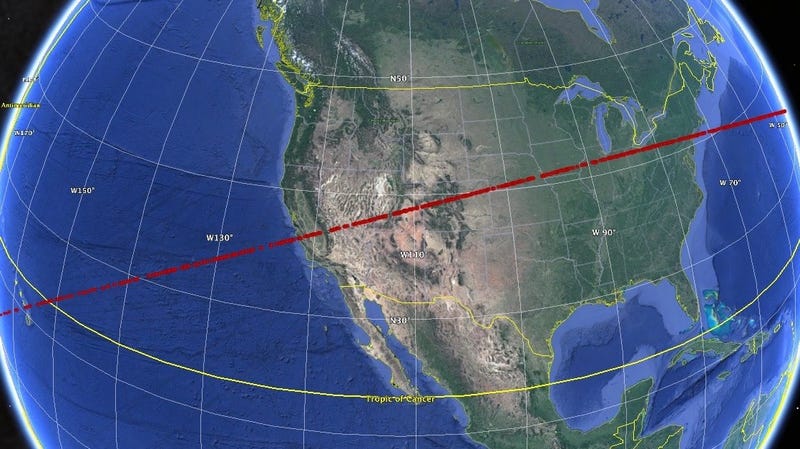
Astronomers are able to create a “risk corridor,” measuring where the asteroid might hit. Its potential paths intersect the United States, some of western Africa, and the Atlantic and the Pacific Ocean.

Each red dot is a potential path the fictional asteroid might take as it passes the Earth in 2027. Clearly, this would be an asteroid worth worrying about.
Image: NASA

Advertisement

Though just a drill, these are the kinds of calculations that astronomers must make when a real asteroid comes close to Earth. The fictional 2019 PDC describes a “potentially hazardous asteroid,” the kind that orbits close to Earth and that could have a catastrophic impact if it actually struck the planet. Scientists recently performed a similar simulation to this one, monitoring a nearby asteroid as though it were an actual threat. The new simulation instead will focus less on the scientific questions, and more on governmental response.

This simulation is the sixth near-Earth-object impact exercise that NASA has taken part in. Not only do these exercises help NASA officials think through what they’d do in the event of a threat, but they also help them know what information is most important to FEMA and other agencies.

“What emergency managers want to know is when, where and how an asteroid would impact, and the type and extent of damage that could occur,” Leviticus Lewis of the Response Operations Division for FEMA said in the NASA press release.

Advertisement

We’ll be keeping track of news from the conference next week and reporting on any interesting developments. You can also follow along via a Twitter account run by the European Space Agency, @esaoperations, which will be sharing real-time updates from the exercise.

Let's block ads! (Why?)


https://gizmodo.com/nasa-and-fema-will-simulate-an-impending-asteroid-strik-1834308695

2019-04-26 15:20:00Z
52780276433744

The Universe Is Moving Too Fast and Nobody Knows Why - Live Science

[unable to retrieve full-text content]

  1. The Universe Is Moving Too Fast and Nobody Knows Why  Live Science
  2. The Universe Is Expanding So Fast We Might Need New Physics to Explain It  Space.com
  3. Astronomers Just Detected The Universe Is Expanding Much Faster Than It Should Be  ScienceAlert
  4. Hubblecast 120 Light: Continued Discrepancy in the Universe's Expansion Rate  HubbleESA
  5. Mystery of the universe's expansion rate widens with new Hubble data  Phys.org
  6. View full coverage on Google News

https://www.livescience.com/65332-hubble-wrong-speed.html

2019-04-26 12:18:00Z
52780276911842