Selasa, 26 November 2019

NASA’s Orion space capsule undergoes testing in Sandusky before moon launch - WJW FOX 8 News Cleveland

[unable to retrieve full-text content]

  1. NASA’s Orion space capsule undergoes testing in Sandusky before moon launch  WJW FOX 8 News Cleveland
  2. Amazing footage of NASA's 'Super Guppy' aircraft delivering the space agency's Orion spacecraft  Daily Mail
  3. NASA's Orion Spacecraft now heads to Sandusky  News 5 Cleveland
  4. Orion to be shuttled through Erie County  Sandusky Register
  5. Watch: NASA's Super Guppy Delivers Orion Spacecraft to Ohio Airport  Geek
  6. View full coverage on Google News

https://news.google.com/__i/rss/rd/articles/CBMiZ2h0dHBzOi8vZm94OC5jb20vMjAxOS8xMS8yNi9uYXNhcy1vcmlvbi1zcGFjZS1jYXBzdWxlLXVuZGVyZ29lcy10ZXN0aW5nLWluLXNhbmR1c2t5LWJlZm9yZS1tb29uLWxhdW5jaC_SAWtodHRwczovL2ZveDguY29tLzIwMTkvMTEvMjYvbmFzYXMtb3Jpb24tc3BhY2UtY2Fwc3VsZS11bmRlcmdvZXMtdGVzdGluZy1pbi1zYW5kdXNreS1iZWZvcmUtbW9vbi1sYXVuY2gvYW1wLw?oc=5

2019-11-26 11:55:00Z
52780447433878

16-million-year-old fossil shows springtails hitchhiking on winged termite - Phys.org

16-million-year-old fossil shows springtails hitchhiking on winged termite
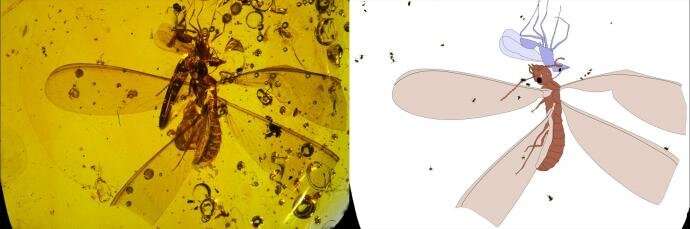
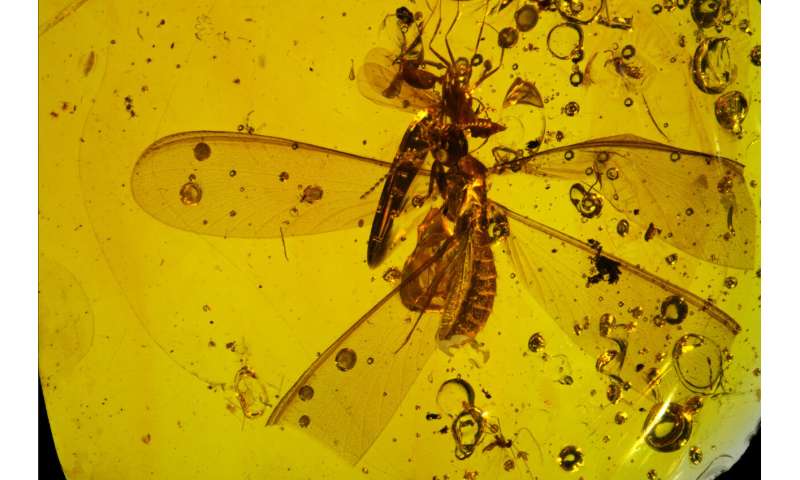
Distribution of springtails on termite and ant hosts within ~ 16 Ma old Dominican amber. Credit: N. Robin, C. D'Haese and P. Barden

When trying to better the odds for survival, a major dilemma that many animals face is dispersal—being able to pick up and leave to occupy new lands, find fresh resources and mates, and avoid intraspecies competition in times of overpopulation.

For birds, butterflies and other winged creatures, covering long distances may be as easy as the breeze they travel on. But for soil-dwellers of the crawling variety, the hurdle remains: How do they reach new, far-off habitats?

For one group of tiny arthropods called springtails (Collembola), a recent fossil discovery now suggests their answer to this question has been to piggyback on the dispersal abilities of others, literally.

In findings published in BMC Evolutionary Biology, researchers at the New Jersey Institute of Technology (NJIT) and Museum national d'Histoire naturelle have detailed the discovery of an ancient interaction preserved in 16-million-year-old amber from the Dominican Republic: 25 springtails attached to, and nearby, a large winged termite and ant from the days of the early Miocene.

The fossil exhibits a number of springtails still attached to the wings and legs of their hosts, while others are preserved as if gradually floating away from their hosts within the amber. Researchers say the discovery highlights the existence of a new type of hitchhiking behavior among wingless soil-dwelling arthropods, and could be key to explaining how symphypleonan springtails successfully achieved dispersal worldwide.

16-million-year-old fossil shows springtails hitchhiking on winged termite
Distribution of springtails on termite and ant hosts within ~ 16 Ma old Dominican amber, and illustration of location of springtails on social insects. Credit: N. Robin, C. D’Haese and P. Barden

"The existence of this hitchhiking behavior is especially exciting given the fact that modern springtails are rarely described as having any interspecfic association with surrounding animals," said Ninon Robin, the paper's first author whose postdoctoral research at NJIT's Department of Biological Sciences was funded by the Fulbright Program of the French-American Commission. "This finding underscores how important fossils are for telling us about unsuspected ancient ecologies as well as still ongoing behaviors that were so far simply overlooked."

Today, springtails are among the most common arthropods found in moist habitats around the world. Most springtails possess a specialized appendage under their abdomen they use to "spring" away in flee-like fashion to avoid predation. However this organ is not sufficient for traversing long distances, especially since most springtails are unable to survive long in dry areas.

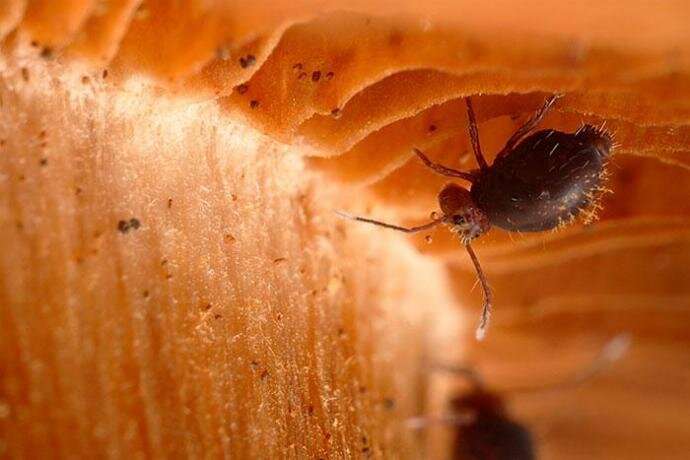
The hitchhikers the researchers identified belong to a lineage of springtails found today on every continent, known as Symphypleona,which they say may have been "pre-adapted" to grasping on to other arthropods through prehensile antennae.

Because springtails would have encountered such winged termites and ants frequently due to their high abundance during the time of the preservation, these may have been their preferred hosts for transportation.

16-million-year-old fossil shows springtails hitchhiking on winged termite
Allacma fusca is a species belonging to one of the three main groups of springtails today known as Symphypleona. Credit: Urmas Tartes/Wikipedia

"Symphypleonan springtails are unusual compared to other Collembola in that they have specialized antennae that are used in mating courtship," said Phillip Barden, assistant professor of biology at NJIT and the study's principal investigator. "This antennal anatomy may have provided an evolutionary pathway for grasping onto other arthropods. In this particular fossil, we see these specialized antennae wrapping around the wings and legs of both an ant and termite. Some winged ants and termites are known to travel significant distances, which would greatly aid in dispersal."

Barden says that the discovery joins other reports from the Caribbean and Europe of fossil springtails attached to a beetle, a mayfly and a harvestman in amber, which together suggest that this behavior may still exist today.

Barden notes that evidence of springtail hitchhiking may not have been captured in such high numbers until now due to the rarity of such a fossilized interaction, as well as the nature of modern sampling methods for insects, which typically involves submersion in ethanol for preservation.

"Because it appears that springtails reflexively detach from their hosts when in danger, evidenced by the detached individuals in the amber, ethanol would effectively erase the link between hitchhiker and host," said Barden. "Amber derives from fossilized sticky tree resin and is viscous enough that it would retain the interaction. ... Meaning, sometimes you have to turn to 16-million-year-old amber fossils to find out what might be happening in your backyard."


Explore further

Specialized beetles shed light on predator-prey associations in the cretaceous

More information: Ninon Robin et al, Fossil amber reveals springtails' longstanding dispersal by social insects, BMC Evolutionary Biology (2019). DOI: 10.1186/s12862-019-1529-6

Citation: 16-million-year-old fossil shows springtails hitchhiking on winged termite (2019, November 26) retrieved 26 November 2019 from https://phys.org/news/2019-11-million-year-old-fossil-springtails-hitchhiking-winged.html

This document is subject to copyright. Apart from any fair dealing for the purpose of private study or research, no part may be reproduced without the written permission. The content is provided for information purposes only.

Let's block ads! (Why?)


https://news.google.com/__i/rss/rd/articles/CBMiWWh0dHBzOi8vcGh5cy5vcmcvbmV3cy8yMDE5LTExLW1pbGxpb24teWVhci1vbGQtZm9zc2lsLXNwcmluZ3RhaWxzLWhpdGNoaGlraW5nLXdpbmdlZC5odG1s0gFYaHR0cHM6Ly9waHlzLm9yZy9uZXdzLzIwMTktMTEtbWlsbGlvbi15ZWFyLW9sZC1mb3NzaWwtc3ByaW5ndGFpbHMtaGl0Y2hoaWtpbmctd2luZ2VkLmFtcA?oc=5

2019-11-26 08:12:48Z
CAIiEEsMimuIVuSeiO1rx7b7QLsqFwgEKg8IACoHCAowpbDpAzCm_hwwj9kp

Senin, 25 November 2019

Long-Hidden 3D Scan of Ancient Egyptian Nefertiti Bust Finally Revealed - Livescience.com

[unable to retrieve full-text content]

Long-Hidden 3D Scan of Ancient Egyptian Nefertiti Bust Finally Revealed  Livescience.com
https://news.google.com/__i/rss/rd/articles/CBMiQGh0dHBzOi8vd3d3LmxpdmVzY2llbmNlLmNvbS9uZWZlcnRpdGktYnVzdC0zZC1zY2FuLXJldmVhbGVkLmh0bWzSAURodHRwczovL3d3dy5saXZlc2NpZW5jZS5jb20vYW1wL25lZmVydGl0aS1idXN0LTNkLXNjYW4tcmV2ZWFsZWQuaHRtbA?oc=5

2019-11-25 12:10:00Z
CBMiQGh0dHBzOi8vd3d3LmxpdmVzY2llbmNlLmNvbS9uZWZlcnRpdGktYnVzdC0zZC1zY2FuLXJldmVhbGVkLmh0bWzSAURodHRwczovL3d3dy5saXZlc2NpZW5jZS5jb20vYW1wL25lZmVydGl0aS1idXN0LTNkLXNjYW4tcmV2ZWFsZWQuaHRtbA

NASA spacecraft makes stop in Mansfield, community invited to check it out - WJW FOX 8 News Cleveland

[unable to retrieve full-text content]

  1. NASA spacecraft makes stop in Mansfield, community invited to check it out  WJW FOX 8 News Cleveland
  2. Why Was NASA’s Super Guppy Flying To Ohio?  Simple Flying
  3. NASA's Orion capsule arrives in Mansfield aboard 'Super Guppy'  10TV
  4. NASA's Orion spacecraft to arrive Sunday and undergo environmental testing in Sandusky  News 5 Cleveland
  5. Super Guppy lands in Mansfield carrying NASA's new space capsule  Mansfield News Journal
  6. View full coverage on Google News

https://news.google.com/__i/rss/rd/articles/CBMiZmh0dHBzOi8vZm94OC5jb20vMjAxOS8xMS8yNC9uYXNhLXNwYWNlY3JhZnQtbWFrZXMtc3RvcC1pbi1tYW5zZmllbGQtY29tbXVuaXR5LWludml0ZWQtdG8tY2hlY2staXQtb3V0L9IBamh0dHBzOi8vZm94OC5jb20vMjAxOS8xMS8yNC9uYXNhLXNwYWNlY3JhZnQtbWFrZXMtc3RvcC1pbi1tYW5zZmllbGQtY29tbXVuaXR5LWludml0ZWQtdG8tY2hlY2staXQtb3V0L2FtcC8?oc=5

2019-11-25 03:55:00Z
52780447433878

Sabtu, 23 November 2019

A 'no-brainer Nobel Prize': Hungarian scientists may have found a fifth force of nature - CNN

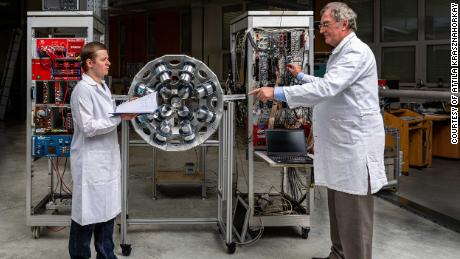
Physicist Attila Krasznahorkay, right, works with a fellow researcher at the Institute for Nuclear Research at the Hungarian Academy of Sciences.
New research may be leading us closer to one more.
Scientists at the Institute for Nuclear Research at the Hungarian Academy of Sciences (Atomki) have posted findings showing what could be an example of that fifth force at work.
The scientists were closely watching how an excited helium atom emitted light as it decayed. The particles split at an unusual angle, 115 degrees, which couldn't be explained by known physics.
The study's lead scientist, Attila Krasznahorkay, told CNN that this was the second time his team had detected a new particle, which they call X17, because they calculated its mass at 17 megaelectronvolts.
"X17 could be a particle, which connects our visible world with the dark matter," he said in an email.
Jonathan Feng, a professor of physics and astronomy at the University of California, Irvine, told CNN he's been following the Hungarian team's work for years, and believes their research is shaping up to be a game changer.
If these results can be replicated, "this would be a no-brainer Nobel Prize," he said.

Hungarian scientists are building on 2016 results

Three years ago, the Hungarian researchers published a similar paper in Physical Review Letters, one of the most prestigious journals in physics.
The nuclear physics experimental team had been studying another isotope, beryllium-8, as it decays down to a ground state. They saw electrons and positrons splitting off from the atom at unusual angles.
Those findings, which showed particles coming off beryllium-8 at around a 140-degree angle, were strange and new.
"We introduced such a new particle, which nobody saw before, and which existence could not be understood by the widely accepted 'Standard Model' of particle physics, so it faced scrutiny," Krasznahorkay said in an email.
The findings by Krasznahorkay's team didn't get much attention at first, but they raised Feng's eyebrows. He said he "didn't want to leave potentially revolutionary results just sitting on the table."

A physicist in California developed a theory to explain the unusual results

In short, it could change physics as we know it, or it could have just been a simple lab error.
"Some people said they screwed up," Feng said.
But he believed the Hungarians were for real. His research group published a paper on the heels of the Hungarians' 2016 work, laying out a theory to observe what Krasznahorkay's experimental team had seen.
They referred to this unseen fifth force in action as a "photophobic force," meaning that it was as though the particles were "afraid of light."
Meanwhile, nuclear physicists around the world set to work looking for errors in the Hungarians' work, and have come up empty-handed over the past few years.
"Some very well-known nuclear physicists have done that exercise," Feng said.
The numbers seemed to add up, and no one could find ways their equipment was calibrated incorrectly.
And Feng said his own team was comparing the Hungarian experiments "with every other experiment that's been done in the history of physics."
The only way to explain X17 was a hitherto undetected "fifth force."

The findings point toward the Holy Grail of physics

To move their breakthrough idea from 2016 forward, the Hungarians would need to repeat the results again. That's exactly what their 2019 results do.
Feng says there was only a one in a trillion chance that the results were caused by anything other than the X17 particle, and this new fifth force.
He added that if another research group could repeat these results with a third type of atom in addition to beryllium and helium, "that would blow the cover off this thing."
Experimental research groups have already been reaching out to him hungry to do that.
More sightings of the fifth force could lead to scientists settling on a specific name for it, understanding its workings more deeply, and developing practical applications for how to harness its power.
They're leading us closer to what's considered the Holy Grail in physics, which Albert Einstein had aimed at but never achieved. Physicists hope to create a "unified field theory," which would coherently explain all cosmic forces from the formation of galaxies down to the quirks of quarks.
But the universe isn't giving up its secrets easily.
"There's no reason to stop at the fifth," Feng said. "There could be a sixth, seventh, and eighth force."

Let's block ads! (Why?)


https://news.google.com/__i/rss/rd/articles/CBMiTmh0dHBzOi8vd3d3LmNubi5jb20vMjAxOS8xMS8yMi93b3JsZC9maWZ0aC1mb3JjZS1vZi1uYXR1cmUtc2NuLXRybmQvaW5kZXguaHRtbNIBUmh0dHBzOi8vYW1wLmNubi5jb20vY25uLzIwMTkvMTEvMjIvd29ybGQvZmlmdGgtZm9yY2Utb2YtbmF0dXJlLXNjbi10cm5kL2luZGV4Lmh0bWw?oc=5

2019-11-23 12:35:00Z
CAIiEH5WU56hlBQrWyHPp4ad3X0qGQgEKhAIACoHCAowocv1CjCSptoCMPrTpgU

A 'no-brainer Nobel Prize': Hungarian scientists may have found a fifth force of nature - msnNOW

Essentially the entirety of physics centers on four forces that control our known, visible universe, governing everything from the production of heat in the sun to the way your laptop works. They are gravity, electromagnetism, the weak nuclear force, and the strong force.

a man standing in front of a store: Physicist Attila Krasznahorkay, right, works with a fellow researcher at the Institute for Nuclear Research at the Hungarian Academy of Sciences.© Courtesy of Attila Krasznahorkay Physicist Attila Krasznahorkay, right, works with a fellow researcher at the Institute for Nuclear Research at the Hungarian Academy of Sciences.

New research may be leading us closer to one more.

Scientists at the Institute for Nuclear Research at the Hungarian Academy of Sciences (Atomki) have posted findings showing what could be an example of that fifth force at work.

The scientists were closely watching how an excited helium atom emitted light as it decayed. The particles split at an unusual angle, 115 degrees, which couldn't be explained by known physics.

The study's lead scientist, Attila Krasznahorkay, told CNN that this was the second time his team had detected a new particle, which they call X17, because they calculated its mass at 17 megaelectronvolts.

"X17 could be a particle, which connects our visible world with the dark matter," he said in an email.

Jonathan Feng, a professor of physics and astronomy at the University of California, Irvine, told CNN he's been following the Hungarian team's work for years, and believes their research is shaping up to be a game changer.

If these results can be replicated, "this would be a no-brainer Nobel Prize," he said.

Hungarian scientists are building on 2016 results

Three years ago, the Hungarian researchers published a similar paper in Physical Review Letters, one of the most prestigious journals in physics.

The nuclear physics experimental team had been studying another isotope, beryllium-8, as it decays down to a ground state. They saw electrons and positrons splitting off from the atom at unusual angles.

Those findings, which showed particles coming off beryllium-8 at around a 140-degree angle, were strange and new.

"We introduced such a new particle, which nobody saw before, and which existence could not be understood by the widely accepted 'Standard Model' of particle physics, so it faced scrutiny," Krasznahorkay said in an email.

The findings by Krasznahorkay's team didn't get much attention at first, but they raised Feng's eyebrows. He said he "didn't want to leave potentially revolutionary results just sitting on the table."

A physicist in California developed a theory to explain the unusual results

In short, it could change physics as we know it, or it could have just been a simple lab error.

"Some people said they screwed up," Feng said.

But he believed the Hungarians were for real. His research group published a paper on the heels of the Hungarians' 2016 work, laying out a theory to observe what Krasznahorkay's experimental team had seen.

They referred to this unseen fifth force in action as a "photophobic force," meaning that it was as though the particles were "afraid of light."

Meanwhile, nuclear physicists around the world set to work looking for errors in the Hungarians' work, and have come up empty-handed over the past few years.

"Some very well-known nuclear physicists have done that exercise," Feng said.

The numbers seemed to add up, and no one could find ways their equipment was calibrated incorrectly.

And Feng said his own team was comparing the Hungarian experiments with "with every other experiment that's been done in the history of physics."

The only way to explain X17 was a hitherto undetected "fifth force."

The findings point toward the Holy Grail of physics

To move their breakthrough idea from 2016 forward, the Hungarians would need to repeat the results again. That's exactly what their 2019 results do.

Feng says there was only a one in a trillion chance that the results were caused by anything other than the X17 particle, and this new fifth force.

He added that if another research group could repeat these results with a third type of atom in addition to beryllium and helium, "that would blow the cover off this thing."

Experimental research groups have already been reaching out to him hungry to do that.

More sightings of the fifth force could lead to scientists settling on a specific name for it, understanding its workings more deeply, and developing practical applications for how to harness its power.

They're leading us closer to what's considered the Holy Grail in physics, which Albert Einstein had aimed at but never achieved. Physicists hope to create a "unified field theory," which would coherently explain all cosmic forces from the formation of galaxies down to the quirks of quarks.

But the universe isn't giving up its secrets easily.

"There's no reason to stop at the fifth," Feng said. "There could be a sixth, seventh, and eighth force."

Let's block ads! (Why?)


https://news.google.com/__i/rss/rd/articles/CBMiiQFodHRwczovL3d3dy5tc24uY29tL2VuLXVzL25ld3MvdGVjaG5vbG9neS9hLW5vLWJyYWluZXItbm9iZWwtcHJpemUtaHVuZ2FyaWFuLXNjaWVudGlzdHMtbWF5LWhhdmUtZm91bmQtYS1maWZ0aC1mb3JjZS1vZi1uYXR1cmUvYXItQkJYY2dzUtIBAA?oc=5

2019-11-23 06:30:00Z
CBMiiQFodHRwczovL3d3dy5tc24uY29tL2VuLXVzL25ld3MvdGVjaG5vbG9neS9hLW5vLWJyYWluZXItbm9iZWwtcHJpemUtaHVuZ2FyaWFuLXNjaWVudGlzdHMtbWF5LWhhdmUtZm91bmQtYS1maWZ0aC1mb3JjZS1vZi1uYXR1cmUvYXItQkJYY2dzUtIBAA

El Nino swings more violently in the industrial age, compelling hard evidence says - Phys.org

El Nino swings more violently in the industrial age, compelling hard evidence says
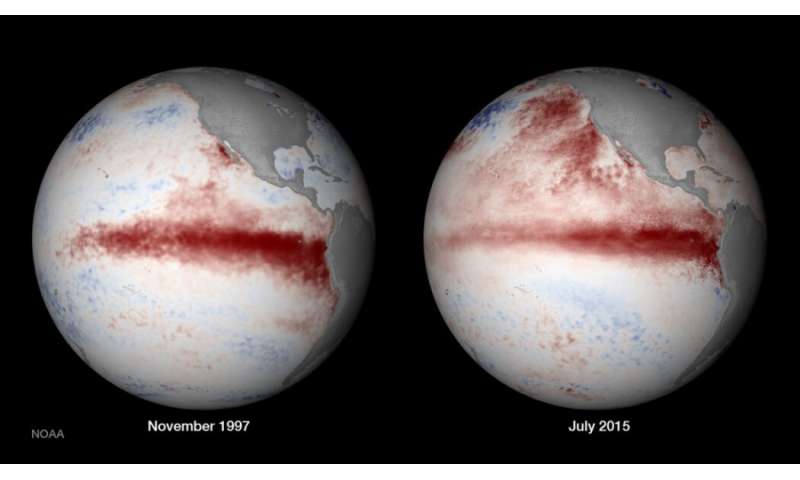
On the right, satellite composition of El Nino in 1997, and on the left, El Nino in 2015. Both were extreme El Nino events that new hard evidence says are part of a new and odd climate pattern. Credit: NOAA

El Ninos have become more intense in the industrial age, which stands to worsen storms, drought, and coral bleaching in El Nino years. A new study has found compelling evidence in the Pacific Ocean that the stronger El Ninos are part of a climate pattern that is new and strange.

It is the first known time that enough physical evidence spanning millennia has come together to allow researchers to say definitively that: El Ninos, La Ninas, and the climate phenomenon that drives them have become more extreme in the times of human-induced climate change.

"What we're seeing in the last 50 years is outside any natural variability. It leaps off the baseline. Actually, we even see this for the entire period of the industrial age," said Kim Cobb, the study's principal investigator and professor in the Georgia Institute of Technology's School of Earth and Atmospheric Sciences. "There were three extremely strong El Nino-La Nina events in the 50-year period, but it wasn't just these events. The entire pattern stuck out."

The study's first author Pam Grothe compared temperature-dependent chemical deposits from present-day corals with those of older coral records representing relevant sea surface temperatures from the past 7,000 years. With the help of collaborators from Georgia Tech and partner research institutions, Grothe identified patterns of in the El Nino Southern Oscillation (ENSO), swings of heating and cooling of equatorial Pacific waters that, every few years, spur El Ninos and La Ninas respectively.

The team found the industrial age ENSO swings to be 25% stronger than in the pre-industrial records. The researchers published their results in the journal Geophysical Review Letters in October 2019. The work was funded by the National Science Foundation.

Slumbering evidence

The evidence had slumbered in and around shallow Pacific waters, where ENSO and El Ninos originate until Cobb and her students plunged hollow drill bits into living coral colonies and fossil coral deposits to extract it. In more than 20 years of field expeditions, they collected cores that contained hundreds of records.

The corals' recordings of sea surface temperatures proved to be astonishingly accurate when benchmarked. Coral records from 1981 to 2015 matched sea surface temperatures measured via satellite in the same period so exactly that, on a graph, the jagged lines of the coral record covered those of the satellite measurements, obscuring them from view.

"When I present it to people, I always get asked, 'Where's the temperature measurement?' I tell them it's there, but you can't see it because the corals' records of sea surface temperatures are that good," said Grothe, a former graduate research assistant in Cobb's lab and now an associate professor at the University of Mary Washington.

El Nino swings more violently in the industrial age, compelling hard evidence says
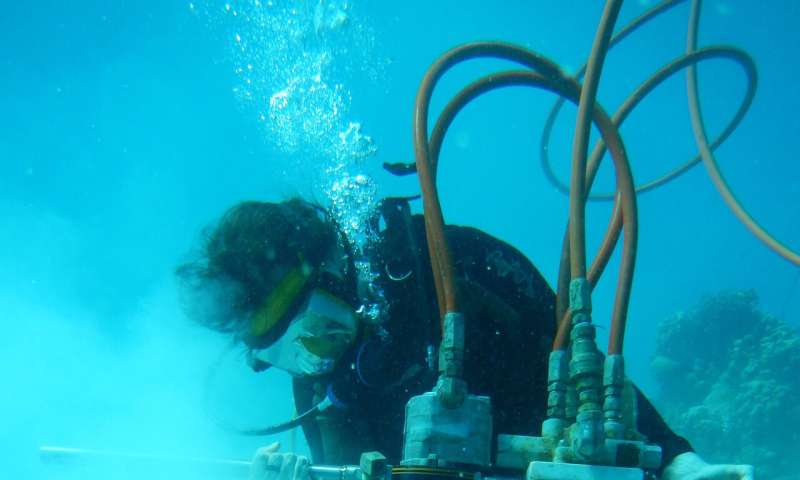
In scuba gear, Georgia Tech professor Kim Cobb drills into corals in the tropical Pacific with a pneumatic coring drill to take samples for studies on recent and historic sea surface temperatures. Credit: Georgia Tech / Cobb lab

First red flag?

In 2018, enough coral data had amassed to distinguish ENSO's recent activity from its natural preindustrial patterns.

To stress-test the data, Grothe left out chunks to see if the industrial age ENSO signal still stuck out. She removed the record-setting 1997/1998 El Nino-La Nina and examined industrial age windows of time between 30 and 100 years long.

The signal held in all windows, but the data needed the 97/98 event to be statistically significant. This could mean that changes in the ENSO activities have just now reached a threshold that makes them detectable.

What is El Nino?

Every two to seven years in spring, an El Nino is born when the warm phase of the ENSO swells into a long heat blob in the tropical Pacific, typically peaking in early winter. It blows through oceans and air around the world, ginning up deluges, winds, heat, or cold in unusual places.

Once El Nino passes, the cycle reverses into La Nina by the following fall, when airstreams push hot water westward and dredge up frigid water in the equatorial Pacific. This triggers a different set of global weather extremes.

Tropical Pacific corals record the hot-cold oscillations by absorbing less of an oxygen isotope (O18) during ENSO's hot phases, and progressively more of it during ENSO's cool phases. As corals grow, they create layers of oxygen isotope records, chronicles of temperature history.

El Nino swings more violently in the industrial age, compelling hard evidence says
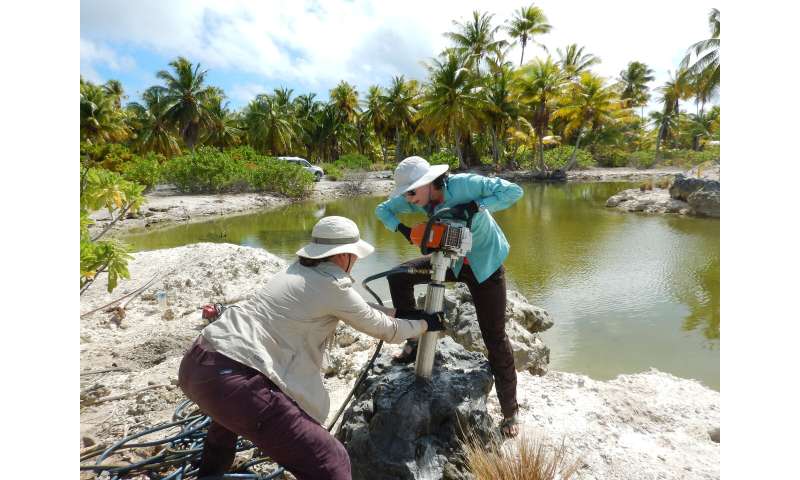
Pam Grothe and Alyssa Atwood drill into a 5,000-year-old coral fossil on Kiritimati Island. Credit: Georgia Tech / Grothe / Cobb lab

Waves, repairs, contortions

Extracting them is adventurous: A research diver guides a chest-high pneumatic drill under the ocean. Its pressure hose connects to a motor on the boat that powers the drill after the diver has taken off her fins and weighed herself down on the reef.

She carefully angles the bit down the axis of coral growth to get a core with layers that can be accurately counted back in time. On occasion, waves put her and her safety diver through washing machine cycles.

"Doing this all underwater adds an extra level of difficulty, even from the simplest tasks like working with wrenches," Grothe said. "But the drill slices through underwater corals like butter. Fossil corals are drilled on land, and the drill constantly seizes up and overheats."

Blowing models away

The physical proof taken from three islands that dot the heart of the ENSO zone has also thrown down scientific gauntlets, starkly challenging computer models of ENSO patterns and causes. A prime example: Previously unknown to science, the study showed that in a period from 3,000 to 5,000 years ago, the El Nino-La Nina oscillations were extremely mild.

"Maybe there's no good explanation for a cause. Maybe it just happened," Cobb said. "Maybe El Nino can just enter a mode and get stuck in it for a millennium."


Explore further

A climate model provides long-term predictions of 'El Niño' events

More information: Pamela R. Grothe et al, Enhanced El Niño‐Southern Oscillation variability in recent decades, Geophysical Research Letters (2019). DOI: 10.1029/2019GL083906

Citation: El Nino swings more violently in the industrial age, compelling hard evidence says (2019, November 23) retrieved 23 November 2019 from https://phys.org/news/2019-11-el-nino-violently-industrial-age.html

This document is subject to copyright. Apart from any fair dealing for the purpose of private study or research, no part may be reproduced without the written permission. The content is provided for information purposes only.

Let's block ads! (Why?)


https://news.google.com/__i/rss/rd/articles/CBMiQ2h0dHBzOi8vcGh5cy5vcmcvbmV3cy8yMDE5LTExLWVsLW5pbm8tdmlvbGVudGx5LWluZHVzdHJpYWwtYWdlLmh0bWzSAUJodHRwczovL3BoeXMub3JnL25ld3MvMjAxOS0xMS1lbC1uaW5vLXZpb2xlbnRseS1pbmR1c3RyaWFsLWFnZS5hbXA?oc=5

2019-11-23 05:43:49Z
CAIiEHl8g6V1ziGve5Wm-ZIjcOEqFwgEKg8IACoHCAowpbDpAzCm_hwwj9kp